










Pilot captures record-breaking auroras in astonishing shots mid-flight PHOTO
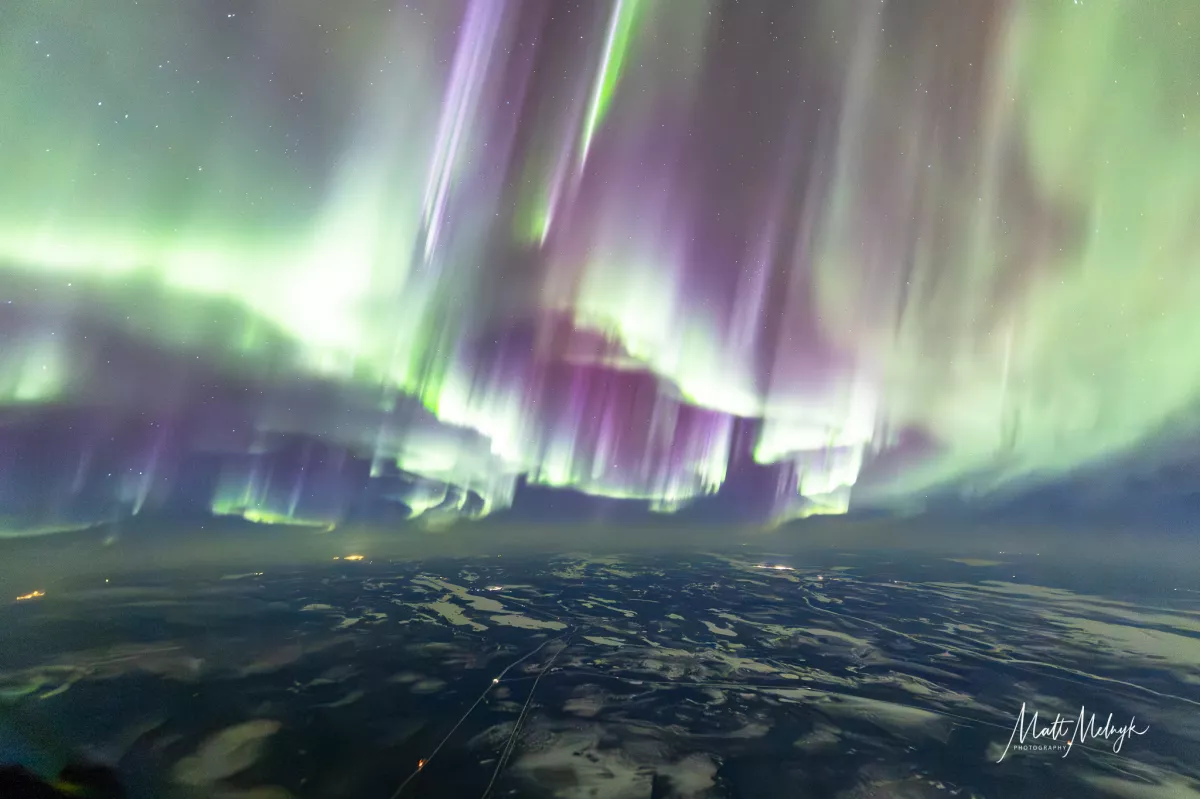
Auroras lit up skies far beyond their usual polar boundaries during powerful geomagnetic storms on the night of January 18–19, as Earth’s magnetic field was shaken by intense solar activity. Skywatchers around the world shared striking images of green, red and deep magenta hues stretching across the night sky. Few, however, had a vantage point quite like that of of airline pilot who witnessed the spectacle from the cockpit of a Boeing 787 Dreamliner.
“The show started as soon as we climbed above the clouds and continued on and off during the flight from Calgary to London,” Matt Melnyk told Space.com.
The photographs were taken from an altitude of roughly 11 kilometers as the aircraft passed over northern Manitoba, Hudson Bay and Baffin Island in Canada. From cruising height, far above cloud cover and city light pollution, auroras can appear brighter, crisper and far more expansive than from the ground. In this case, the northern lights seemed to engulf the entire sky, with vivid curtains of colour rippling across the darkness in response to shifts in Earth’s magnetic field.
“This was the most incredible display of aurora I've ever seen in my 20 years of flying!” Melnyk added. “This flight I will remember for days to come.”
The display was triggered by a “severe” and record-breaking geomagnetic storm that struck shortly after the Sun released a powerful X-class solar flare. A torrent of superfast solar particles slammed into Earth’s magnetic shield, producing widespread auroras at unusually low latitudes across the Northern Hemisphere, particularly in Europe.
The strongest geomagnetic storm in the past two decades occurred in May 2024, when activity reached the rare G5, or “extreme,” level. While the January event did not surpass that benchmark, scientists say it ranks among the most powerful solar radiation storms ever recorded.
The storm began on January 19, when a fast-moving cloud of solar radiation — known as a coronal mass ejection (CME) — collided with Earth’s magnetosphere. The impact temporarily distorted the planet’s magnetic field, allowing charged particles to penetrate deeper into the atmosphere and ignite dramatic auroral activity.
As a result, auroras were visible across much of the UK and in parts of continental Europe, including France, Germany, Switzerland, Austria, Belgium, Norway, Denmark, the Netherlands and Croatia, where nightfall coincided with the storm’s peak.
By Nazrin Sadigova







 editor@caliber.az
 +994 55 444-88-98
 Азербайджан, Баку, ул. Низами, 203, Af Business House, 5-й этаж