










Private firms propel space economy toward $2.3 trillion future
The global space industry has evolved into a rapidly expanding, data-driven sector valued at around $600 billion, with projections suggesting it could exceed $2.3 trillion by 2040, the latest article by Deutsche Welle says. This growth reflects not only increasing investment but also a structural transformation in how space activities are financed and utilised.
The industry is broadly divided into two segments: the upstream market, which includes launch infrastructure, rockets, and satellites, and the larger downstream market, focused on services such as navigation, communication, and Earth observation. While roughly $150 billion is directed toward upstream capabilities, downstream applications account for approximately $450 billion, underscoring the sector’s shift toward data-centric business models.
A key driver of this transformation has been the transition from state-led space programs to private-sector dominance. During the Cold War, space exploration was primarily government-funded and politically motivated. Since the early 2000s, however, governments have increasingly acted as customers, while private firms deliver launch services and satellite technologies. Companies such as SpaceX and Blue Origin exemplify this shift.
Technological innovation, particularly reusable launch vehicles, has dramatically reduced costs by as much as 90% over the past two decades, according to McKinsey. This has lowered barriers to entry and enabled a broader ecosystem of companies to emerge, expanding the commercial viability of space-based services.
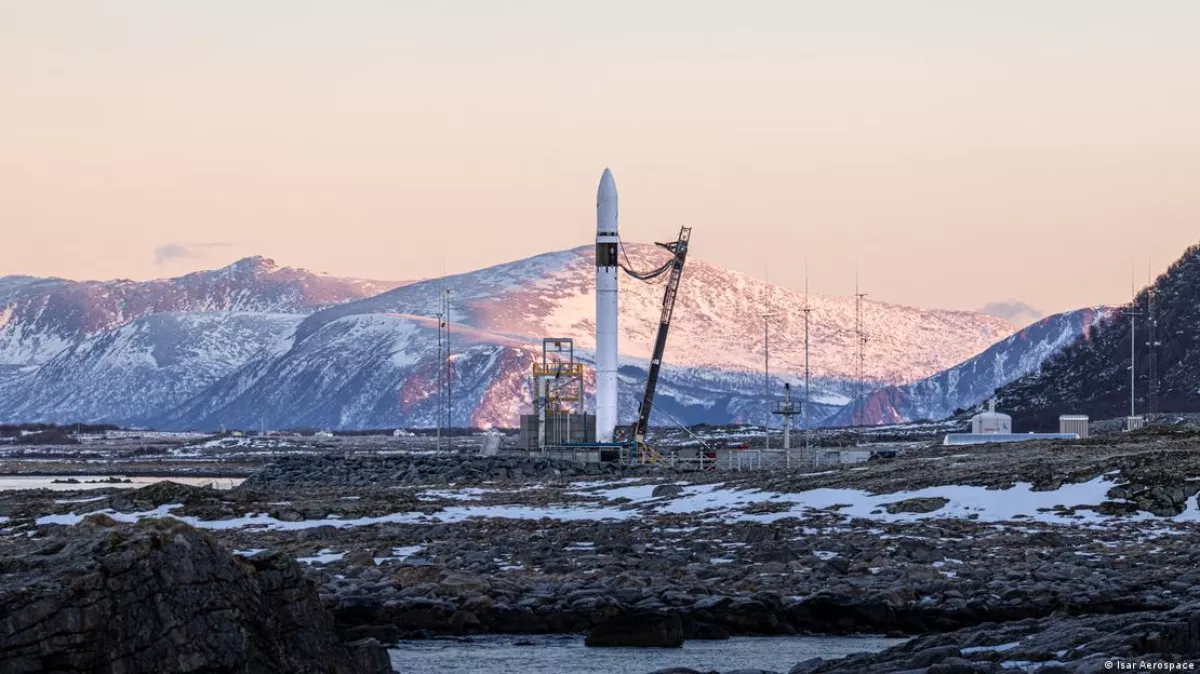
Isar Aerospace is testing rockets that it has developed
While American firms dominate public perception, Europe — and Germany in particular — is actively developing its own capabilities. German companies such as Isar Aerospace, Rocket Factory Augsburg, and HyImpulse are working on launch vehicles, while others like OHB and The Exploration Company are involved in satellite systems and reusable spacecraft. Additionally, firms such as OroraTech, Constellr, and LiveEO are leveraging satellite data for applications ranging from wildfire monitoring to infrastructure analysis.
Despite this growing ecosystem, industry leaders argue that stronger government support is necessary. Organizations such as the Federation of German Industries (BDI) and the German Aerospace Industries Association (BDLI) stress that increased investment, reduced bureaucracy, and more strategic state contracts are essential to remain competitive.
Globally, the United States still leads the space market with about 40% share, compared to Europe’s 17%. To maintain or expand its position, Europe would need to significantly increase investment levels. Germany has already pledged billions to the European Space Agency and military space capabilities, but experts argue this may not be sufficient.
Ultimately, the article highlights that space is no longer a niche or prestige domain but a foundational pillar of modern infrastructure. From navigation to communications and security, space-based technologies are becoming indispensable, making strategic investment in this sector a necessity rather than an option.
By Tamilla Hasanova







 editor@caliber.az
 +994 55 444-88-98
 Азербайджан, Баку, ул. Низами, 203, Af Business House, 5-й этаж