










The style of the new America Trump sends a cold shock through Davos
Everyone seems to have long grown accustomed to the fact that Donald Trump likes to surprise, shock, and leave audiences bewildered — not only through his actions, but also through his words. Rarely does one of his speeches pass without bone-crushing revelations about a particular leader, country, or global phenomenon. And yet his address on January 21 once again stirred the world. Partly, this effect stemmed from the venue itself: the World Economic Forum in Davos — a place that traditionally brings together many of his ideological opponents from the liberal camp.
In essence, the dead-end nature of the global liberal programme, Europe still operating within its framework, and America shaking off the intoxication of liberalism became the central themes of Trump’s speech. In this context, it is worth reflecting in particular on the significant element of spectacle that is invariably present in the public appearances of the 47th President of the United States. A closer look makes one thing clear: Trump has mastered the art of stand-up — with one caveat. Stand-up is usually associated with humour, whereas Trump for the most part employs only the external techniques of the genre — intonation, posture, gestures — while speaking about matters of the utmost seriousness.
At the same time—and this is important—there is always a joke in his speeches, serving as a kind of finishing shot. The result is a powerful political performance. “They killed the birds. They ruined your landscapes. Other than that, I think they're fabulous,” Trump concluded the part of his speech devoted to what he sees as the uselessness of the “green transition” with this caustic remark, triggering an outburst of laughter in the hall.
As before, he lamented Europe’s self-destruction caused by ill-conceived migration and energy policies and urged Europeans to follow the example of the Americans—or rather, of the new White House administration.
The next wave of laughter came when, having “opened” Europeans’ eyes to Europe, Trump observed: “Perhaps no current issue makes the situation more clear than what's currently going on with Greenland. Would you like me to say a few words of Greenland?” He then began, with the pedantry of a surgeon, to explain why America needs Greenland. At that point, many were no longer laughing: Trump’s barbed remarks went far beyond the bounds of European political correctness. Suffice it to recall just one line: “Without us, right now, you'd all be speaking German,” he said, reminding his audience of the United States’ role in the Allies’ victory in the Second World War—and, more broadly, in the modern architecture of European security.
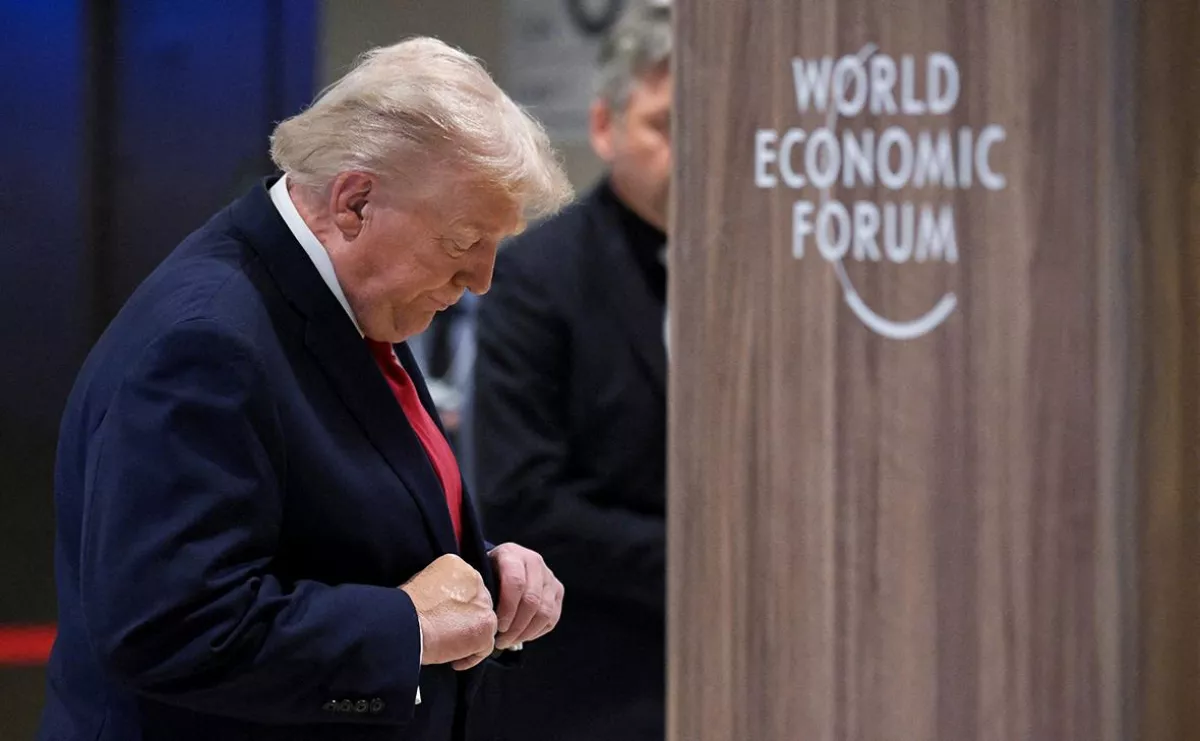
Yet Trump’s speech was not only a string of cynical revelations. When he said that the war in Ukraine was not his war, but that he could not calmly watch tens of thousands of people die in a single week, his voice treacherously faltered. We would not be so naïve as to rule out the possibility of acting, but if it was an act, then what a remarkable one. And if Trump was genuinely moved, that says a great deal about the scale of his personality.
One of his rhetorical devices is to return to the same theme after it appears to have been concluded. Thus, he spoke about the American economy twice, and returned to Europe—seemingly—three times. The final word was about Europe as well: reminding Europeans of their shared destiny with Americans, Trump added, “The United States is back, bigger, stronger, better than ever before, and I'll see you around.”
For all the controversy of its theses, the American president’s speech is striking for its freshness and uncompromising tone. The leitmotif of the hour-long address is exceedingly simple: America has stopped experimenting, is returning to a straightforward understanding of its own strength, and this will have to be reckoned with. This is how he put it when speaking about Venezuela: “Once the attack ended, the attack ended and they said, ‘Let's make a deal.’” And, after a dramatic pause, he added: “More people should do that.”
Even through the screen, one could feel the chill that swept through the hall—many in the audience were clearly uneasy.
Many analysts, examining Trump’s manner of speaking, point to what they see as the supposed sparseness of his language. In reality, it is quite the opposite: his speech is excessively rich—if richness is understood not as an abundance of synonyms, but as factual density and emotional intensity.
The concreteness of his vocabulary is not a weakness but a strength. Each sentence may seem overly simple on its own, yet together they form a powerful rhetorical barrage. Of course, Trump’s explosive charisma and magnetism play a decisive role: in the mouth of a less skilful speaker, such a speech might indeed appear poor. It is much like a talentless writer attempting to imitate Hemingway’s style.
Whatever one’s attitude towards Donald Trump and his policies, one thing must be acknowledged: his address was not a classical, but a vivid example of clear political expression—a model of a distinctive genre of political stand-up, in which humour plays only a supporting role, rescuing the audience with sudden laughter from the paralysis induced by the coldness of reality.







 editor@caliber.az
 +994 55 444-88-98
 Азербайджан, Баку, ул. Низами, 203, Af Business House, 5-й этаж