










Raid on Nakhchivan: Baku will not tolerate provocations from Tehran Analysis by Serhey Bohdan
The drone raid on March 5 targeting the Nakhchivan Autonomous Republic of Azerbaijan was far less surprising than many foreign media outlets initially suggested. For roughly the past thirty years, the government of Iran has pursued a highly questionable political game in the South Caucasus, persistently supporting Armenian expansionism. In this respect, it has behaved much like the global powers it criticises—those that once backed Armenian territorial seizures. Remarkably, Tehran continued this policy even after Armenian nationalists suffered repeated defeats.
Now we see that, despite Iran being deeply engaged in a devastating war, irresponsible elements within the Iranian leadership have still found an opportunity, under the cover of these events, to make a hostile move against Azerbaijan. Ilham Aliyev responded immediately to what he described as a terrorist attack, emphasising that Azerbaijan has no intention of being drawn into a war with Iran, but will not allow Tehran to encroach upon the country’s sovereignty and security.
A logical continuation of Iran’s policy of recent decades
Following the incident, Tehran denied any involvement in the four drones that attacked Nakhchivan. This is similar to previous Iranian claims that it had no connection to a number of attacks against Arab states. However, after two Iranian attack aircraft were reportedly shot down the day before—just ten minutes’ flight from Qatar—such denials have become increasingly difficult to take seriously.

Some commentators have suggested the possibility of a “false flag operation,” asking rhetorically: why would Iran need such an action at all? Yet the question is far from rhetorical. Iran’s behaviour in this case follows quite logically from its foreign policy and military strategy in the region.
In the 1990s, Iran effectively sided with Armenia in its war against Azerbaijan. This was largely driven by the resurgence of Persian nationalism with pan-Iranian undertones—an ideology before which both the universal ideals of the Iranian Revolution and even traditional Shiite solidarity receded into the background. Pan-Iranianism regarded Armenian nationalists as natural allies against Azerbaijan, which for Great Persian chauvinists had always been viewed merely as a space for expansion and domination.
Iran has, in many respects, continued to stand on the side of Armenian nationalists to this day. Over the years, power in Iran has changed hands several times, and ideological and cultural norms have been repeatedly revised. Yet the country has consistently drifted toward a form of Great Persian chauvinism—an attitude that has now become widespread.

In this context, the recent appearance on Iran’s opposition scene of the son of the former shah — Reza Pahlavi — is also telling. His father, Mohammad Reza Pahlavi, held the official title “Aryamehr” (“Light of the Aryans”), which reflected a dismissive attitude toward the Turkic peoples despite their key role in Iran and in Iranian culture. This development is yet another manifestation of the broader transformation of Iranian society—both inside the country and within the diaspora—toward ethnic nationalism and even racism.
Unfortunately, the Iranian state itself has also been moving in this direction. One need only look at the new embassies built by the Islamic Republic of Iran in recent decades, designed in a distinctly imperial Achaemenid Empire style that evokes a romanticised vision of ancient Persian grandeur.
Over the past decades, Tehran’s support for Armenian nationalists has not been limited to rhetoric. In the early years, it was Iran that helped Armenia withstand the blockade it faced as a consequence of its territorial seizures and claims against neighbouring states. Later, Iran continued to play a crucial role in supplying Armenia and also provided the separatists in the Karabakh region of Azerbaijan with a reliable rear base from the south.

Prominent experts from Armenian revanchist circles have never hidden their views. On Friday, for example, the statement of Grigor Balasanyan was widely circulated, claiming that “life has shown” that the separatist entity on territories seized from Azerbaijan “has been a guarantor of stability and security not only for Armenia but also for Iran.”
Tehran has also regularly exerted military pressure on Baku, sometimes through unusual exercises, other times simply by concentrating troops along the border. Even without access to classified intelligence, it is clear that Iranian state structures have long been connected with well-known Armenian nationalist scholars. These figures participated in separatist movements in Azerbaijan during the Gorbachev era and, in more recent decades, have assisted Armenian intelligence in organising a terrorist underground within Azerbaijan.
All of this fits the logic of the growing Great Persian chauvinism in its pan-Iranianist form. This ideology insists on opposing non-Iranian peoples, even when historically such confrontation is absurd and, in terms of current realities, unnatural—effectively setting a path toward the potential destabilisation of Iran itself.
Absurd, illogical, and dangerous
In Iran, these hostile actions have been justified as responses to Azerbaijan’s alleged cooperation with third countries against Iran. In reality, the facts suggest that Azerbaijan was working with these third parties in pursuit of its own interests and in the interest of restoring its territorial integrity. Meanwhile, it was Armenia that served as a hub for espionage directed “against Iran,” a matter widely known in the 2000s and 2010s.
Recently, Ilham Aliyev emphasised: “Azerbaijan neither participated nor will participate in any operations against Iran this time around. This is our principled position. We have no interest and no policy to conduct operations against neighboring countries. We protect - and have always protected - our territorial integrity.”
However, Armenian elites have long been quite successful in convincing Iranian leaders that “white is black” and that Azerbaijan is an enemy of Iran. Over the past quarter-century, such interpretations of hostile actions were never substantiated—usually consisting only of casually cited statements or private comments.
A much greater role was likely played by Armenian promises to help Iran in dealing with the West and Russia, supposedly leveraging the “all-powerful” Armenian diaspora. In reality, these diasporas and lobbies often turned out to be myths, yet the myth nevertheless functioned as a perpetuum mobile sustaining the Iranian–Armenian alliance.
Interestingly, the Iranian establishment continued to engage with revanchist elements in Armenia even after repeated defeats of Armenian nationalists by Azerbaijan and the effective collapse of their forces under the weight of their own problems—well after Azerbaijan’s victories and the complete military defeat of Armenian forces in previously occupied Azerbaijani territories.
What would the authorities of a neighbouring country have done in the spirit of good-neighbourly relations? Most likely, they would have welcomed the reality that they now share a border not with a rogue extremist and mafia enclave, as the separatist entity had been, but with a normal, functioning state. They might even have offered congratulations at the border—despite any previous misunderstandings. After all, a new reality had arrived, and one must live with it, nolens volens. Especially considering that Iran never actually benefited from intrigues with Armenian nationalists.
A strike against the Zangezur Corridor?
It also seems likely that the perpetrators of the Nakhchivan drone attack had another aim in mind: to signal Iran’s alleged capability to sabotage plans for the creation of the Zangezur Corridor. Looking at the current military situation realistically, it is clear that Iran is neither cornered nor incapacitated. So far, the successes of its adversaries amount mainly to the killing of certain openly visible Iranian leadership—a feat that, historically, has occurred even on a large scale in the 1980s. In other words, it is not much of an achievement.
The attack on Nakhchivan is yet another of countless proofs that talk of an Iranian collapse is entirely unfounded. Amid a continuing fierce war, Tehran has effectively launched a parallel operation in a completely different sphere, entirely unrelated to the ongoing conflict.
This is, of course, irresponsible even from the perspective of Iran’s own interests during wartime, not to mention its impact on good-neighbourly relations and regional stability. But it is not only for these reasons that Tehran’s claims against Azerbaijan are baseless and illogical.
Let us outline the basic facts. Armenian revanchists repeatedly refused to negotiate with Azerbaijan on establishing a more efficient and seamless transport connection between the country’s separate territories. At that point, the President of the United States stepped in.
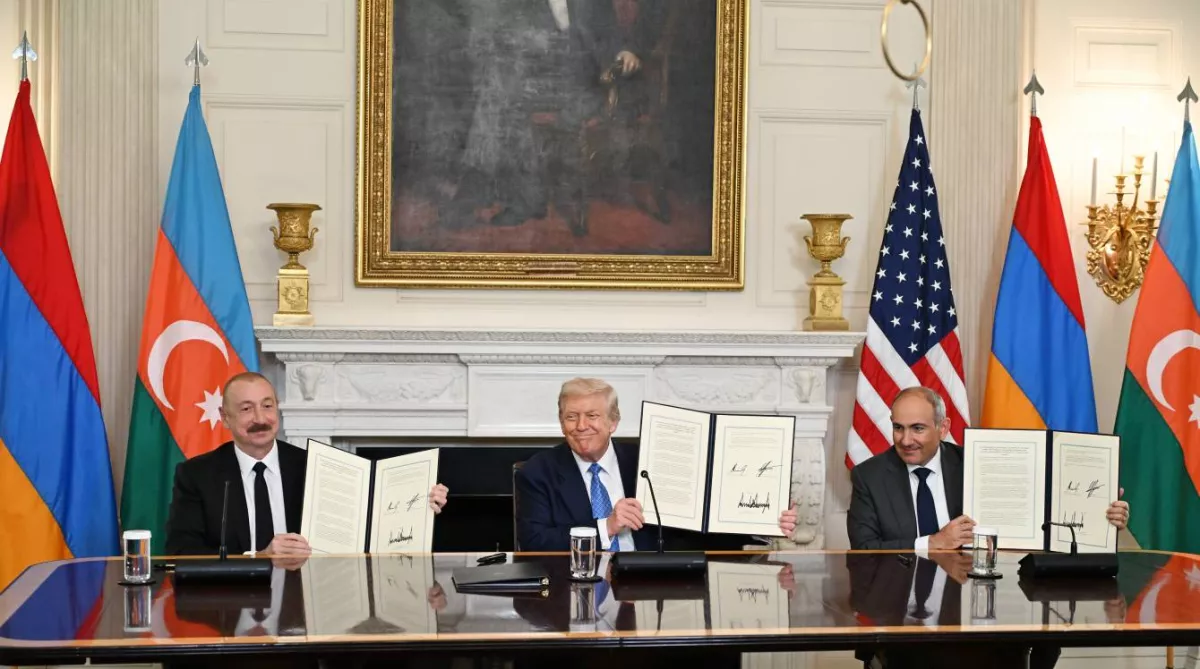
Donald Trump resolved the issue, transforming it into a project involving the United States. It was the Armenian allies of Iran who then decided to effectively transfer the southern Armenian territories to an American contractor. The result is the creation of what has been dubbed the “Trump Route for International Peace and Prosperity”, whose main goal is to improve connectivity between regions of Azerbaijan and to develop international transit across Eurasia.
Importantly, this route does not threaten Iranian security. Yes, as a consequence of the Armenian authorities’ decision, the link between Armenia and Iran will, to put it mildly, be weakened.
There is every reason to believe that if Armenia had not sabotaged Baku’s proposals for the Zangezur Corridor, the outcome could have been very different. The project would likely have remained an Azerbaijani–Armenian initiative and might even have been more acceptable to Tehran. It should be noted, however, that Iran opposed the Zangezur Corridor even before the United States became involved. This hardly constitutes good-neighbourly behaviour, given that the project is of vital importance for securing the territorial integrity of Azerbaijan.
If the current outcome displeases Iranian authorities, to whom should they direct their complaints—Armenian partners? Contrary to logic and common sense, they turned against Azerbaijan and promised to block the implementation of the Zangezur Corridor. Yet the absurdity escalated further with the drone attack, crossing all conceivable and inconceivable limits.
First, from the perspective of Iran’s own interests, what exactly is the threat posed by the Zangezur Corridor? Armenia is neither a significant trading partner for Iran, nor its “window to the world”—rather a dead-end. It is neither a political ally nor even a culturally close neighbour.
Second, did anyone seriously believe that sending drones into Nakhchivan could intimidate Azerbaijanis or drag them into a war, thereby escalating the conflict into a new format? Theoretically, could it then involve Armenia and Russia to trigger a confrontation between blocs? It is clear, however, that Azerbaijan is not Lebanon, Somalia, or Armenia, where external actors act with near impunity and sovereignty exists only in name, since their governments often lack both the institutional capacity and political will to assert themselves—unlike Azerbaijan. (See, for example, Armenia’s relations with Russia and the European Union.)
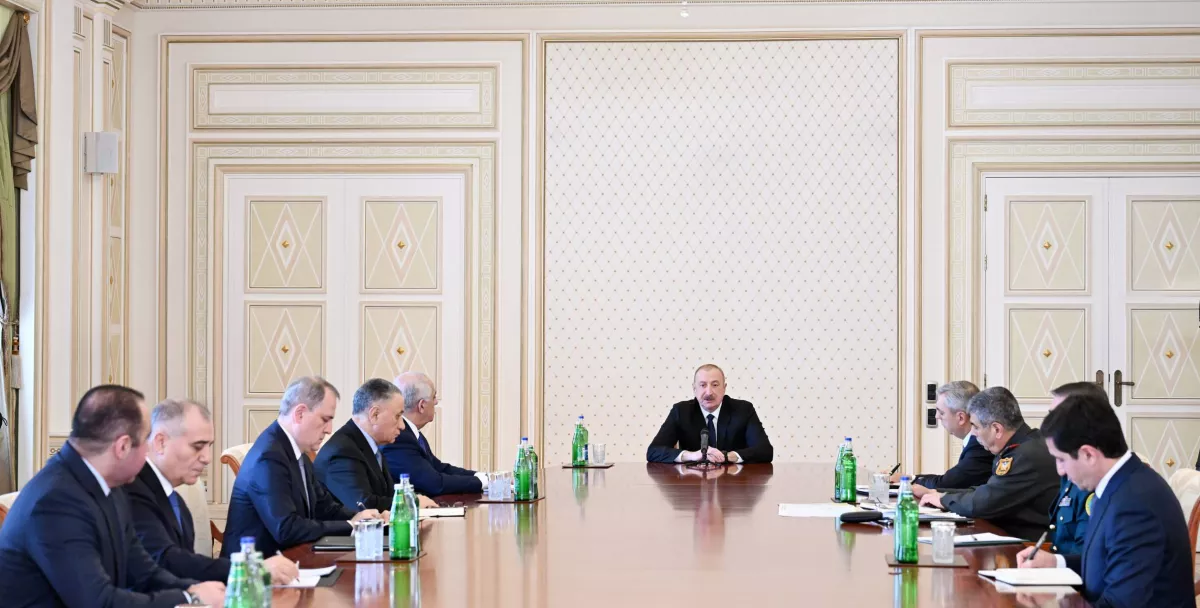
Following the Nakhchivan raid, President Ilham Aliyev convened a Security Council meeting, making it clear that Azerbaijan considers the attack a provocation, will not succumb to it, but will respond with force if necessary. Iranian authorities have been asked to clarify the situation, apologise, and hold those responsible accountable. At the same time, Azerbaijan’s security agencies have been ordered to prepare plans for a forceful response to the incident.

At the same time, Baku clearly framed the situation as separate from the ongoing war. President Ilham Aliyev emphasised this in his remarks, stating: “On numerous occasions, particularly following last year’s clashes, we informed the Iranian side that Azerbaijan’s territory would not be used against any neighboring state. We will not allow this, and we have never allowed it.”
The Azerbaijani government reinforced this position with other gestures of good-neighbourliness. Despite external pressures on Iran from non-regional actors, Baku continued engagement with Tehran after the outbreak of war. Following the President’s instructions, the Foreign Minister contacted his Iranian counterpart, and President Aliyev personally visited the Iranian embassy to express condolences over the assassination of the Supreme Leader of the Islamic Revolution, Ali Khamenei. Who among foreign leaders today has had the courage to follow such a moral imperative of basic human compassion?
On the very day of the Nakhchivan attack, as Aliyev recalled, Azerbaijan honoured a request from the Iranian Foreign Ministry to evacuate their staff from war-torn Lebanon—without accepting any payment. The Iranian embassy in Beirut is one of the key posts in Iran’s diplomatic network, particularly in the Middle East, and its personnel faced almost certain death. If Azerbaijan, alone or in coordination with third parties, had wished to harm Iran, it could have simply refused under some pretext. Unfortunately, this clear gesture of neighbourly goodwill remained one-sided—while Azerbaijani diplomacy extended help, drones were sent to strike Nakhchivan.
Iran has long needed to reconsider its policy toward the South Caucasus, and especially toward Azerbaijan. Its current approach is destructive—not only for bilateral relations, but for regional stability and even for Iran itself. It is flawed on multiple levels: it relies on a defeated Armenian expansionism, it preserves only a semi-closed “window to the world” in the north for Iran, and it risks undermining internal stability by generating discontent among Iranian citizens of Azerbaijani ethnicity.
Baku is therefore offering Tehran a chance to heed reason, return to the principles of good-neighbourliness, and abandon this absurd and self-destructive path. Should Tehran continue to ignore these warnings, Azerbaijan possesses political, diplomatic, economic, and ultimately military means to effect change.
As a responsible state, Azerbaijan is not rushing to extreme measures, fully aware of the risks and potential consequences—Armenian nationalists were repeatedly given opportunities to leave occupied territories without bloodshed. Yet Baku’s “Iron Fist” exists, and its use, if necessary, would be strictly a matter of protecting national interests—not connected in any way to Israel’s or the United States’ military operations against Iran.







 editor@caliber.az
 +994 55 444-88-98
 Азербайджан, Баку, ул. Низами, 203, Af Business House, 5-й этаж