










Azerbaijan shifts its agricultural strategy Review by Khazar Akhundov
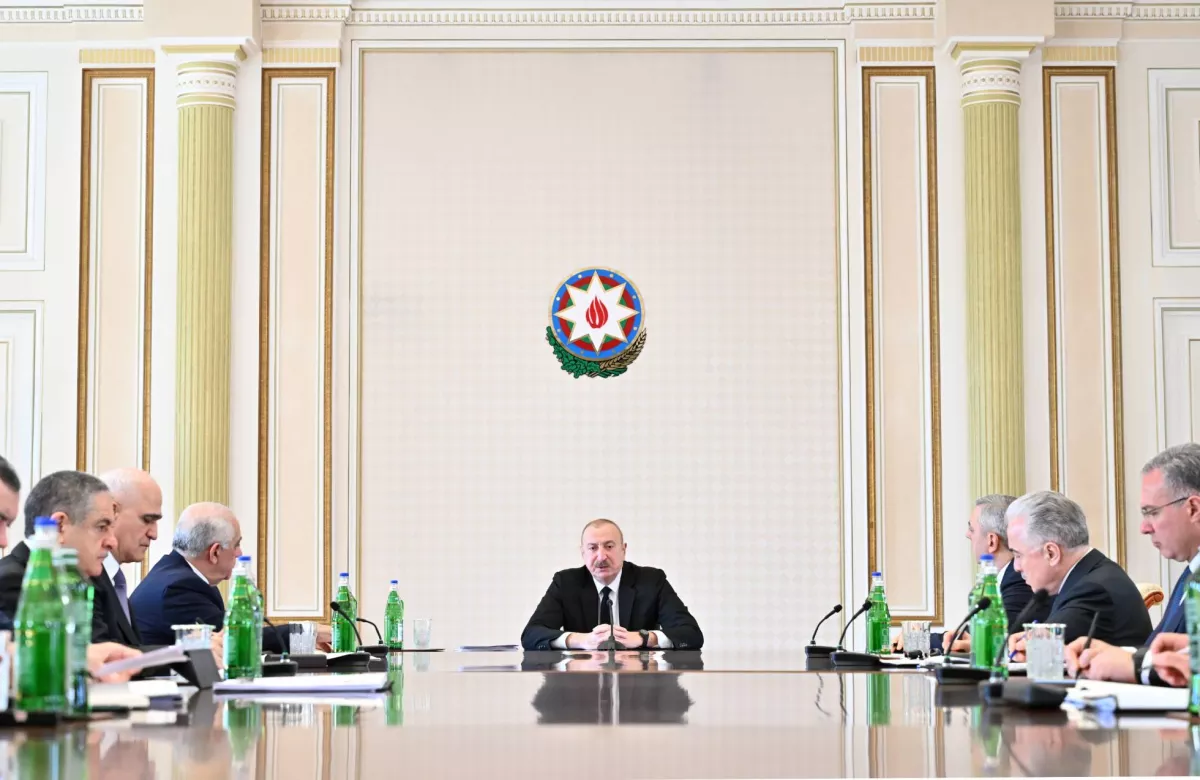
Climate change, imported inflation, disruptions to transport and trade chains, and the energy crisis are all having a severely negative impact on the global agricultural market. To a certain extent, these adverse trends are also affecting Azerbaijan’s agricultural sector, making it necessary to accelerate and deepen sectoral reforms in order to ensure the country’s food security. This involves shifting the domestic agricultural sector and processing industry towards intensive development, introducing water-efficient irrigation systems on a large scale, increasing productivity across a number of sectors, and significantly boosting exports of locally produced agricultural goods. These and other issues were discussed during a meeting chaired by Azerbaijani President Ilham Aliyev on May 25, dedicated to the development of agriculture.
Speaking at the meeting, the President of Azerbaijan recalled that one of the key components of the State Programme for Regional Development, implemented since 2004, had been measures aimed at modernising the country’s agro-industrial complex. Several subsequent five-year regional development programmes were adopted, while transport, energy, water, and public utilities infrastructure continued to improve, giving a new impetus to the development of all rural regions of the country.
Among the major achievements were the construction of large new reservoirs — primarily Takhtakorpu, Shamkirchay, and Goytapa — as well as the reconstruction of irrigation canals. Azerbaijan also created a uniquely large-scale system of subsidies and concessional lending for farmers, under which agricultural producers received benefits for the purchase of fertilisers and fuel, while part of the costs of sowing and land cultivation was covered by the state.
Farmers also gained access to leasing mechanisms for agricultural machinery and highly productive pedigree livestock. In agricultural regions, elevators, refrigeration and storage facilities, as well as processing and canning enterprises, were built.
Over these years, the head of state noted, several state programmes were adopted in areas such as viticulture, cotton growing, hazelnut cultivation, citrus farming, and other sectors, all of which received strong momentum for development. As a result of these reforms, the once nearly lost sericulture industry was revived, while cotton yields increased many times over. For comparison, cotton production had fallen to as little as 20,000 tonnes annually during the period of deepest decline, whereas today annual harvests exceed 360,000 tonnes.
Many of the transformations mentioned above continue to be implemented successfully. However, in recent years, Azerbaijan’s agricultural sector as a whole has been demonstrating insufficient growth rates. According to data from the State Statistics Committee, agricultural production in the country increased by only 1.5% in 2024, with growth slowing further to 0.9% in 2025. In the first quarter of 2026, the combined growth rate of agriculture, forestry, and fisheries rose slightly to 1.2%, yet these figures still remain insufficiently high.
“I am dissatisfied with the recent dynamics of agricultural production. A short while ago, instructions were given to the Presidential Administration and the Government to prepare and adopt a new State Program for the development of agriculture, which must be comprehensive and all-encompassing. It should include both public investment and private-sector investment. The program must be highly specific and short-term. The matters we discuss today will concern the adoption and implementation of this program,” President Ilham Aliyev stated during the meeting.
The head of state also noted that the trends currently observed around the world are negatively affecting agricultural production as well. Wars, conflicts, disruptions to transport chains, the energy crisis, and certain fuel-related difficulties have placed many traditional producers in a difficult position. Taking this into account, every country must naturally consider its own food security and take concrete steps to strengthen it.
At the same time, Azerbaijan, like many other countries, is experiencing the negative consequences of large-scale urbanisation, which has led to a mass migration of people from rural areas to cities. According to the head of state, this issue was also reflected in discussions held during the recent World Urban Forum in Baku.
“We, on the other hand, must ensure that a reverse migration process—from cities back to villages—begins. To achieve this, disparities between rural and urban areas across all sectors must be reduced,” President Ilham Aliyev stressed.
“The purpose of the Regional Development Program and the programs I mentioned—several of which have been adopted—was to create conditions in the regions so that people can live there, remain there, work on their ancestral lands, and engage in traditional activities such as farming, harvesting, and tourism. In other words, the service sector in the regions must also meet high standards,” the head of state added.
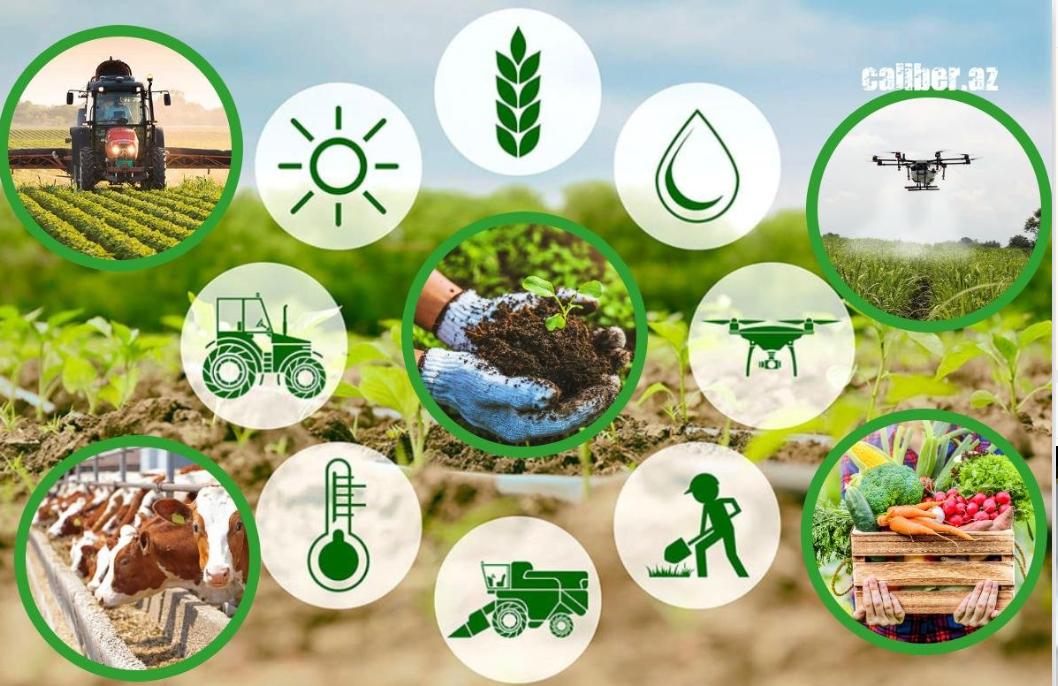
In this context, the President of Azerbaijan outlined the key priorities of the state programme for 2026–2030, aimed at overcoming the stagnation observed in recent years in the development of the agricultural sector. In particular, it focuses on increasing productivity in crop production through the application of advanced irrigation and other agrotechnologies, and the use of digital management systems for land certification based on soil quality, as well as improving yields through the cultivation of optimal crops. It also envisages expanding the processing of agricultural raw materials into final products with high added value, broadening the range and volume of food production through the introduction of modern technologies, and localising production in agro-parks, thereby increasing the share of exported processed goods. While urea production has already been established in Azerbaijan, there are plans to localise the production of other types of fertilisers in the country.
In his speech, President Aliyev provided concrete figures on the development of various agricultural sectors, highlighting areas of high self-sufficiency and established export capacity, as well as sectors where domestic production does not meet internal demand and dependence on imports remains high.
“Vegetables, melons and gourds, fruits, and berries: the situation here is positive,” the head of state noted.
The country is 107% self-sufficient in vegetables, with domestic production reaching 1.77 million tonnes per year and exports standing at 214,000 tonnes. Melon production amounts to 460,000 tonnes, with exports of 18,000 tonnes and virtually no imports. Fruit and berry production totals 1.4 million tonnes, with a self-sufficiency level of around 140% and stable exports of 600,000 tonnes. The self-sufficiency ratio for grapes is also relatively high at 92%, with production of 211,000 tonnes and exports of 10,000 tonnes.
In potatoes, the country is 91% self-sufficient. The deficit is not significant, with imports amounting to around 160,000 tonnes and exports at 71,000 tonnes, indicating potential to achieve full import independence and further expand external supplies.
Strong indicators are also observed in nut production, which stands at 84,000 tonnes, with hazelnut exports exceeding 30,000 tonnes, placing the country among the world’s top three to four producers in this segment.
The situation is relatively favourable in tea production, at 11,000 tonnes with 86% self-sufficiency, as well as in salt production, where 80,000 tonnes fully cover domestic demand and enable exports of 20,000 tonnes. Sugar self-sufficiency stands at 102%, with exports of 96,000 tonnes.
There is also no need for egg imports: production reaches 2.34 billion units, of which 90 million are exported.
However, in several other areas, Azerbaijan needs to increase production. This primarily concerns bread wheat, where the country is only 55% self-sufficient, and, unfortunately, this coefficient has not been increasing.
“We are essentially treading water. For many years, wheat production in our country has remained at this level, despite a significant impetus having been provided and numerous agroparks having been established,” the head of state noted. “Domestic production stands at 1,573,000 tons, while imports amount to 1,267,000 tons. We must reduce these imports. Naturally, taking into account our geography, arable lands, and the need to cultivate other agricultural products, we should not set the goal of achieving 100 percent self-sufficiency in food wheat. However, in any case, 55 percent is an unacceptable figure, and it must be increased.”
For legumes, domestic production amounts to 23,000 tonnes, imports to 15,000 tonnes, resulting in a self-sufficiency index of 63%. The situation with other grain crops (mainly fodder grains) is generally positive, with the country being 95% self-sufficient and imports remaining minimal.
At the same time, Azerbaijan needs to increase production, improve its raw material base, and expand processing in vegetable oils, where the self-sufficiency level is only 52%. With annual production of 56,000 tonnes, imports amount to 62,000 tonnes.
A similar situation is observed in butter production, where the self-sufficiency index stands at 62%. Despite domestic production of 26,000 tonnes, the country imports around 20,000 tonnes annually.
It is also necessary to improve indicators in meat and fish production. While poultry farming and small ruminant livestock breeding remain relatively stable, the self-sufficiency index for beef stands at 84%, with imports amounting to 30,000 tonnes. In fish and fish products, self-sufficiency does not exceed 81%, while imports total 23,000 tonnes.
“We must achieve 100 percent self-sufficiency in meat, milk, and poultry. I stated the figures: they are currently at approximately 80–90 percent. To bring this to 100 percent, I believe opportunities exist, and as I mentioned, this program must be short-term, covering the years 2026–2030,” President Ilham Aliyev emphasised.
Speaking at the meeting, Minister of Agriculture Majnun Mammadov stressed that sectoral development and growth in recent years have been largely driven by intensive farming.
“Accelerating the transition to intensive agriculture in crop production largely depends on the application of modern irrigation methods. Thus, the average productivity of food wheat in the country is 3.2 tonnes, while in 2025 the average productivity in all farms participating in the food wheat cultivation programme and in farms using modern irrigation methods reached 5.8 tonnes,” he said.
According to the minister, this example clearly shows that expanding the use of modern irrigation methods must become one of the key priorities of the State Programme.
A similar situation is observed in other areas of crop production. For example, while the average yield of vegetables in open fields is 20 tonnes per hectare, it reaches 60 tonnes under modern irrigation systems.
“At the same time, in greenhouses it averages 300 tonnes nationwide, and in some successful farms this figure even reaches 450 tonnes. This shows that greenhouses allow for the production of large volumes of output on very small areas,” Mammadov emphasised.
It is evident that, within the framework of the State Programme, the main focus will be placed on those segments of the agricultural sector where Azerbaijan faces the greatest domestic production deficits. The implementation of large-scale sectoral transformations will require the mobilisation of substantial financial resources, and alongside state investments, favourable conditions must be created to ensure the predominance of private initiative in such projects.
“Private sector representatives must also play a special role in the implementation of the State Program. In this context, the responsibility of business representatives must, of course, come to the forefront. More favorable conditions should be created to encourage investment and strengthen their commitment to the country,” President Ilham Aliyev noted. “Of course, we will also utilize various mechanisms. We must use both concessional loans and other instruments to achieve a larger volume of investment by Azerbaijani entrepreneurs in agricultural development.”
In this context, the head of state stressed the importance of informing and encouraging foreign investors, as well as attracting international companies to develop the most in-demand agricultural sectors for the country. He also instructed relevant bodies — including the Ministry of Agriculture and the Ministry of Economy, as well as the government and other institutions — to intensify work with the private sector.
“Considering that almost half of 2026 is already behind us, only four and a half years remain for the implementation of this program. Therefore, state funds for financing the program must be allocated this year,” the head of state noted, stressing that, according to preliminary estimates, more than 2 billion manats ($1.17 billion) will be required for the implementation of measures envisaged by the state, while the private sector’s share in these initiatives will exceed 3 billion manats ($2.94 billion).







 editor@caliber.az
 +994 55 444-88-98
 Азербайджан, Баку, ул. Низами, 203, Af Business House, 5-й этаж