










Russia and the Chinese fireworks What Putin took from Beijing
“Even if we haven’t seen each other for a day, it feels like three autumns have passed,” — with this Chinese proverb, Russian President Vladimir Putin began his speech at a meeting with Chinese President Xi Jinping in Beijing. This introduction was intended to underscore the special, almost trusting nature of Russian-Chinese relations. If we take into account that Putin’s visit took place just a few days after Donald Trump’s visit to Beijing, the geopolitical message was quite clear: Moscow is seeking to demonstrate that today it is closer to China than the United States. It should also be added that Xi Jinping himself welcomed Putin in an exceptionally warm manner. “President Putin, my long-time friend. I am glad to welcome you to China on this official visit,” said the Chinese leader.
However, it seems that symbolism ultimately became the main substance of the visit. Vladimir Putin’s trip to Beijing can hardly be described as a breakthrough event in Russian-Chinese relations, although its political and image-related significance turned out to be noticeably greater than its practical results.
Among the more than forty documents signed, only two truly stand out — the Joint Statement on Further Strengthening the Comprehensive Partnership and Strategic Interaction, as well as the Joint Declaration on the Formation of a Multipolar World and a New Type of International Relations. It is in these texts that Moscow and Beijing articulated their shared vision of the global order, opposed unilateral actions by the United States, and emphasised the need to build a more balanced international system. The documents also contain criticism of “hegemonic countercurrents” in global politics, while Russia and China effectively declare their readiness to coordinate positions on key issues of global security.
Overall, the atmosphere of the visit was deliberately shaped around this display of strategic closeness. The ceremonial reception, the size of the Russian delegation, dozens of signed documents, and the emphasised personal rapport between Vladimir Putin and Xi Jinping were all intended to create the impression of a stable political alignment between the two powers.
That is precisely why most of the documents signed in Beijing are framework or declaratory in nature. They record a convergence of positions on key international issues but do not amount to the emergence of a fully-fledged military-political bloc, something that, according to some observers, the Russian leader may have been expecting.
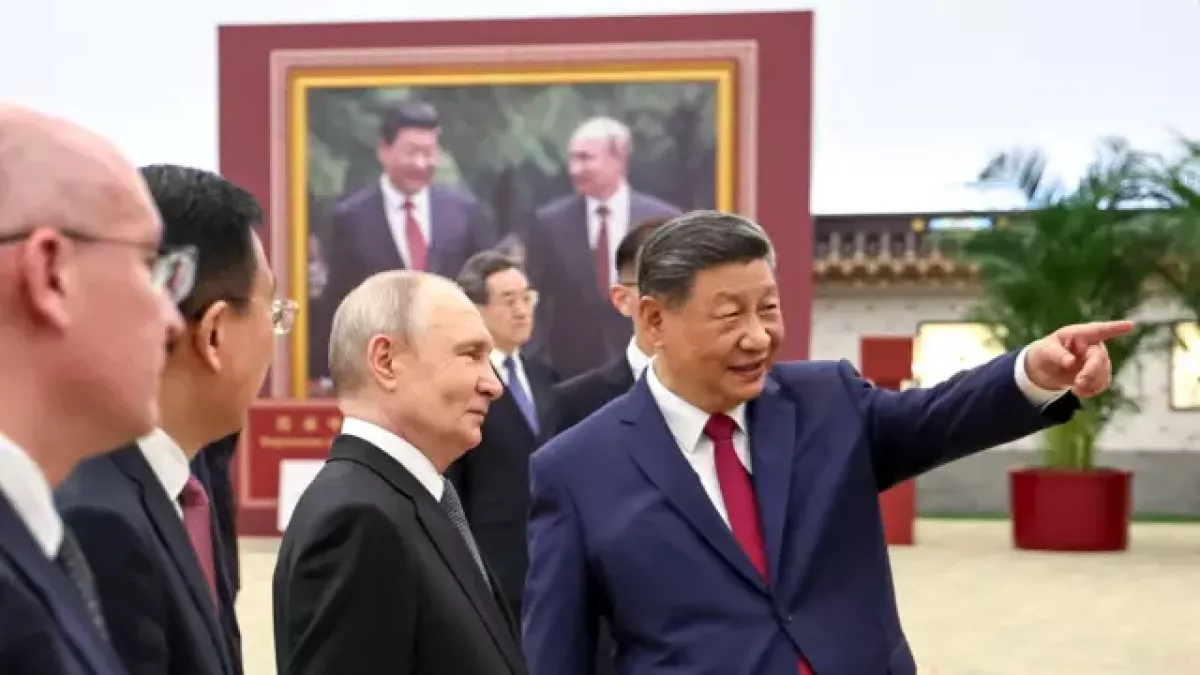
Another layer of intrigue is linked to the economy. For Moscow, China today holds exceptional importance. Since 2022, the Russian economy and foreign policy have become significantly more dependent on Beijing. China has simultaneously turned into the largest market for Russian energy resources, a source of technology, an alternative financial channel, and a key foreign policy partner. It is no coincidence that representatives of energy and raw materials corporations dominated the Russian delegation.
A special place in the talks was once again given to the “Power of Siberia 2” gas pipeline project. For the Kremlin, this is not merely an economic initiative but an attempt to embed China even more deeply into a long-term system of interdependence. Moscow expects that large-scale energy ties will make Beijing less inclined to distance itself from Russia, even under pressure from the United States. However, the absence of final agreements shows that China is not in a hurry and continues to seek the most favourable terms — even amid fluctuations in energy prices caused by the US and Israeli war against Iran and instability around the Strait of Hormuz.
However, returning to geopolitics, it is important to reiterate: it would be incorrect to say that Putin returned from Beijing empty-handed. Yes, the main practical issue — the final agreement on the “Power of Siberia 2” project — was not resolved. But it would be naive to assume that this was not understood in Moscow beforehand. Therefore, the primary objective of the visit was not so much to sign new energy deals as to strengthen Russia’s own political capital by demonstrating strategic proximity to the world’s second superpower — the People’s Republic of China. And this objective, the Kremlin appears to consider achieved.
Continuing this line of image-based gains, the real winner of recent days has been Beijing. By hosting in quick succession the leaders of the United States and Russia — states that today define the main lines of global confrontation — China demonstrated its position as being “above the fray,” thereby taking a significant step toward consolidating its status as a world power responsible for peace on the global stage.







 editor@caliber.az
 +994 55 444-88-98
 Азербайджан, Баку, ул. Низами, 203, Af Business House, 5-й этаж