










Travel with ease and comfort Baku and Tbilisi strengthen transport connectivity
Alongside the expansion of transit freight flows in recent years, the Closed Joint-Stock Company “Azerbaijan Railways” (ADY) has been actively developing domestic passenger services. The track infrastructure has been modernised, and various types of passenger trains have been purchased from the Swiss company Stadler Rail Group. However, pandemic restrictions introduced six years ago limited passenger services exclusively to the territory of the country.
Now, Azerbaijan and Georgia have recently agreed to resume daily passenger rail service on the Baku–Tbilisi–Baku route starting from May 26, 2026. ADY and its partners at Georgian Railway JSC have already coordinated the timetable, ticket prices have been announced, train sets are being prepared, and other technical issues are being addressed.
The history of the Trans-Caucasian railway line dates back to May 8, 1883, when the railway connection linking Baku with Tbilisi was commissioned. Later, this railway line connected the Caspian Sea with the Black Sea, reaching the Georgian ports of Poti and Batumi, thereby ensuring stable exports of Baku oil to foreign markets.
In the current century, this railway corridor has played an equally important role in transporting oil, other cargo, and passengers. Over the past two decades, this route has undergone several stages of modernisation, becoming Azerbaijan’s main export corridor for freight transit to Türkiye and Europe.
Moreover, following the commissioning of the Baku–Tbilisi–Kars (BTK) railway, ADY specialists had been developing plans for expanding cross-border passenger routes, primarily linking Azerbaijan with Türkiye via the BTK line. In October 2019, a pilot passenger train service (No. 38/37) was successfully launched from Baku to Tbilisi and further towards the Turkish border. However, the subsequent outbreak of the COVID-19 pandemic forced stakeholders to postpone the project for a longer period.
One of the most negative consequences of the pandemic was also the closure of Azerbaijan’s land borders. For the past six years, passenger train services to Georgia were suspended. This difficult situation had an adverse impact on the development of domestic tourism, including by constraining inbound travel flows.

It is symbolic that a breakthrough in this direction has emerged in the current May, close to the 143rd anniversary of the launch of the Trans-Caucasian railway line.
During the talks between President of Azerbaijan Ilham Aliyev and Prime Minister of Georgia Irakli Kobakhidze, who visited Azerbaijan to participate in the World Urban Forum (WUF13), a number of documents were signed to expand cooperation in the fields of economy, energy, and transport.
According to the Azerbaijani Ministry of Economy, in line with a joint Azerbaijani–Georgian intergovernmental communiqué, an agreement was also reached to resume daily passenger rail service on the Baku–Tbilisi–Baku route.
“The issue of operating the Baku–Tbilisi passenger train between Georgia and Azerbaijan has been discussed, and in accordance with the instructions given by the leaders of both countries, the relevant state structures are working in this direction,” said Hikmet Hajiyev, Assistant to the President of Azerbaijan and Head of the Department for Foreign Policy Affairs of the Presidential Administration, speaking to the media on May 19 during the WUF13 forum.
At present, specialists of the Closed Joint-Stock Company “Azerbaijan Railways” and their Georgian counterparts are working at an accelerated pace to resolve technical and organisational issues related to the restoration of train services on the Baku–Tbilisi–Baku route.
In particular, the Azerbaijani railway authority has released information on the passenger train schedule. The trains are expected to depart from Baku daily at 23:10 and arrive in Tbilisi the following day at 08:41. From the Georgian capital, the train will depart at 21:00 and arrive in Baku the next day at 06:24.
On the territory of Azerbaijan, trains operating on the Baku–Tbilisi–Baku route will make stops at Bilajari, Yevlakh, Ganja, Aghstafa, and Boyuk Kasik stations. On the Georgian side, stops are planned at Gardabani and then at Tbilisi Railway Station.
In addition, “Azerbaijan Railways” has also presented information on ticket prices. Thus, the fare from Baku to Tbilisi will amount to 81 manats ($47). At the same time, travel from Yevlakh, Ganja, and Aghstafa on the same route will be cheaper, ranging from 67 to 57 manats ($39-33). From Boyuk Kasik to Gardabani, the ticket price will be 51 manats ($30).
Undoubtedly, taking into account inflationary trends and other objective factors over the past seven years, railway ticket prices have increased. For comparison, in 2019, the cost of a trip from Baku to Tbilisi in a sleeper carriage was around 37 manats ($21).
Nevertheless, the resumed railway route will clearly remain cheaper than current airfares, especially considering that as of late May, one-way flight tickets from Baku to Tbilisi for a passenger with luggage start from 199 manats ($117).
In addition to lower prices, passengers on this route will have the opportunity to travel on a high-speed, modern, and comfortable train set. According to information provided to Caliber.Az by Azerbaijan Railways (ADY), services on this route will be operated using trains ordered from the world-renowned Swiss company Stadler Rail Group. A total of 20 sleeper carriages have currently been procured.
Overall, the Swiss company’s carriages are available in four categories: “Standard”, “Comfort”, “Business”, and “Restaurant”. They are equipped with modern facilities, lighting systems, and internet access.
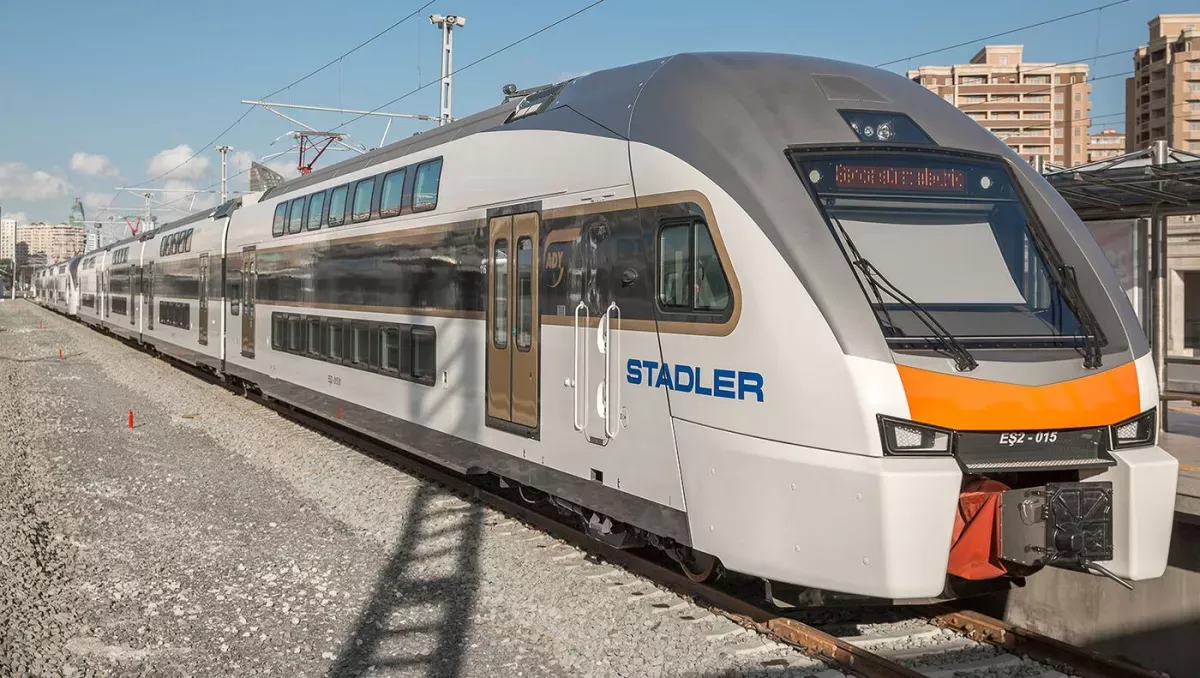
These trainsets are designed to carry over 200 passengers in one direction and are capable of travelling at an average speed of 100 km/h on straight sections of railway lines, while also being able to accelerate with ease to higher speeds on modernised segments of the network when necessary.
Over the past decade, Azerbaijan Railways (ADY) has also procured 50 locomotives from the French company Alstom, including ten intended for passenger services. In particular, the Prima M4 model acquired by ADY is capable of reaching speeds of up to 160 km/h, and when combined with high-speed Stadler carriages, it will significantly reduce travel time on the Baku–Tbilisi route.
The distance on this corridor is 560 kilometres. In recent years, ADY has carried out extensive work to strengthen railway infrastructure and upgrade communication and signalling systems in order to improve speed performance. The length of electrified railway lines has also increased, allowing for a reduction in the use of diesel locomotives in favour of electric traction.
Around 65% of the country’s railway network has been electrified, with a transition to alternating current implemented on key sections of the East–West and North–South international transport corridors. Thanks to this, 100% of ADY passenger trains now operate on electric traction, while new traction substations enable savings of up to 30% in electricity consumption.
Notably, among the agreements signed in Baku was also the protocol of the 41st meeting of the Coordination Council on the rehabilitation, reconstruction, and construction of the railway section from Marabda to the border with the Republic of Türkiye (Kartsakhi), within the framework of the development of the Baku–Tbilisi–Kars (BTK) railway project.
This document formally secured the transfer of the relevant railway infrastructure to the joint Azerbaijani–Georgian enterprise BTKI Railways LLC for the purpose of managing and overseeing this railway line, marking an important step in strengthening regional connectivity.
Azerbaijan’s key role in the development of the Baku–Tbilisi–Baku route is evident. It should be recalled that in 2023–2024, the country invested over $120 million in the reconstruction and repair of a 183-kilometre section of the BTK line in Georgia. This allowed the corridor’s throughput capacity to increase from 1 to 5 million tons of cargo, while also improving train speeds, including potential passenger services.
The latter is particularly important for the future expansion of passenger rail connectivity from Azerbaijan through Georgia to Türkiye. According to expert estimates, at the initial stage the BTK corridor could handle up to 1 million passengers per year, and later—if demand grows—this figure could rise to as many as 3 million travellers.
In the longer term, with the development of the BTK route, it may become possible to establish regular passenger rail services all the way to Ankara and even Istanbul. To support this vision, Türkiye launched a high-speed rail connection between Ankara and Sivas two years ago, reducing travel time between the two cities from 12 hours to 2.
In the near future, Türkiye also plans to commission a connecting line from Yerköy to Kayseri and extend it further to Erzincan, Erzurum, and Kars, which serves as a key transport hub for the BTK corridor.







 editor@caliber.az
 +994 55 444-88-98
 Азербайджан, Баку, ул. Низами, 203, Af Business House, 5-й этаж