










Digital monarchs: How IT billionaires are building a “New America” of their own Analysis by Shereshevskiy
A struggle is underway in the United States between two political currents. One is represented by Silicon Valley billionaires, the ideologues associated with them, and a segment of the Republican Party; the other is represented by the Democratic Party and the business interests that support it.
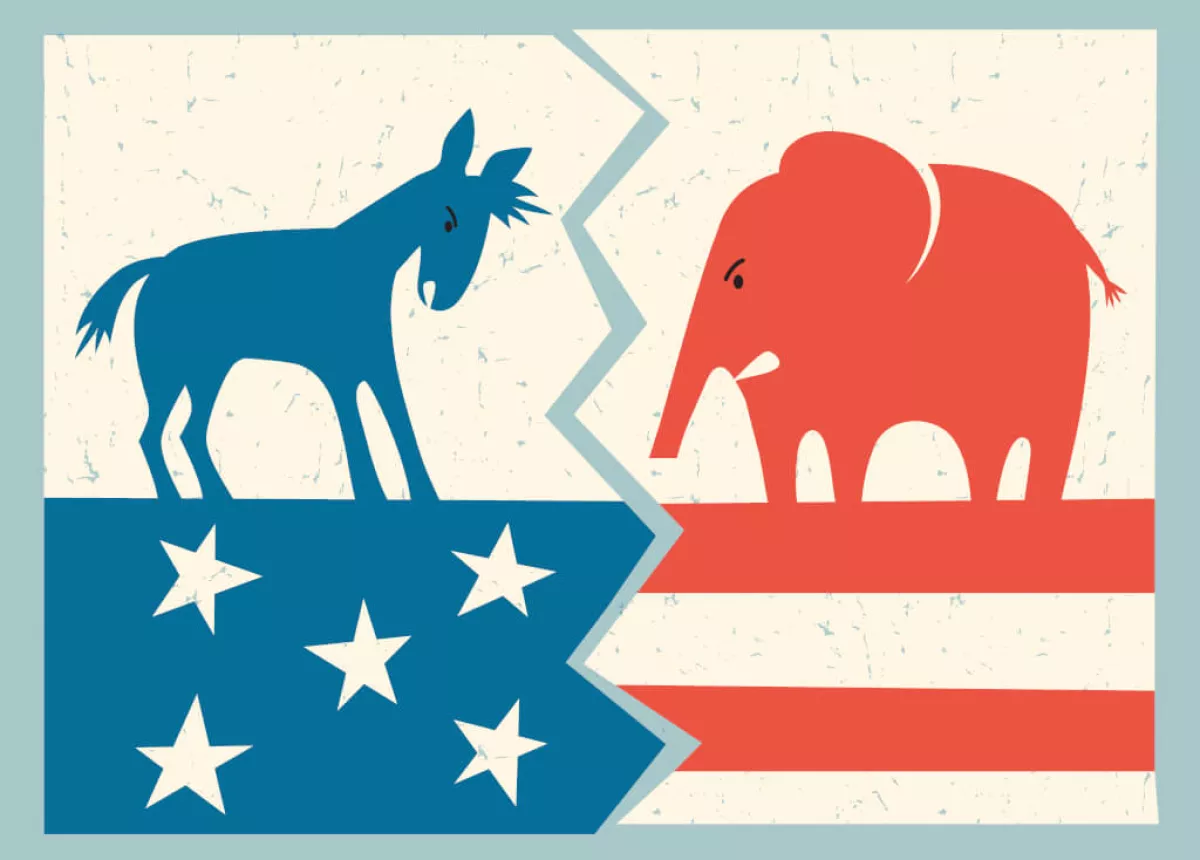
The Democrats generally support preserving the existing political and economic system in the United States. Some factions within the party—particularly progressives and the left wing—also advocate higher taxes on the wealthy and expanded government funding for infrastructure, education, and healthcare. At the same time, certain Democrats support restrictions on free speech through bans on so-called “hate speech,” favour affirmative action policies and diversity quotas for women and certain minority groups in university admissions and employment, defend abortion rights, and seek tighter regulations on private firearm ownership, including limitations on the right to use firearms for self-defence.
Opposing them are the groups that have rallied around the Republican Party and Donald Trump, who, in their view, offer new approaches to organising public life and governance.
The leading figures of Silicon Valley—including Peter Thiel, Elon Musk (before his disagreements with Donald Trump intensified), the political theorist and writer Curtis Yarvin, and a number of other influential figures—have championed the idea of the so-called “Dark Enlightenment,” which advocates a particular set of political and economic reforms. Having gained influence within Trump’s circle, this group has amassed considerable power.
Representatives of the tech elite envision a form of pure libertarian capitalism with minimal government regulation. Beyond deregulation and tax cuts, however, they advocate broader transformations. Their ideal is a world in which major corporations privatise many of the key functions traditionally performed by the state.

For example, Elon Musk’s companies are taking on functions related to communications and transportation, while Palantir is acquiring a role in the defence sector through cooperation with other defence contractors. Private military companies are also assuming certain defence functions that were traditionally carried out by the armed forces. Such a privatisation of state functions by business implies radical political and economic transformations.
First, tech giants seek to consolidate financial flows under their control, effectively privatising the state itself. In this model, the government would collect taxes from the population and then channel those funds to private companies through government contracts in exchange for the provision of various services, whether in transportation, infrastructure, or defence. Such extensive state support would obviously generate enormous profits for these corporations, not only through the contracts themselves but also by increasing stock market confidence in the stability of their shares, since the government would be unable to dispense with companies that have effectively become part of the state.
Second, such a model leaves no room for democracy. Indeed, there are doubts as to whether the contemporary American system can truly be described as democratic, given the significant influence wielded even by officially registered lobbyists representing multinational corporations. Businesses would hardly spend hundreds of millions of dollars on the election campaigns of politicians and political parties without expecting favourable legislation in return.
Yet even the existing ability of society to replace one group of ruling oligarchs with another every few years is unacceptable to advocates of the Dark Enlightenment. In their view, this hinders the efficient governance of the country, particularly when measured by the goal of maximising profits.
Accordingly, Thiel, Yarvin, Musk, and their supporters advocate organising the state along the lines of a super-corporation or a cartel of major companies, with government being run in the manner of a corporate board of directors. They describe themselves as “neo-monarchists” or “neo-reactionaries,” likely in contrast to progressive democrats.

For Yarvin, at least, the ideal model is the absolutist Prussian monarchy of the early modern era.
According to followers of the Dark Enlightenment, they are opposed by the so-called “Cathedral” — a bureaucratic cadre, an army of officials, journalists, and intellectuals trained in “left-leaning” universities. In their view, it is precisely these bureaucratic forces that govern America. They use the ideas of social justice and assistance to the poor in order to gain popularity in society. In addition, the “Cathedral” shapes public opinion through the education system, the media, and the same universities, thereby closing the loop of influence. Therefore, in the event of coming to power, supporters of the Dark Enlightenment would want to carry out a large-scale purge of the bureaucratic apparatus, reducing it or appointing people with similar views to replace those who are dismissed. At the same time, they would seek to defund universities and establish a certain degree of control over them.
In the field of social culture, supporters of this movement propose a mixed and eclectic set of ideas. They are characterised by a defence of absolute individual freedom and freedom of speech as a counterbalance to left-liberal attempts to criticise, criminalise, or ban certain forms of expression. However, discussions of human rights are often combined with demands to ban abortion, criticism of Islam, the spread of xenophobia toward migrants, and attacks on universities.
Part of this inconsistency stems from the fact that ideas of pure capitalism and transferring the state into the ownership of an elite of business leaders are poorly received by the public. Many people suspect whether this would lead to taxes and other state assets being simply captured by powerful corporations. In addition, if elements of the welfare state are dismantled, what would happen to the millions of poor Americans who receive subsidies?
Therefore, supporters of the Dark Enlightenment require an ideological “packaging” that would allow them to gain majority electoral support, since without it they still struggle to come to power. They have managed to gain significant influence within the Republican Party by coalescing around Trump, not least through anti-immigration rhetoric, support for hardline conservatives, and Islamophobia.
The very emergence of the Dark Enlightenment ideology may be driven by changes in the United States’ political and economic system. Branko Milanovic, a former World Bank economist and author of research on global inequality, argues that rising inequality automatically leads to the concentration of power in the hands of a narrow group of actors. The presence in society of individuals and companies with hundreds of billions or even trillions of dollars in capital naturally results in them beginning to determine key questions of socio-economic life and politics. When the owner of a corporation worth three or four trillion dollars has lunch with the FBI director, the Treasury Secretary, or maintains friendships with members of the Supreme Court, it becomes less relevant what name is given to the political system. On the other hand, the ideology of the Dark Enlightenment serves to formally legitimise and reinforce such trends.
However, this ideology has already encountered a number of contradictions.
Millions of large and small entrepreneurs are closely tied to the use of cheap migrant labour. This applies both to low-skilled workers in construction, agriculture, and the restaurant business, and to corporations’ ability to hire skilled specialists abroad.
The foundation of America’s economic power is the importation of talent. If, as the Trump administration attempted, this inflow is restricted, it could lead to business decline and defeat in competition with other countries. At the same time, many business representatives were dissatisfied with raids on migrant workers, since such actions could deprive enterprises of cheap labour.

There is also a contradiction between two political concepts within the Dark Enlightenment itself. One views a properly organised state as a corporate board of directors, in which influential leaders of private corporations sit, while the other envisions it as an absolute monarchy. These are not the same thing. A board chairman does not necessarily possess absolute power, whereas an absolute monarch can remove those who fall out of favour. In a monarchy, such a process is natural, but can tech giants be certain they will always remain in the ruler’s favour? The fluctuating relationship between Trump and Musk, which shifts between conflict and reconciliation, clearly illustrates this problem.

Finally, absolute freedom of speech and the declaration of human rights sit uneasily alongside the ultra-conservative ideas of figures such as Leonard Leo — a lawyer close to the Trump administration who played a key role in shaping the conservative majority on the U.S. Supreme Court. Leo supports a ban on abortion, an idea that is unpopular in the United States, arguing that a minority should impose its will on the majority through state institutions.
Mass raids on migrants, Trump’s sharp reaction to criticism in the media, and attempts to influence media owners can hardly be described as signs of full and unrestricted freedom of speech.
Conservative Republicans came to power by criticising the Democratic Party’s attempts to restrict freedom of speech, to prosecute cultural figures for “incorrect statements,” or even for mere suspicions of inappropriate behaviour. The rise in prices during the Biden administration also played a major role, becoming one of the key reasons for the Democrats’ defeat. But can Republicans now demonstrate that they are exemplary defenders of individual liberty while also being capable of ensuring economic growth?







 editor@caliber.az
 +994 55 444-88-98
 Азербайджан, Баку, ул. Низами, 203, Af Business House, 5-й этаж