










The age of AI: Azerbaijan builds a “digital fortress” Overview by Khazar Akhundov
Among the key Sustainable Development Goals of the United Nations are the reduction of the digital divide and the creation of a digital ecosystem that fosters human capital development. Having placed a strategic bet on the Fourth Industrial Revolution (4IR), Azerbaijan, in recent years, has been implementing digital solutions in industry and the financial sector, adopting artificial intelligence (AI), and more.

However, the progress of digital transformation—especially the spread of AI tools—also carries significant cybersecurity risks. In Azerbaijan, the protection of critical information infrastructure is classified as a key state priority, and both achievements and potential threats in this area were discussed recently in Baku during the 4th National Cybersecurity Forum.
Last year, President Ilham Aliyev approved the “Concept of Digital Development of Azerbaijan” and the “Artificial Intelligence Strategy of Azerbaijan for 2025–2028.” The main objective of these documents is to ensure the country’s digital transformation of the economy, including within the framework of Industry 4.0. In recent years, steps have also been taken in the Republic to develop the Government Cloud (G-Cloud) system and to build Big Data infrastructure and data centres. At the same time, the 4SIM Azerbaijan Centre for Analysis and Coordination of the Fourth Industrial Revolution, operating under the Ministry of Economy, has begun forming an artificial intelligence ecosystem.
As part of the unified action plan, “New Digital Architecture of Azerbaijan,” international vendors, software companies, and specialised organisations in High-Tech and FinTech are being attracted to the country. These sectors are in high demand for the digitalisation of the domestic financial sector and the development of the Open Banking system. In addition, the republic is enhancing the digital capacity of payment systems, developing Smart City mechanisms, digitalising the utilities sector, and gradually building the infrastructure for the Internet of Things (IoT).
All this work is under the direct control of the head of state and is being steadily accelerated, as Azerbaijan must carve out its niche in the global specialised market in the shortest possible time. This is an irreversible trend, as the digital economy today is almost on par with the traditional one, and it is expected that the value added generated by AI by 2030 will amount to around $16 trillion.
It is evident that such a complex and extensive digital toolkit requires reliable protection against cyber threats. Therefore, alongside the development of the digital economy, coordinated measures to safeguard the country’s cyberspace are of critical importance.
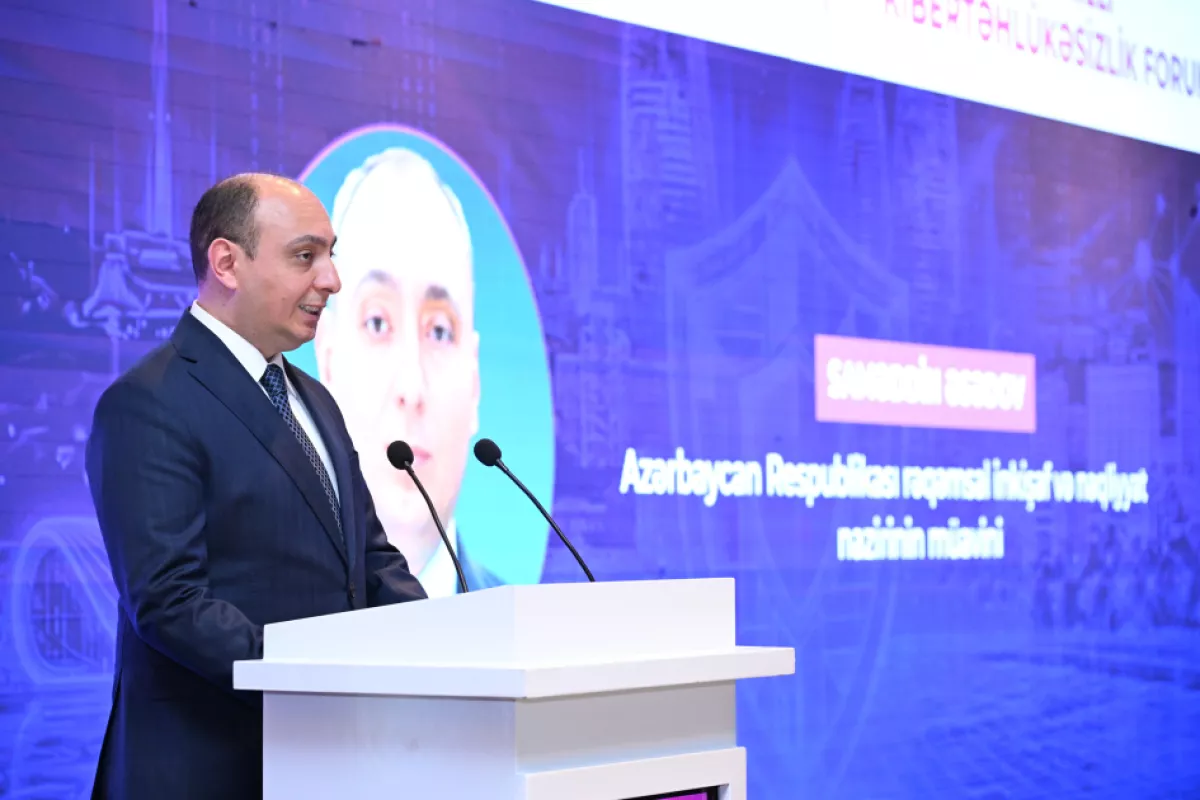
According to Deputy Minister of Digital Development and Transport Samaddin Asadov, speaking at the IV National Cybersecurity Forum, the development of electronic payments, cloud technologies, and artificial intelligence makes life easier, but at the same time creates new risks. He also emphasised that cyberattacks are not only aimed at individual systems but also at critical infrastructure, economic processes, and public stability. For this reason, cybersecurity today is one of the strategic priorities worldwide.
According to him, over the past six months alone, around two thousand resources distributing malicious content have been neutralised in the country. During the reporting period, approximately 200 large-scale DDoS attacks were also prevented, more than 1.5 million cases of data leakage were identified, and the activity of 160,000 botnet networks was disrupted. Overall, in recent years, numerous phishing attacks targeting the banking, corporate, and private sectors have been recorded. At the same time, DDoS attacks—including those against media websites and government portals—are observed almost weekly.

All of this is not surprising, as cyber threats increase proportionally in countries with high network traffic and a developed digital environment. This is especially characteristic of the Azerbaijani state, which in recent years has achieved a high level of broadband internet access, established an extensive e-government system, and launched large-scale digitalisation processes in the financial sector, industry, intermediary business, energy, and transport.
The Deputy Minister also emphasised that at the leadership level, special attention is paid to this area in the country: “The main goal for the coming period is to transform Azerbaijan into one of the leading regional cybersecurity centres, and to this end it is necessary to develop threat analysis and early warning systems, expand the national CERT ecosystem, and promote innovation and AI technologies.”
Asadov particularly noted that, in order to ensure data exchange in the field of cybersecurity at the state level and protect the information space from modern threats and cyberattacks, a Unified Cybersecurity Platform has been created, to which more than 70 organisations are connected.

In turn, on the basis of the abolished “Electronic Security Service,” the “National Cybersecurity Agency” was recently established (under the Ministry of Digital Development and Transport). The new body will carry out coordination, regulation, and monitoring in this field, ensure the resilience of the information infrastructure, and provide warnings about cyber threats.
The agency’s responsibilities also include implementing measures against the placement of information on online resources whose distribution is prohibited by law, as well as activities in the field of personal data protection. At the request of data owners and operators, the structure will conduct audits of the collection, processing, and protection of personal data for compliance with regulatory requirements. Another area of its work will be countering the activities of foreign online bookmakers, organisers of gambling, and suppressing illegal foreign online lotteries and betting services operating within the country.
At the 4th National Cybersecurity Forum, issues related to the impact of the rapidly evolving artificial intelligence system on cybersecurity were also examined. In particular, the Deputy Head of the State Service for Special Communications and Information Security of Azerbaijan, Allahveran Ismayilov, recalled that, according to recent reports by the World Economic Forum, AI technologies are among the key factors that will have the greatest impact on the cybersecurity domain in the near future.
In this context, he stressed the need to strengthen systematic and proactive approaches to security, as in many cases today, the pace of technological development is outstripping defensive capabilities. This creates new challenges in the field of information security that require more flexible and adaptive approaches.

The potential of AI technologies and the risks in this field were also discussed at the recent event in Baku titled “The Future of Financial Cybersecurity in the Age of AI.” According to Elnur Eyvazli, Director of the Information Security Department at the Central Bank of Azerbaijan, the transfer of personal data to cloud systems when using artificial intelligence entails certain risks.
“Artificial intelligence significantly simplifies life; however, under no circumstances should personal and confidential data be transferred to AI systems,” he stressed. “Many of the AI services we use are based on cloud computing. If systems are used within organisations (on-premise), this can be controlled to some extent, but transferring personal data to cloud systems may pose serious security risks.”
In order to address potential threats, alongside the development of cybersecurity infrastructure, Azerbaijan is also focusing on training specialised professionals and strengthening human capital in the IT sector. In addition, efforts are being intensified today to improve legislation and develop skilled personnel. According to the Ministry of Digital Development and Transport, within the framework of awareness-raising activities, more than 705 events were held in the first half of the year, and around 48,000 citizens were informed on cybersecurity issues.
To enhance the level of countering cyber threats through the exchange of experience and the implementation of advanced methods of combating cybercrime, the country is consistently cooperating with relevant structures in Türkiye, Israel, the European Union, and the United States. In this regard, Azerbaijan has achieved tangible progress: according to the International Telecommunication Union (ITU) report, the country has risen by 40 positions in the Global Cybersecurity Index in recent years, surpassing a number of leading states worldwide.







 editor@caliber.az
 +994 55 444-88-98
 Азербайджан, Баку, ул. Низами, 203, Af Business House, 5-й этаж