










Shot in the Back: Khalisa and the bloody path of Vazgen Sargsyan Exposé and evidence
The village of Khalisa in Armenia’s Ararat region is today called Noyakert. The name was changed, just as the names of hundreds of Azerbaijani villages across the territory of Armenia were altered. By the end of 1988, not a single Azerbaijani remained in Khalisa. Those who had lived here for generations were expelled within just a few November days in 1988 under threats, beatings, searches, and passports torn to pieces along the road. Among those who led the expulsions, who went from yard to yard with a plastic bag collecting gold and other valuables taken from those being forced out, was a young nationalist named Vazgen Sargsyan — the future “Sparapet,” future Minister of Defence, future national hero of Armenia, after whom the Military Academy of the Ministry of Defence of the Republic of Armenia and one of Yerevan’s major streets are named today.
No — this is not a reconstruction from the Azerbaijani side. It is a retelling of an eyewitness testimony — an Armenian woman, an active participant in the so-called “Karabakh movement,” the sister of the commander of one of the first nationalist detachments, who personally knew Sargsyan and his circle.
Svetlana Markaryan set everything out in her book “Krakots tikunkits” — “Shot in the Back.” The book was published in Armenian, remained in obscurity for years, and entered the wider Russian-speaking space thanks to researcher and blogger Albert Isakov, who discovered it, translated it, and published a key excerpt on his YouTube channel with a direct reference to the original.
This turns Markaryan’s text into a public document that Yerevan can no longer ignore or dismiss as an Azerbaijani fabrication. The document exists. It is in Armenian. The author is Armenian.
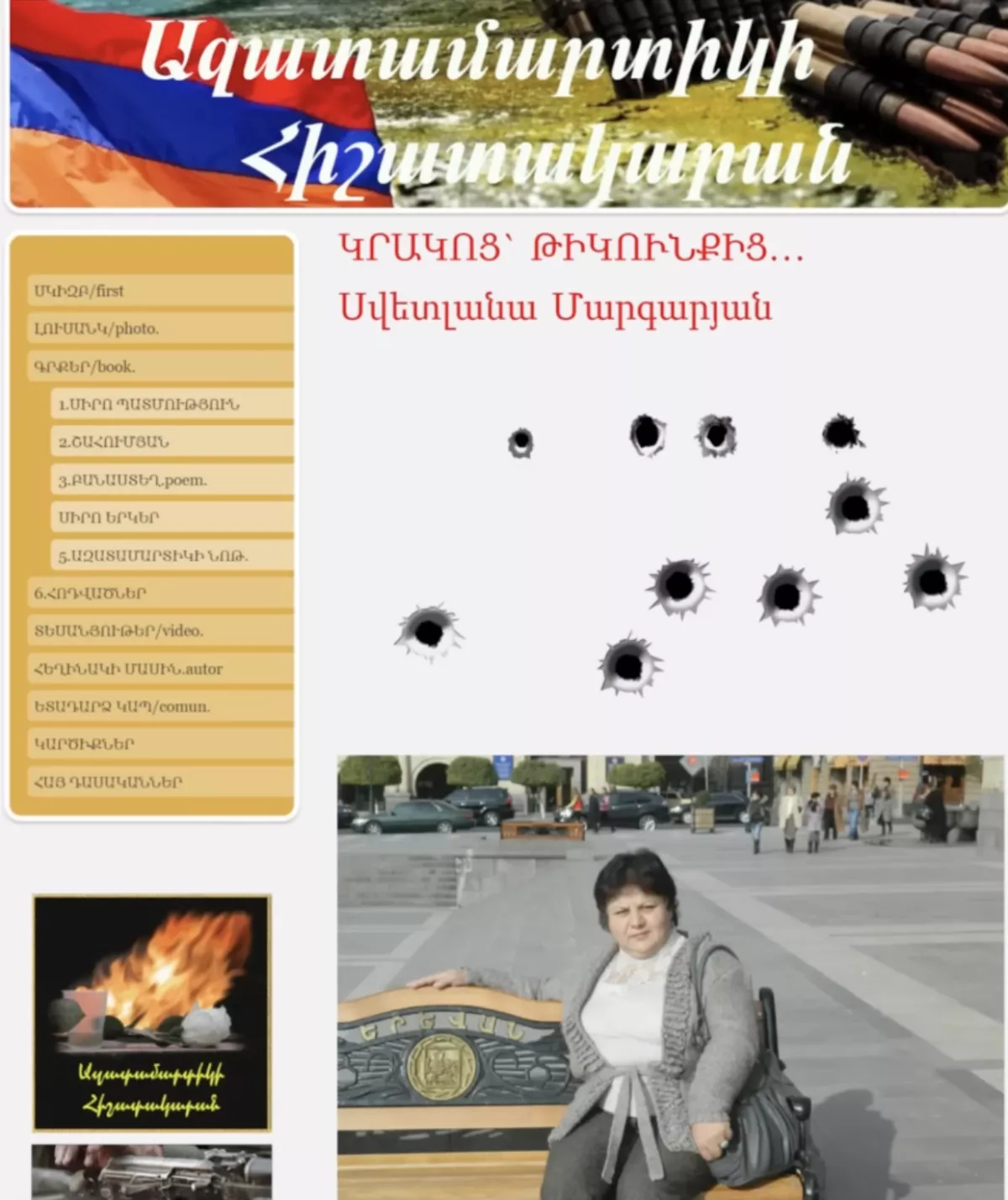
From this simple circumstance unfolds a collapse of a historical narrative that Armenian historiography has been falsifying for almost 40 years.
The core Yerevan thesis about the events of 1988–1989 is built on a symmetrical construct: that Armenians were allegedly killed in pogroms in Sumgayit and Baku, while Azerbaijanis in Armenia “left on their own,” “exchanged homes,” “received compensation,” and “peacefully departed” their villages. This construct is foundational. On it rests the concept of the “sole victimhood,” which in turn underpins the entire Armenian foreign policy position on the Karabakh issue — from the Soviet period to the Washington Declaration of 2025.
If this symmetry is removed, and it is shown that Azerbaijanis were violently expelled from Armenia by the very same people who later became national heroes, then everything collapses. The moral authority of the Armenian side collapses. The very basis for Yerevan’s ability to address Baku in an accusatory tone collapses.
Markaryan’s book shatters this foundation. And it is not an Azerbaijani historian, not a Caliber.Az journalist, and not a Baku-based political analyst speaking on air, who does it. It is a woman who, in 1988, was among the first in Artashat to spread the ideas of “miatsum” (unification).
Markaryan does not write out of any philanthropic sympathy toward Azerbaijanis. She writes out of hatred toward Sargsyan, who imprisoned her relatives, and toward Ter-Petrosyan, who sanctioned it. Her book is an internal Armenian reckoning, and precisely for that reason, her testimony about the events in Khalisa carries absolute credibility. She did not set out to rehabilitate the victims of ethnic cleansing — this emerges in her account as a “side effect” of the main narrative.
The story is as follows. Late autumn 1988, Ararat region. A group of Armenian women from Baku, accommodated in the Artashat theatre, ask for a bus to travel to Azerbaijani-populated villages in a neighbouring district and attempt to arrange home exchanges.
The Azerbaijanis of Khalisa and Shidli are still in their homes, alarmed, and taking night watches. Markaryan travels by bus with thirty Armenian women from Baku to Khalisa, where they are met with suspicion but not hostility. Some of the villagers agree to discuss an exchange. As it gets dark, the driver fears a possible armed attack, and the group departs.
The next morning in Artashat, Markaryan is approached by a member of the local “Karabakh” committee named Geros, who demands that the trips be stopped. A directive attributed to Vazgen Sargsyan is cited, conveyed through an intermediary: the Azerbaijanis of Ararat are “our share,” while those of Artashat should sort out their own matters.
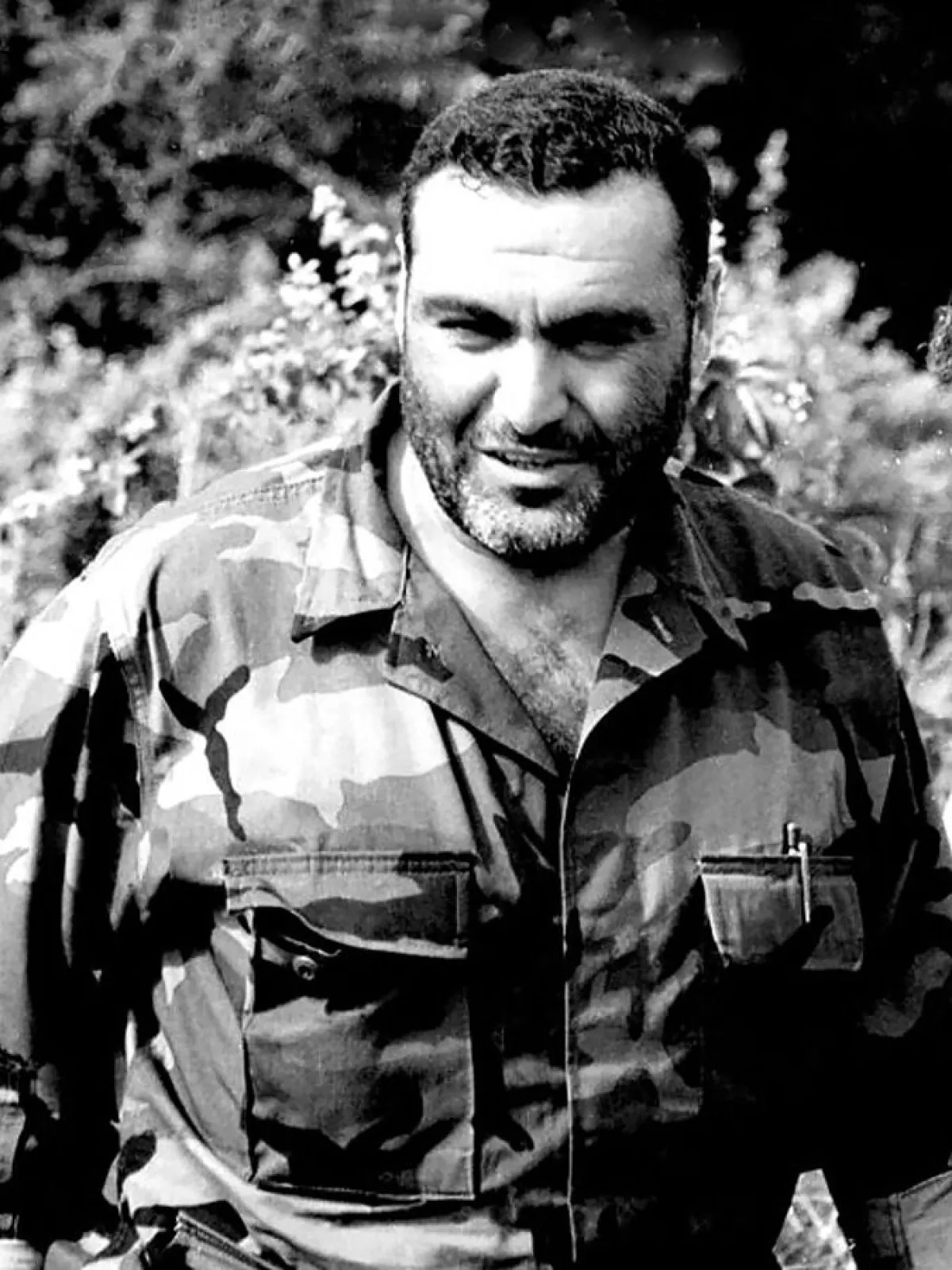
Vazgen Sargsyan
The phrase “our share” is worth pausing on. It sounds like a line from the minutes of a bandit group dividing territory. Not “the issue requires coordination,” not “the exchange process must be organised,” but “our share.” In these two words lies the entire substance of what was happening: an organised operation with the division of districts between groups, allocation of roles, collection points for valuables, and pre-assigned commanders. A division of property and people.
Markaryan, angered, travels to Khalisa again the next day, defying the ban. And she walks into what she describes as hell. The village streets are littered with documents and passports, some of them torn apart. On the road, there is a truck and yellow “Zhiguli” cars. Near the Zhiguli stands Kamo, a disabled man missing one leg, on crutches, watching with rage.
Vazgen Sargsyan is moving quickly through Azerbaijani houses, issuing orders to Armenians who have broken into them. In his hands is a plastic bag into which gold and money taken from Azerbaijanis are being handed over. Reinforcements arrive from Artashat — “colleagues” led by Geros and Sedrak — bringing several women with them to search those already sitting in the back of the truck.
Azerbaijanis are being led out of their homes under blows and forced into the truck bed; those who resist are beaten until they bleed.
In this hell, there are two scenes that would remain before Markaryan’s eyes for the rest of her life, and which transform “Shot in the Back” from a private memoir into a historical document of international significance.
Scene one. An elderly woman, about seventy-five, is being dragged to a truck. She is shouting in Armenian — yes, in Armenian; she speaks it fluently, like the entire older generation of her circle: “I will not leave my home, kill me.” She is forcibly brought to the truck, resisting. Kamo, the disabled man, approaches, raises his crutch, and strikes the elderly woman with full force to the stomach and chest, again and again. Her face is covered in blood. Markaryan’s cousin, a 29-year-old witness to the scene, the next morning falls into a fever and remains bedridden for two months, repeating in delirium: “That old woman won’t leave my eyes. I kept imagining she was my mother.”
Scene two. Three young Azerbaijani women approach Markaryan. One of them — about seventeen to nineteen years old — is in her eighth or ninth month of pregnancy. The other two support her and beg for help to get her safely into the truck: “Sister, sister, she’s pregnant, she is about to give birth.”
Markaryan goes with them to the truck and asks that the pregnant woman not be beaten. From above, two Azerbaijani men try to pull her up by the arms — and suddenly she is grabbed from below by several men and pulled down to the ground under the crowd’s feet. The pregnant woman ends up beneath the stamping, enraged crowd.
When Markaryan turns around, she has already been placed in the truck, with clothes placed under her head; whether she is alive and whether the child is alive, no one knows. An Armenian woman from Baku standing nearby whispers: “If she didn’t die, she surely will.”
This is Khalisa, November 1988. This is what Armenian historical literature describes as the “exodus of Azerbaijanis from Armenia.” It is the foundation upon which later “heroic biographies” of the “national liberation struggle” were built.
And precisely for that reason, the figure of Vazgen Sargsyan — moving through this scene with a bag for valuables — is presented not as a biographical episode, but as a structural feature of the entire Armenian nationalist project of the late 1980s and early 1990s. The “Sparapet,” military commander, Minister of Defence, whose portraits hang in the offices of the Yerevan General Staff, is portrayed here not as a “defender of the homeland,” but as someone who began as an organiser of raids on Azerbaijani villages and a collector of seized gold. According to this narrative, this was known to everyone around him at the time.
Markaryan claims she herself was aware of it. In the ninth chapter of her book, there is an episode which, if it were brought before an international court, would have closed any political path for Sargsyan.
April 1990, a crowd is ascending to the Tsitsernakaberd memorial to honour the victims of the 1915 events. In the crowd, Markaryan calls out to Sargsyan. He is agitated and angry. He asks her whether it is true that she told members of her brother’s unit about the money brought from Khalisa. Markaryan replies yes, because they had asked for funds for weapons and were “fighting a common enemy.”
Sargsyan responds that “not a single kopeck from this money can be given to anyone, because we obtained it at the cost of our lives and it is ours.” He further states that 60,000 roubles from the same funds taken from Azerbaijanis in Ararat have already been transferred to the local police chief to “settle the case.”
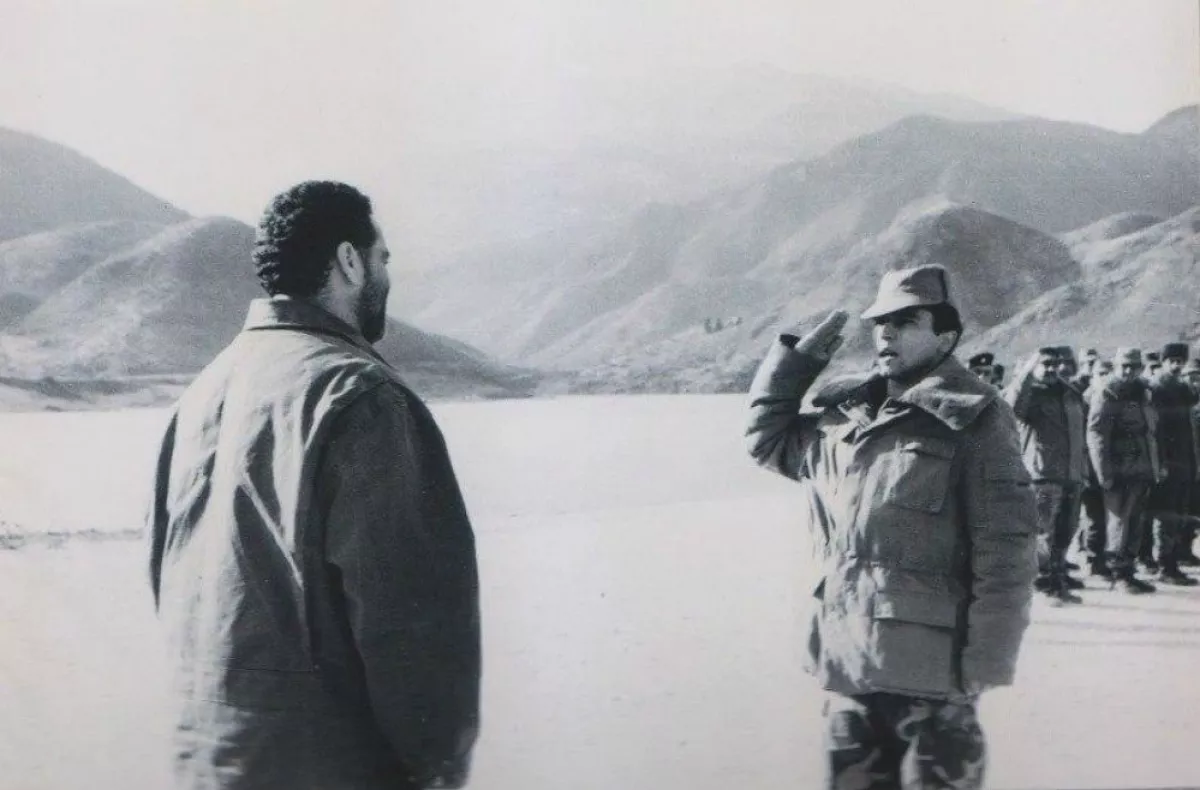
Mikael Arzumanyan salutes Vazgen Sargsyan
There is another detail in the book that deserves special attention. Markaryan, describing that November, casually drops the remark: “After all the terrible pogroms and barbarity, not a single Azerbaijani had even had his nose broken.” She writes this literally two pages before describing Khalisa, where an elderly woman’s ribs are broken with a crutch and a pregnant woman is thrown under the feet of a mob.
This is not a contradiction in the author’s logic — it is a structure of the Armenian nationalist movement’s self-awareness of that era. The expulsion of two hundred thousand Azerbaijanis from Armenia is simply not perceived as an event requiring moral acknowledgement. The fact that in Gugark in November 1988, twenty Azerbaijanis were killed — according to Armenian official data themselves — is not even mentioned by Markaryan. It lies beyond her moral field of vision.
And this is perhaps the most terrifying thing in her book: the author is not lying; she is sincerely incapable of considering what she describes as something that should disturb her sleep.
Direct lines from the Khalisa episode extend into the political biography of modern Armenia. The unit of Samvel Markaryan, Svetlana’s brother, was disbanded in the spring of 1990 and became the basis of the “Army of Independence” — a structure that was being formed at the time by Movses Gorgisyan and Ashot Navasardyan, who had just been released from prison. From the same unit, on April 2, 1990, the Republican Party of Armenia was created — the same party that ideologically inherited the ideas of Garegin Nzhdeh and his Tseghakron racial doctrine, and which later governed the country for ten years through Serzh Sargsyan, remaining one of Armenia’s leading political forces today.
The money taken in Khalisa largely went into the fund of this movement. Part was used to purchase weapons in Russia, part to maintain armed fighters, and part, according to Markaryan herself, ended up in the hands of committees: “not a single penny served its true purpose. It was appropriated by members of the committees, who at that very moment laid the foundations for the future deception and plundering of the country.”
This would mean that the Karabakh War was financed, among other sources, by funds taken from displaced Azerbaijani families. The looting of 1988 was converted into arms purchases in 1990–1991 and into military operations in 1992–1994. Vazgen Sargsyan did not “go from activist to minister.” He first plundered Azerbaijani villages, then used that money to buy weapons, then fought in Karabakh with those weapons, and later received a ministerial post for what he had previously done.
And this is equally the biography of Robert Kocharyan, Serzh Sargsyan, Ashot Navasardyan, Movses Gorgisyan, Monte Melkonyan, and the entire pantheon of Armenian “heroes.” Some of them were not personally present in Khalisa, but all belonged to the same network. Those who do not remember these names can simply look at the map of Yerevan and read the plaques: Vazgen Sargsyan Military Academy, Vazgen Sargsyan Park, Vazgen Sargsyan Street — one of the central streets in Yerevan. He is buried at Yerablur with full state honours as a national hero.
The Republican Party of Armenia, founded by his circle, remains a systemic political force. And Kocharyan is seeking a return to big politics.
From all of this follows a simple and heavy conclusion. Modern Armenian statehood has not broken with the genealogy of ethnic cleansing — it institutionally continues to commemorate it. This is not an aberration or a leftover that will soon be corrected. It is a structural feature of political consciousness.
No official state apology has been made to the Azerbaijani people for the expulsion of more than two hundred thousand people from Armenia in 1988–1991. No criminal cases have been opened for the events described in Markaryan’s book, and none will be opened. No restitution, no recognition, no work of memory.
On the website of Armenia’s Ministry of Defence, the page dedicated to the “Sparapet” remains silent about Khalisa. And that page is read by cadets of the Military Academy named after him.
Between the village of Khalisa in the autumn of 1988 and any present-day statement from Yerevan about a “peace agenda” lies an unacknowledged mass of victims. Svetlana Markaryan wrote her book because she could not remain silent about how Sargsyan imprisoned her brother. She had personal motives — a private case against a specific man.
But as long as official Yerevan remains silent, others will speak on behalf of the pregnant seventeen-year-old Azerbaijani girl who fell under the feet of a mob on the main street of Khalisa, and the seventy-five-year-old woman beaten to death with a disabled man’s crutch. Those who remember… We remember!







 editor@caliber.az
 +994 55 444-88-98
 Азербайджан, Баку, ул. Низами, 203, Af Business House, 5-й этаж