










Caspian transit: expanding Azerbaijan–Central Asia logistics axis Overview by Khazar Akhundov
Amid escalating geopolitical tensions in Eastern Europe and the Middle East, interest in the Middle Corridor has grown significantly. This shift has prompted Caspian littoral states to accelerate transport infrastructure development, modernise port facilities, and expand their cargo fleets. Alongside oil shipments, trans-Caspian non-oil transit is becoming a key pillar of Azerbaijan’s economic ties with Central Asian countries, particularly in cooperation with Turkmenistan.
Baku and Ashgabat are steadily increasing fleet capacity to boost cargo turnover. A recent milestone in this process was the arrival at Alat Port of the cargo vessel Gadamly, built in Turkmenistan to order for CJSC “Azerbaijan Railways”.
“Today we are witnessing an important event in the development of transport and logistics cooperation in the Caspian region: the first cargo vessel built in Turkmenistan, Gadamly, will be used for container transportation between the ports of Baku and Turkmenbashi. This event is not only an addition of a new vessel to maritime lines, but also a significant contribution to the development of the Middle Corridor as a whole,” said Arif Aghayev, Deputy Chairman of CJSC “Azerbaijan Railways” (ADY), speaking at the official ceremony of the vessel’s reception.
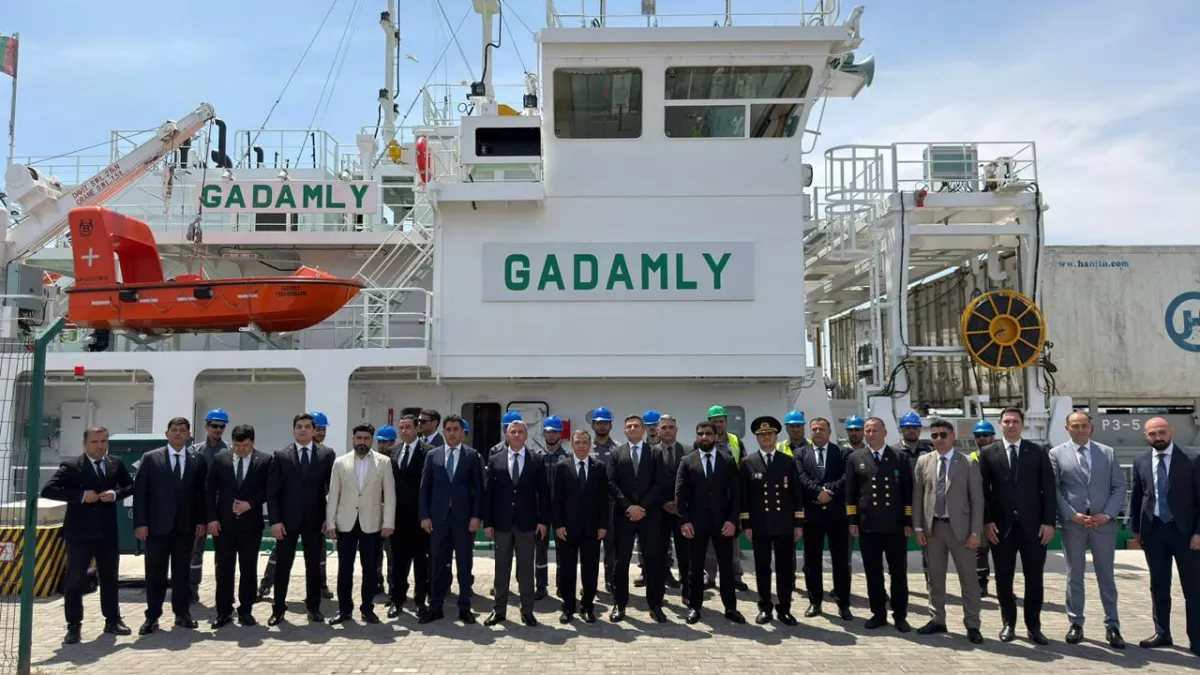
The Gadamly dry cargo vessel, with a carrying capacity of 6,100 tonnes, is capable of transporting 240 standard 20-foot containers (TEU). The ship was built at the Balkan Shipbuilding and Repair Yard, located near the Turkmenbashi port, to the order of CJSC “Azerbaijan Railways” (ADY). The vessel is equipped with modern navigation systems, engines, and high-tech equipment, and has a crew of 14.
The ship was launched at the end of last year, and after outfitting and completion of commissioning works, a ceremonial launch into its maiden voyage in the Caspian Sea took place on May 8 this year, attended by the President of Turkmenistan, Serdar Berdimuhamedow.
As the Deputy Chairman of ADY noted, cargo volumes along the Middle Corridor are growing rapidly, and the commissioning of the new dry cargo vessel will have a positive impact on the annual freight handling indicators at the Baku International Sea Trade Port (BISTP).
Aghayev also said that construction of a second vessel for regular container transportation between the ports of Baku and Turkmenbashi is ongoing: “I believe this will be completed by the end of autumn 2026. The carrying capacity of both vessels will be 240 TEU.”
The expansion of fleets with new dry cargo vessels is an important trend in cooperation between Central Asian countries and Azerbaijan, which are actively developing the land–sea Trans-Caspian International Transport Route (TITR). Thus, at the beginning of May, the “Baku Shipyard” (BSY) and the Kazakh company KTZ Express Shipping signed an agreement to construct two dry cargo vessels with a container capacity of 537 TEU each at the BSY shipyard.
In turn, landlocked Uzbekistan is planning to place orders for the construction of ferries at shipbuilding yards in Azerbaijan and Turkmenistan.
The Trans-Caspian route is becoming an increasingly important corridor for container cargo transshipment between China, Europe, and Türkiye. To optimise these processes, port and railway infrastructure across the Caspian region is being consistently developed. In particular, over the past four years, delivery times along the TITR have decreased from 58–60 days to 15 days, while cargo volumes have increased more than sevenfold—from 600,000 tonnes in 2021 to 4.5 million tonnes in 2025.
This momentum is also evident in Azerbaijan: last year, the Azerbaijan Caspian Shipping Company (ASCO) increased dry cargo handling by 45%, while ferry-based container transshipment more than doubled.
“In 2026, the volume of container transshipment at Baku port is planned to increase by 13,000 TEU compared to last year, reaching 120,000 TEU,” noted Eldar Salahov, Director General of Baku International Sea Trade Port LLC, during the ceremony at the port.
The CEO recalled the recent commissioning of Berth No. 7, where the technical capacity of the pier has been enhanced and a new-generation port crane with a lifting capacity of 125 tonnes has been installed. He emphasised that the new dry cargo vessel and the upgraded berth will further expand the transshipment capabilities of the Alat port.
Notably, the commissioning ceremony of the new vessel clearly reflects the steady expansion of transport and logistics cooperation between Baku and Ashgabat in recent years. Over more than one and a half decades, more than 36 million tonnes of Turkmen oil have been transited to global markets via Azerbaijan through tanker fleets and the Baku–Tbilisi–Ceyhan (BTC) pipeline.
Within a parallel scheme, Turkmen petroleum products and fuel have also been exported to global markets via ferry-rail transshipment through Azerbaijan, including shipments directed to the SOCAR Black Sea terminal in the Georgian port of Kulevi.
Azerbaijan and Turkmenistan also cooperate actively in expanding the transshipment of non-oil cargo along the Middle Corridor, including within transport frameworks such as Lapis Lazuli and CASCA+.
In order to diversify freight transshipment, including container flows, a decision was recently made to redirect part of the TITR traffic to Turkmenistan. Since the beginning of 2023, maritime feeder container services on the “Turkmenbashi – Baku – Turkmenbashi” route have been launched, with the ferries Berkarar and Bagtyyar operating from the port of Turkmenbashi.
In this context, the Lapis Lazuli corridor project, launched seven years ago, is developing a prospective transport vector linking Torghundi in Afghanistan’s Herat province with Ashgabat in Turkmenistan, and further via the Caspian ports of Turkmenbashi and Alat, through Georgia to Türkiye.

A key area for expanding freight transportation is seen in the transshipment of fertilisers and other bulk cargo from Central Asian countries, including Turkmenistan, using the capacity of the Alat port.
It should be recalled that at the end of 2023, a modern fertiliser terminal with an annual handling capacity of 2.5 million tonnes was commissioned at the Baku International Sea Trade Port (BISTP). This is the most powerful specialised terminal on the Caspian Sea, designed to receive bulk cargo arriving from the ports of Aktau and Turkmenbashi, and to handle transshipment of sulphur, urea, and ammonium nitrate fertilisers.
To appreciate the scale of this flow, it should be noted that last year approximately 1.13 million tonnes of fertilisers—urea and sulphur—were transported from Turkmenistan via Azerbaijan (through BISTP and partly the ports of Hovsan and Zira). These figures also include urea shipments from Uzbekistan transiting through the port of Turkmenbashi.
In recent years, Azerbaijani–Turkmen logistics cooperation has also covered joint projects in cargo digitalisation. The two countries have worked to simplify cross-border and customs procedures and reduce tariffs on maritime and railway services, contributing to the growth of multimodal freight transportation, including transit container handling. These objectives are further supported by the accession of Baku and Ashgabat to the UN protocol on electronic consignment notes (e-CMR).
This work is being accelerated, and in February of this year, the heads of the railway authorities of Azerbaijan, Turkmenistan, Uzbekistan, and Georgia signed a protocol covering issues of digitalisation and the development of freight transportation along the Middle Corridor.
The parties emphasised the need to expand digital data exchange to ensure coordinated operations between the railway administrations and international seaports of the two countries, as well as to broaden multimodal transportation.
Among other things, the leadership of Azerbaijan Railways (ADY) and the Government of Turkmenistan recently discussed issues related to the modernisation of infrastructure at the Turkmenbashi International Seaport, dredging works, and increasing cargo throughput through this maritime gateway.







 editor@caliber.az
 +994 55 444-88-98
 Азербайджан, Баку, ул. Низами, 203, Af Business House, 5-й этаж