










Against a free Armenia Deutsche Welle stirs the waters
“In all your questions, I see one interesting red line. Maybe this is just my personal perception, but there is a sense that Armenia, as people are used to seeing it, should not change and should not move forward. I know many people think this way. But Armenia must change. Armenia must not remain a victim.”
The above quote belongs to Armenian National Assembly Speaker Alen Simonyan. It was addressed to DW commentator Konstantin Eggert toward the end of an interview and very accurately reflected the tone with which the latter attempted to conduct the conversation. And although the journalist himself quickly brushed aside this perception, it sounded unconvincing, because any attentive viewer who watched and listened to the discussion from the very first second could hardly avoid agreeing with Simonyan.
It is indeed a highly curious phenomenon. The German state-funded media outlet Deutsche Welle, which positions itself as a beacon of democracy and liberal values, effectively demonstrated a colonial approach in its conversation with an Armenian statesman, subtly advancing the idea that small nations outside Europe are obliged to remain in their places and, through perpetual conflicts with their neighbours, safeguard the peaceful sleep of the Old Continent.
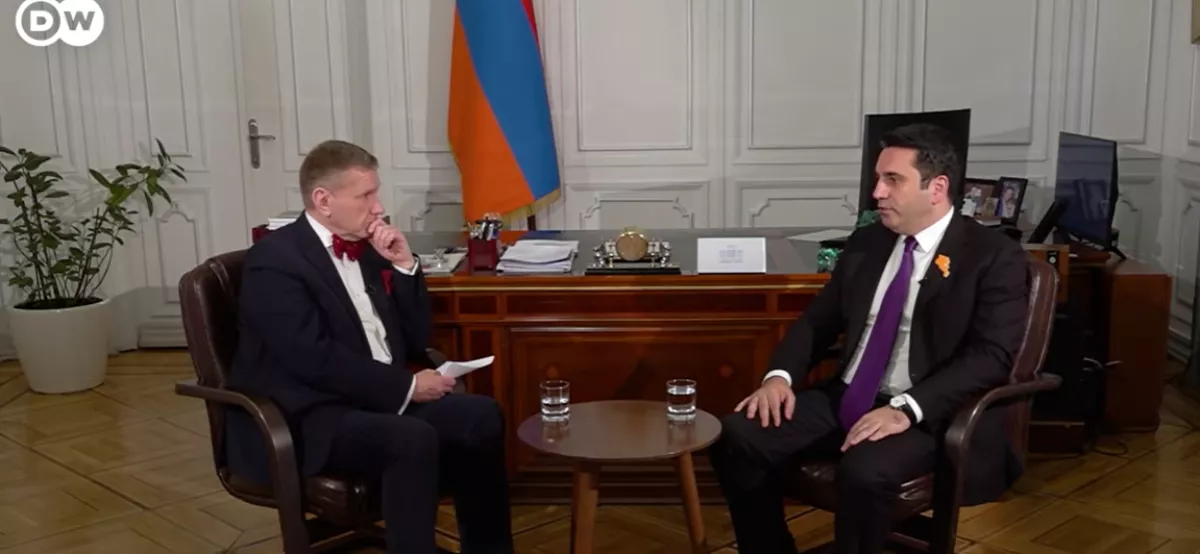
The Russian-speaking DW journalist began the conversation by asking whether Armenia was ready to apply for membership in the European Union. At first glance, this may seem like a perfectly reasonable question, but on closer reflection, one cannot fail to notice its striking rudeness and tactlessness. After all, accession to the EU is a highly complex process, and quite often it is the organisation itself — not the countries seeking membership — that creates the obstacles to joining.
Incidentally, this was precisely the spirit in which Alen Simonyan answered the question. Yet what interests us more in this situation is the attitude displayed by Deutsche Welle. To pose such a question in such a manner means crudely pointing out to an Armenian official the distance separating his country from the European Union, underscoring its dependence on external forces — that very status of “victim” to which Simonyan referred.
However, Simonyan did not allow Konstantin Eggert to indulge in any sense of dominance. Calmly and methodically, he laid out all the factors influencing Armenia’s potential accession to the EU, without so much as a single exclamation or emotional cue suggesting an ardent desire for his country to become part of the European family.
In this context, the part of the conversation devoted to Russia was equally revealing. Clearly inspired by Alen Simonyan’s previous sharp remarks directed at Moscow, the correspondent evidently hoped to extract something provocative for his programme by raising the subject of the notorious Russian “gas blackmail” and Moscow’s barely concealed threats toward Yerevan. One can only imagine his disappointment when, instead, he encountered Simonyan’s cautious and balanced position. The Armenian speaker made it clear that he had no intention of making statements tailored to satisfy a European audience, nor would he allow himself to be portrayed as some eccentric politician constantly searching for opportunities to say something sensational about Russia.
Here are a couple of excerpts from Simonyan’s responses on the Russian issue: “Russia, like any major country, has its own interests”; “I want to understand why Armenia should operate on an all-or-nothing principle and spoil relations with countries with which it has had long-standing ties.”
This was indeed one of the most intriguing parts of the interview. Alen Simonyan effectively acted as a breakwater against the pathos of Emmanuel Macron, who repeatedly declared during his visit to Yerevan that Armenia — once a satellite of Russia — had now made its choice in favour of Europe. On the surface, this may sound like a complimentary statement, yet it carries a distinctly arrogant colonial undertone: Armenia supposedly emerged from under Russian influence only to fall under European influence instead. In effect, the speaker of the Armenian parliament was responding to Macron by making it clear that Armenia is not replacing one suzerain with another, but rather attempting to pursue a sovereign policy of its own.
As for Konstantin Eggert — squinting, legs crossed, seemingly expecting either sarcastic attacks on Russia or complaints about Moscow — he was ultimately forced to swallow this bitter pill in silence.
Yet he did not stop there. Consider, for example, this question posed by Konstantin Eggert: “So, this means the following. From what you’ve just told me, as I now understand it, Artsakh, Nagorno-Karabakh… Armenia should no longer concern itself with this issue, and this is generally something positive for Armenia.”
It should be noted here that Alen Simonyan had not once used the word “Artsakh” prior to this. Yet the journalist, referring to Azerbaijan’s Karabakh region by the separatist designation, effectively revealed his own position — namely, that he questions Azerbaijan’s territorial integrity and sympathises with Armenia’s revanchist forces. Moreover, he was doing so in direct contradiction to Yerevan’s own official position.
But here too, Simonyan firmly put the provocative journalist back in his place.
“Yes, we have declared this many times. It is a trap. A trap for an independent Armenia. A trap designed to ensure that Armenia would never truly be independent. And at the same time, so that Azerbaijan would not be independent either, but would remain under control and serve as a lever. And I believe — not only do I believe this, we have already declared it — that the page of the ‘Nagorno-Karabakh movement’ is closed, and we must not return to this issue again. And this is the only correct path.”

No less provocative were the journalist’s questions about Türkiye. Interestingly, already after the first question (on the prospects for a settlement with Türkiye), Alen Simonyan responded with the very words we placed at the beginning of this article — that in the West there is a desire to see Armenia as an eternal victim. This is not accidental: first, the speaker was already tired by the end of the conversation of the interviewer’s biased tone, and second, he seemed to anticipate the next question on the Turkish theme, which turned out to be even more overtly provocative.
When Simonyan, answering the first question in the spirit that Armenia should remain open to the world, that past problems must be left in the past, and that normalisation with Türkiye is already a settled issue, the journalist replied with a smirk:
“You know, you mentioned the past that should be, so to speak, left to the past. I, maybe about six months ago, spoke with an acquaintance of mine. He is a very senior Turkish diplomat — I won’t name him, but a very senior one. And I asked him about the perception of the events of 1915, the ‘Armenian genocide’, and so on. A person who is well-educated in the European sense immediately switched into a mode of quoting from the relevant textbooks.”
The impropriety of this remark is striking, from whatever angle one looks at it. First of all, when answering the initial question, Alen Simonyan tactfully avoided the topic of the events of 1915, in which, incidentally, all ethnic groups of the Ottoman Empire suffered, including Turks.
And thus, the European journalist’s attempt — by hook or by crook — to introduce this subject appears highly inappropriate, unethical, and morally questionable. It looked like nothing more than a banal provocation, even a veiled warning: “Why have you decided to make peace with the Turks? Did you ask us, the self-appointed arbiters, whether you are allowed to do so?”
It is almost comical, but Konstantin Eggert, with the enthusiasm typical of European neo-converts, also tried to drive a wedge into relations between Armenia and Georgia, lamenting Georgia’s rejection of certain elements of the European integration agenda — such as minority rights and LGBTQ rights — and presenting this rejection as one of the main obstacles to EU membership.
Simonyan parried this move as well:
“First of all, I disagree with you when the first thing you mention is minority rights and LGBTQ rights… I believe that in the case of Georgia, our colleagues from the European Union should continue their work, should talk to Georgia, and discuss all the issues that concern the Georgian side.”
When the host asked whether Armenia’s application for NATO membership was possible, Alen Simonyan responded unequivocally that Armenia should not join military blocs. “I do not want my country to be a bargaining chip for Russia, Brussels, or the United States,” he said, adding: “We should not repeat the mistakes we made in the past.”
When asked what those mistakes were, Simonyan replied: “We lived in the past. We tried to bring the past back. We did not think about the future. Our future was shaped by the stories, the perceptions, and the history of the past. The vision was that this country, these borders, are not permanent, that today is just a transitional moment that will pass in history, and that we would have a chance to reclaim, for example, lands that once belonged to Armenia 100 years ago, a thousand years ago. And in this search for a country, we did not notice how we almost lost the real Armenia with which we gained independence in 1991.”
We will not focus here on Simonyan’s remarks about “history belonging to the past” or “lands that belonged to Armenia a thousand years ago.” What matters is the very fact that the Armenian official once again confirmed that ideas of territorial claims against neighbouring countries must be abandoned once and for all.
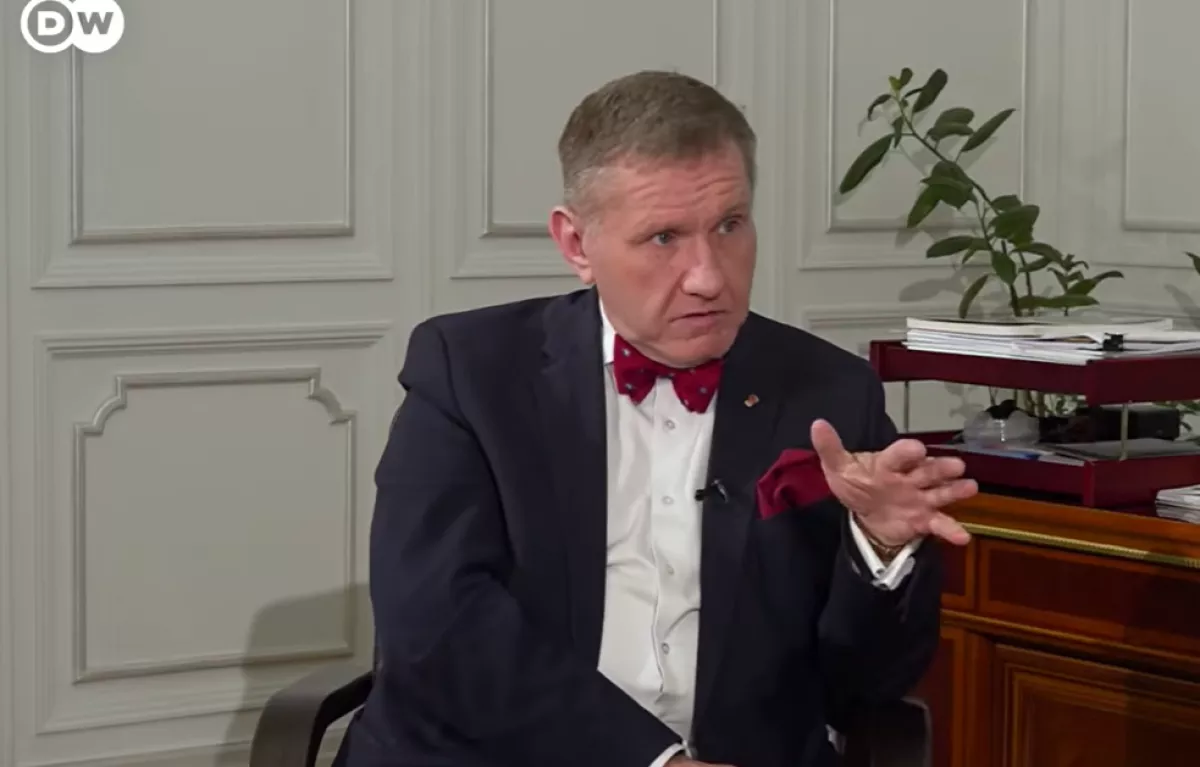
And here, Konstantin Eggert asks the very “Artsakh question” already mentioned above. It is enough to observe the ironic glint in the eyes of the former Russian, and now either Lithuanian or German journalist as he pronounces this remark, as well as his reflections on the difficulties of normalisation with Türkiye, to grasp a simple idea: Turkophobia is a scourge that was imported into Armenians from outside.
Watching him, one can easily imagine European monarchs’ envoys with the same expression “working” Ottoman Armenian subjects, pushing them toward rebellion and betrayal.
In conclusion, it can be stated that throughout the entire interview the DW journalist sought to extract from the Speaker of the Armenian Parliament a discourse portraying Armenia in a conflictual light — regardless of the direction of that conflict, whether Russia, Azerbaijan, Türkiye, or even Georgia. Instead, he received a clear message: Armenia no longer wants to be a puppet in the hands of others, a blind instrument of third powers, or a tool of conflict management by great states. Armenia wants to pursue a sovereign policy and live in peace with its neighbours.
A worthy response. The Speaker of the National Assembly of Armenia, Alen Simonyan, did not fall for cheap tricks or provocations from unscrupulous actors. What remains is to continue following this course, to align actions with these words, and not to succumb to the temptations of third parties who, as before, will continue to try — despite the sprouts of good-neighbourliness — to appeal to base instincts of national exclusivity and hatred toward neighbours.







 editor@caliber.az
 +994 55 444-88-98
 Азербайджан, Баку, ул. Низами, 203, Af Business House, 5-й этаж