










Yerevan after the French showcase Macron acknowledges Baku’s position
The 8th summit of the European Political Community in Yerevan was notable, among other things, for the active participation of French President Emmanuel Macron. This is hardly surprising: first, Macron quite reasonably considers the EPC to be his own brainchild; and second, no less importantly, the forum was held this time in Armenia—a country to which Paris has traditionally extended extensive patronage, and which France, in Macron’s own words, regards as a “big sister.”
Such heightened engagement was also shaped by the broader geopolitical context, which we will address below.
So, the French president behaved in Yerevan with a certain ease—one might even say nonchalantly—though, it must be admitted, not vulgarly. Still, there was a lingering sense of excess, an almost deliberate overabundance. Here he is jogging through the streets of Yerevan; there he is at a panel discussion with European colleagues; then giving a quick interview to journalists; shortly afterwards addressing the French community in Armenia; and finally rounding off the day with a speech at a formal dinner.
The next morning, he speaks at the Yerevan Dialogue Forum, signs a declaration on strategic partnership between France and Armenia with Pashinyan, and then holds a joint press conference with the Armenian prime minister. In between engagements, the distinguished French guest even finds time to enthusiastically perform a song by Aznavour, accompanied by an Armenian pianist and an Armenian drummer—one in whom it is hard not to recognise the Armenian prime minister himself.
By all appearances, the French president was the central figure at the forum. At one point, it even seemed as though everyone else had simply left. Perhaps that was indeed the case, though it is not especially important. What matters is that Yerevan and Paris demonstratively showcased the highest degree of closeness.
And while Pashinyan’s remarks remained fairly neutral towards third parties, Macron’s speeches quite openly pointed to the country with which, in his view, Armenia is no longer aligned—namely, Russia.
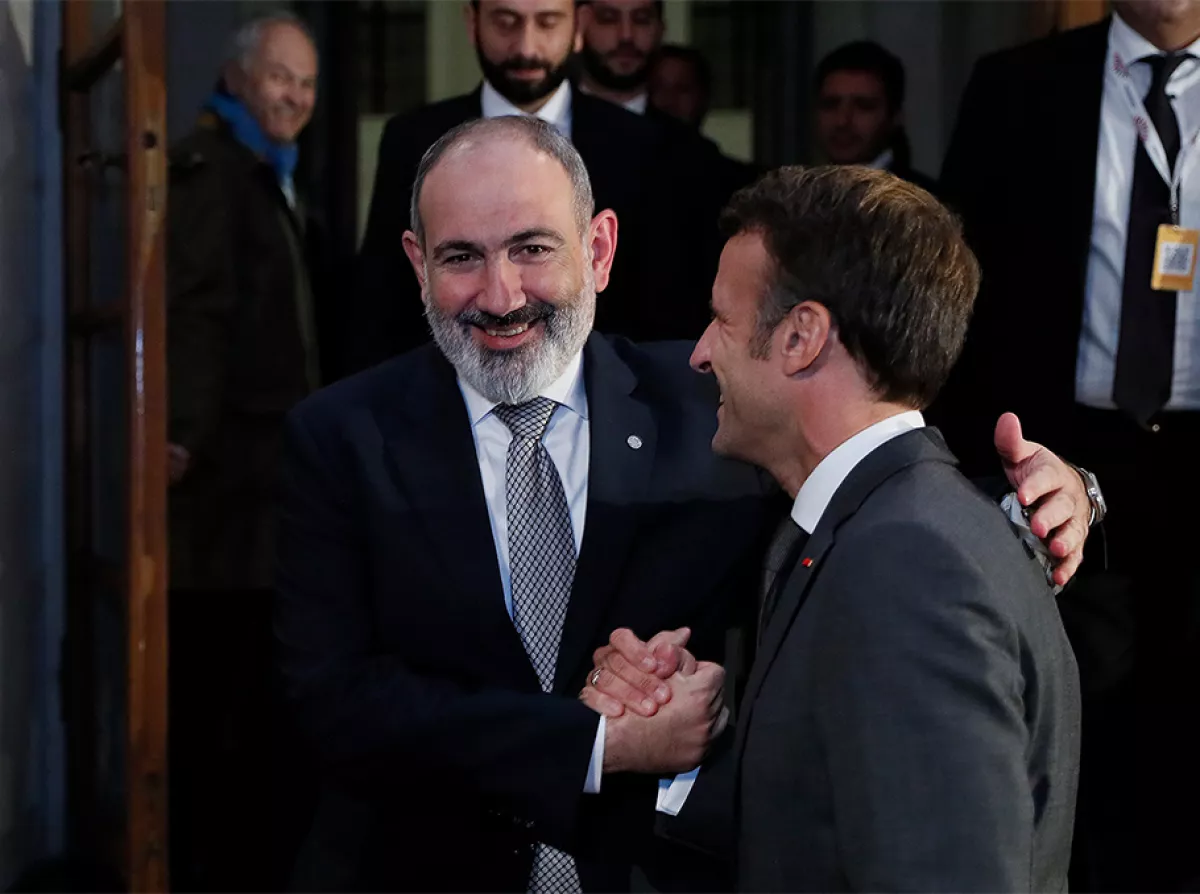
Macron’s remarks consistently focused on the need to strengthen Europe’s strategic autonomy and to eliminate its excessive dependence—above all on the United States, China, and Russia. He repeatedly pointed to Armenia as an example of a country that has made a conscious choice in favour of Europe.
Consider, for instance, this statement: “The work done by Nikol on Armenia is truly impressive. Let’s be honest: eight years ago, the situation was entirely different. Back then, many countries viewed Armenia as a de facto satellite of Russia. Nikol carried out a ‘Velvet Revolution’ and chose to reduce the country’s dependence on Russia. For that, he has faced—and continues to face—pressure. His choice in favour of peace and Europe sends a strong signal.”
Or this one: “For a long time, Armenia was seen as dependent on Russia. But after the ‘Velvet Revolution,’ bold decisions were taken to change that course.”
Or at the very least: “Armenia in the 21st century is a country striving for independence from Russia—for Europe, for peace, and for prosperity.”
Macron became so carried away by Armenia’s drift away from Moscow and towards Europe that he openly acknowledged something official Baku—and, in particular, Azerbaijan’s President Ilham Aliyev—had long been saying: that Armenia had, for a considerable period, not truly functioned as an independent state. “Armenia has not been able to become an independent country for nearly 30 years. It is not independent today either. Armenia is, in fact, a colony,” President Aliyev stated on November 20, 2020 in an address to the nation.
It is also noteworthy that both Pashinyan and Macron, in their remarks—including during the joint dinner—lavished praise on one another, recalling the first EPC summit in Prague and the exceptional significance of the mutual recognition by Armenia and Azerbaijan of each other’s territorial integrity on the basis of the 1991 Alma-Ata Declaration. Pashinyan spoke of Macron’s “firm hand” in guiding him towards those agreements with Ilham Aliyev, while Macron described Pashinyan’s decision as an act of great courage.
It is worth noting here that Azerbaijan required no mediation—least of all from France—to recognise Armenia’s territorial integrity. By contrast, Pashinyan’s recognition of Azerbaijan’s territorial integrity was not an act of goodwill, but the result of Baku’s firm and resolute policy. In this sense, contrary to Macron’s framing, the greater “courage”—or rather, recklessness—on the part of the Armenian prime minister would have been to refuse to recognise Azerbaijan’s sovereignty over Karabakh in the autumn of 2022.
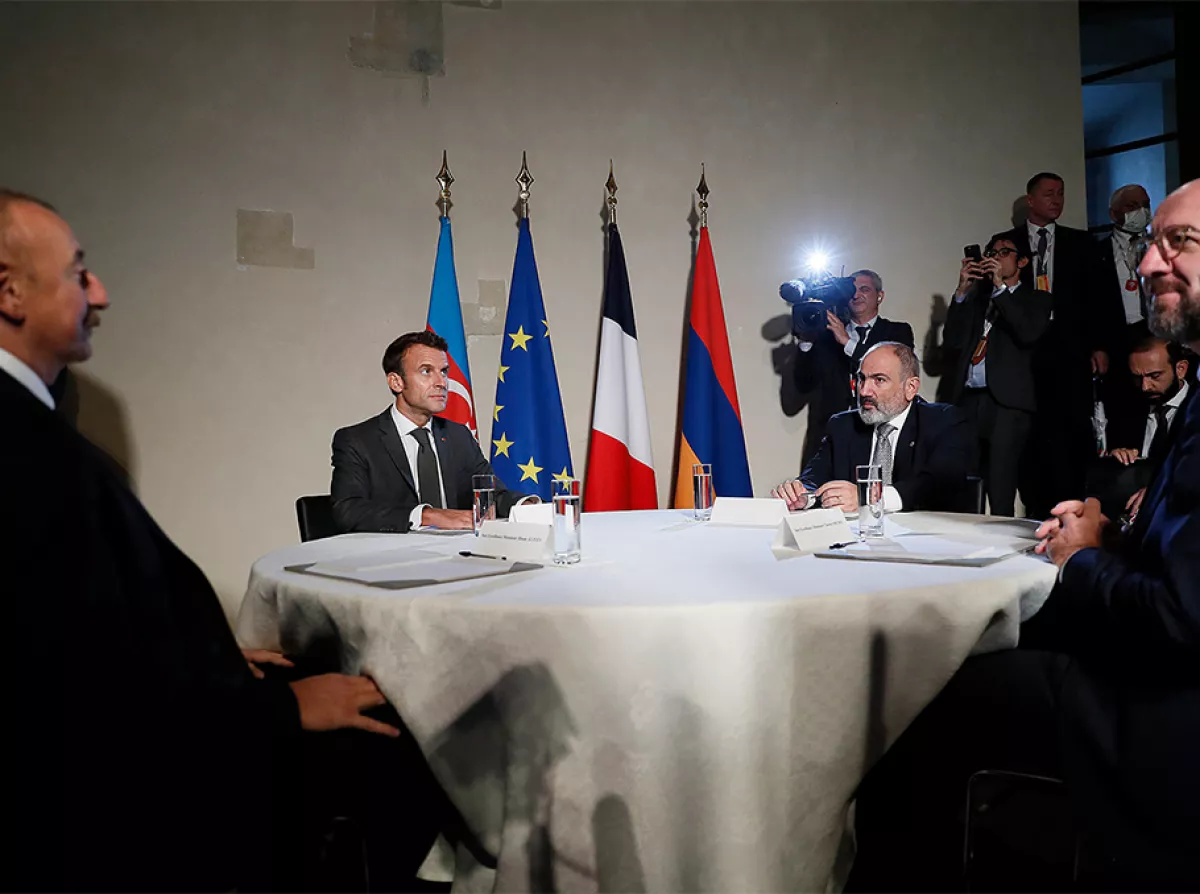
If we turn to the details of that evening in Prague, it is worth recalling that the many hours of negotiations were not without political manoeuvres initiated by France. Even before the meeting began, it was clear that the French side—never having concealed its sympathies for Armenia—would once again attempt to lobby Yerevan’s interests. However, President Aliyev’s firm stance left no room for manoeuvre for the leaders of Armenia and France, and the four-party talks ultimately resulted in the Prague Statement, which became yet another diplomatic success for official Baku.
It is important to note that both Macron and Pashinyan, in their other public appearances in Yerevan, also referred to the Prague agreements as the foundation of the peace process.
Yes, it appears that in European corridors of power—as in Yerevan—it has been understood that the issue of “miatsum” is closed. This does not mean that there will be no further attempts to create friction—this is particularly evident in the European Parliament and in the legislative bodies of certain European countries. However, overall, Europe—at least its executive branch—seems to be opting (perhaps still tactically) for a peaceful South Caucasus, as the region is becoming one of the few remaining bridges connecting the Old Continent with Asia.
The question remains, however: is there anything substantive behind Macron’s speeches in Yerevan, or were they, as is often the case, merely words? The European “celebration” in Yerevan was infused with a strong French flavour—one that risks leaving a rather bitter aftertaste.







 editor@caliber.az
 +994 55 444-88-98
 Азербайджан, Баку, ул. Низами, 203, Af Business House, 5-й этаж