










European Parliament’s games and Trump’s manoeuvres Caliber.Az weekly review
The editorial team of Caliber.Az presents the latest episode of the programme “Events” with Murad Abiyev.
Azerbaijan – Armenia
Azerbaijan is suspending all areas of cooperation with the European Parliament — such a decision has been taken by the Milli Majlis. In addition, the participation of the Azerbaijani parliament in the activities of the EU–Azerbaijan Parliamentary Cooperation Committee is being terminated. Procedures are also being launched to end the Milli Majlis’s membership in the Euronest Parliamentary Assembly.
The basis for these steps is the recently openly hostile initiative of the European Parliament towards Azerbaijan, namely the resolution “Supporting democratic resilience in Armenia.” A part of the document is devoted to baseless accusations against Baku.
This situation highlights a contradiction within the EU itself: some of its institutions, primarily the executive ones, are developing pragmatic cooperation with Azerbaijan, particularly in the fields of energy and logistics, while others — and here we are mainly talking about the legislative branch — are promoting a provocative agenda.
This is explained both by the ideological bias of European lawmakers and by the outright corruption of the most active among them, who are closely linked to the Armenian diaspora and Armenian lobbying groups. Here again, the name of former International Criminal Court prosecutor Luis Moreno Ocampo comes up. After leaving office, this “servant of justice” turned to lobbying activities and, according to his own admission, built a network of contacts within European institutions, including high-level connections. Through this network, attempts are being made to influence political and judicial processes, including decisions of the European Court of Justice, and even to push for a revision of agreements between the EU and Azerbaijan.
At the same time, links can be traced between these mechanisms and actions aimed at influencing domestic political processes in Armenia through the support of various business and diaspora-linked figures.
Thus, European lawmakers, allegedly caught in the grip of the “global Armenian mafia”, are acting not only against Azerbaijan but also against the legitimate authorities in Armenia led by Pashinyan and, more broadly, against peace in the South Caucasus.
However, despite all the obstacles being created, the peace process between Baku and Yerevan continues. During the outgoing week, the first visit of an Azerbaijani delegation to Armenia took place, led by Deputy Prime Minister Shahin Mustafayev, within the framework of the joint border delimitation and demarcation commission.
Earlier, a similar visit to Azerbaijan was carried out by Armenian Deputy Prime Minister Mher Grigoryan. These contacts represent one of the key elements of the normalisation process between the two countries.
United States
“War is over, long live the war” — this is roughly how analysts comment on the news that Donald Trump has notified Congress of the end of the war with Iran. “The hostilities that began on February 28, 2026, have terminated,” the letter sent by Trump to the speakers of both houses of Congress states.
The issue is that on May 1, the 60-day period expired during which the president is allowed to conduct military operations without congressional approval. Trump has already announced that he will not seek authorisation from Congress — and this is also understandable, as such approval is unlikely to follow, despite the Republican majority in both chambers, since many Republicans do not support this war.
Commentators suggest that Trump is following a formal procedure and, by declaring the end of one war, may immediately announce a new one, which would effectively reset the 60-day clock. However, this scenario appears somewhat difficult to implement, as it would not be easy in such a case to justify that these are not one and the same conflict, but two separate wars.
If Trump, in fact, plans to resume military actions against Iran, he would need a relatively long pause or some action by Tehran that could be presented as a pretext for declaring a new war — for example, an attack on Israel or on US regional allies in the Middle East.
The IRGC, which would of course be interested in placing Trump in a difficult position ahead of the midterm elections to Congress, nevertheless has limited incentive to expose the country to another, even more severe strike, the consequences of which are difficult to predict.
It is also interesting to consider how the end of hostilities should be interpreted in the context of the issue of the Strait of Hormuz. How long will the Americans maintain the blockade of Iranian ports? Will this be regarded by Congress as a continuation of hostilities? Possibly yes, rather than no.
On this basis, in my view, there is a high probability that Trump may lift the blockade. And then the most interesting phase will begin. If the Americans lift the embargo, while the Iranians, in turn, continue to block vessels of US allies, Iran will gradually lose its status as a victim in this conflict and acquire the image of a violator of the international order. This, in turn, could later provide Trump with an opportunity to resume military actions.
Thus, Trump is currently taking a tactical pause during which he will issue statements about the successful completion of the operation against Iran and mobilise resources to boost his ratings both within his party and in the country as a whole ahead of the midterm elections.
A rather intriguing detail, by the way — Democrats and a segment of Republicans who have turned against Trump over the war with Iran were seen standing and applauding British King Charles III when he, in his address to them, effectively called on America to enter a war with Russia.
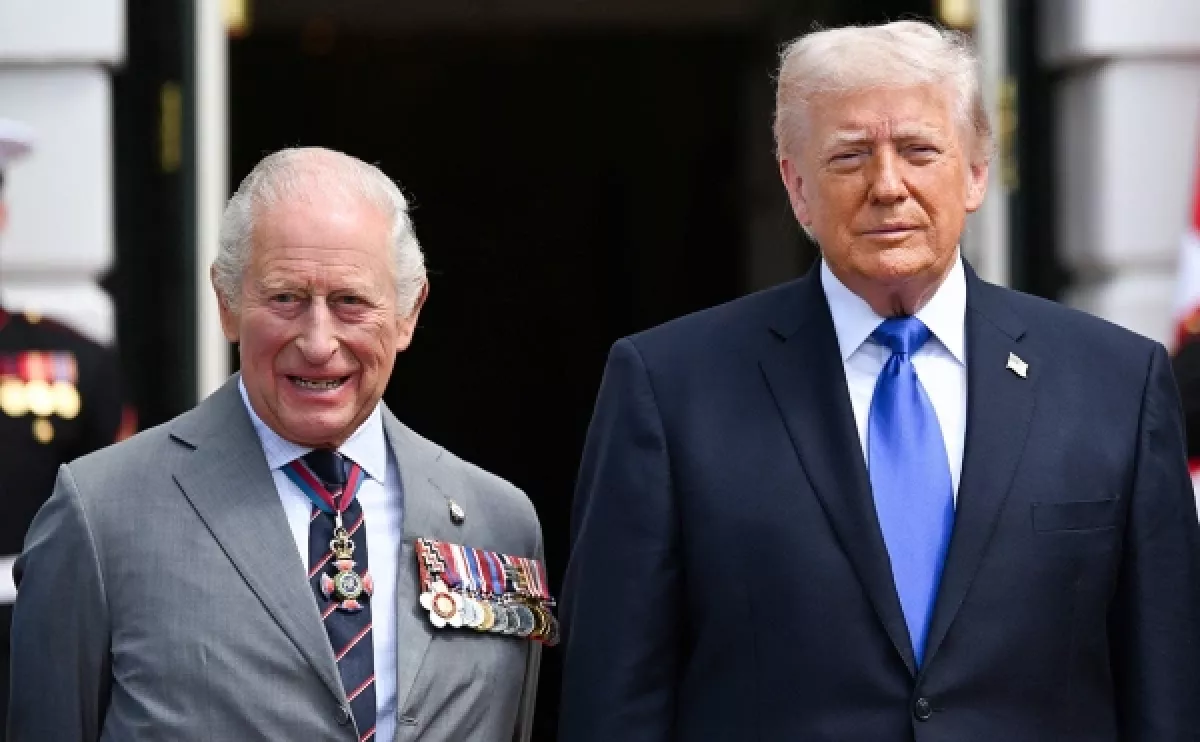
In general, the British monarch’s visit to Washington, and especially his speech in Congress, was marked by a tone of condescending flattery towards the United States and its democratic traditions, with subtle hints that these are, in essence, an extension of British heritage. The King gave the impression of a wise family head who had come to restore order in the household of a somewhat wayward younger brother. The central theme of his remarks was that America should not distance itself from Europe’s problems, but rather defend it from the so-called “Russian threat.”
Trump politely listened to King Charles’s barbs and lectures. However, before the British monarch’s visit had even fully concluded, the White House occupant responded by announcing a possible withdrawal of US troops from Germany. But that was not all — while the King was still in Washington, Trump also held a demonstrative phone call with Vladimir Putin.
From the official statements of both sides, it is difficult to determine what exactly was agreed upon, although it is known that the conversation lasted an hour and a half. Some form of tacit exchange may be taking place regarding Iran and Ukraine. These “services” may not be of a strategic nature, but at the tactical level, they allow both sides to project a message of continued dialogue and a lack of intent to escalate confrontation with one another.







 editor@caliber.az
 +994 55 444-88-98
 Азербайджан, Баку, ул. Низами, 203, Af Business House, 5-й этаж