










Europe’s gas map is shifting toward Azerbaijan Overview by Khazar Akhundov
Europe’s traditional energy partnership with Azerbaijan has been steadily strengthening in recent years, driven by the expansion of the Southern Gas Corridor (SGC) pipeline system. As Azerbaijan increases both production and exports of natural gas, its role in the European energy market continues to grow.
This development is becoming particularly significant amid global supply disruptions, including reduced liquefied natural gas flows from the Persian Gulf due to ongoing geopolitical tensions. According to Gas Infrastructure Europe, gas injection into European underground storage facilities has dropped to its lowest level in 14 years, underscoring growing concerns over energy security.
In this context, greater volumes of Azerbaijani pipeline gas are increasingly viewed as a key component of the European Union’s efforts to stabilise its energy supply. On May 18, in an interview with Euronews, President Ilham Aliyev confirmed plans to expand Azerbaijan’s gas production and further develop the Southern Gas Corridor system.
The ongoing Middle Eastern conflict and the continued blockade of the Strait of Hormuz have resulted in a global energy crisis, and efforts to overcome it are now a key priority for states around the world, particularly European countries.
The gas market of the Old Continent is experiencing a severe crisis due to the suspension of liquefied natural gas (LNG) supplies from Qatar, whose facilities and infrastructure were damaged in attacks by Iranian drones and missiles. Overall, around 25% of LNG supplies to EU countries came from the Gulf region and are now practically unavailable.
The situation has been further aggravated by unusually cold weather in winter, and especially in the spring of this year. As a result, by the end of the winter heating season, gas storage levels in the EU’s underground gas storage (UGS) facilities fell to extremely low levels.
At the same time, according to Gas Infrastructure Europe data as of mid-May 2026, net injections into European storage sites have been at the lowest levels in the past 14 years. Storage filling rates are also being affected by high prices at the Dutch and German gas hubs.
Europe is compensating for the shortfall in pipeline gas by importing relatively expensive LNG from the United States and other regions of the world, with imports showing continuous strong growth since last spring.
Meanwhile, as of mid-May, the spot price for day-ahead delivery at the benchmark Dutch TTF hub rose to $607 per 1,000 cubic meters. By comparison, in April, gas was traded at an average of $547 per 1,000 cubic meters, while before the outbreak of the Gulf War, prices were even lower.
Against this backdrop, demand for more affordable and stable supplies of Azerbaijani natural gas is at its highest in Southern and Eastern European countries. In order to meet the growing demand for Azerbaijani gas, the long-term capacity of the Southern Gas Corridor component — the Trans Adriatic Pipeline (TAP) — is being increased by 1.2 billion cubic meters per year starting from 2026.
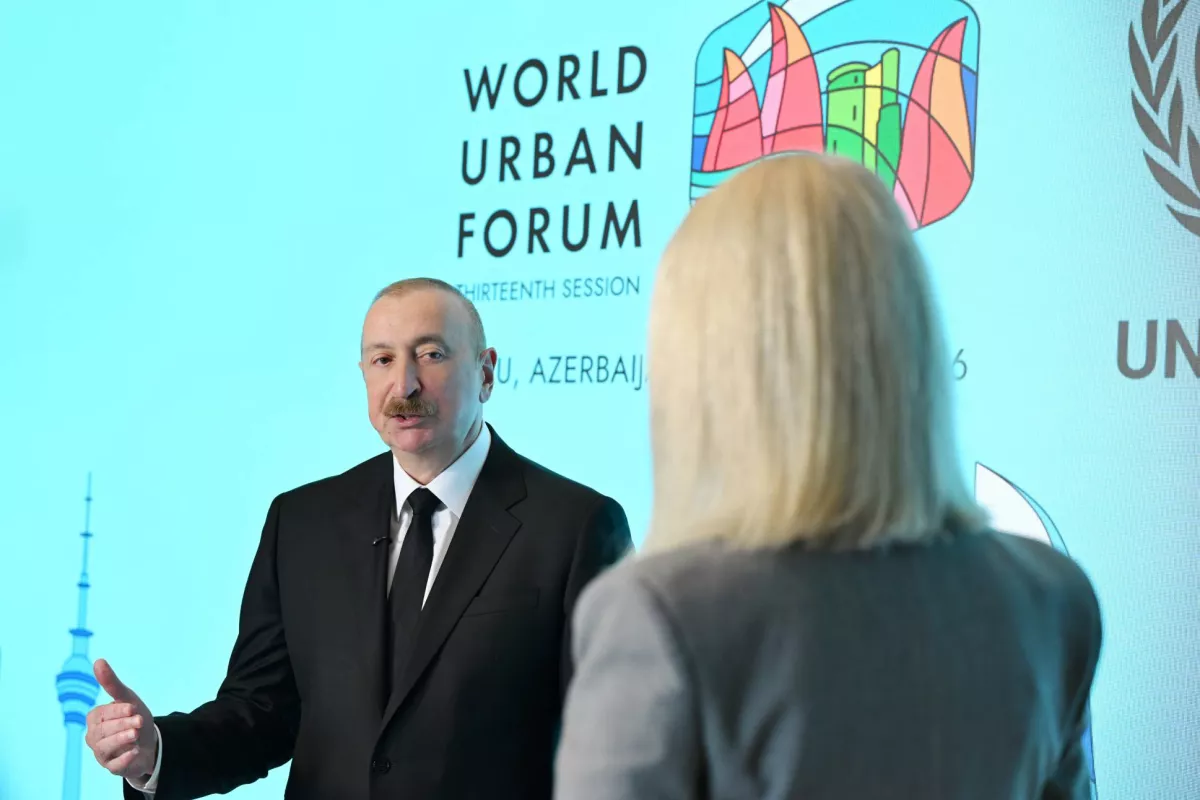
Aspects of Azerbaijan’s gas cooperation with Europe were also highlighted during the ongoing World Urban Forum (WUF13) in Baku, on the sidelines of which President Ilham Aliyev gave an interview to Euronews.
“We started our cooperation on the energy track with Europe some time ago. Especially, it had a ‘speed-up’ process after 2020, when we commissioned the Southern Gas Corridor, which today provides natural gas for 16 countries,” Ilham Aliyev noted. “In terms of the number of countries to which we supply gas via pipelines, we are number one. The number is growing. Ten members of the European Union are our clients. And in total, 12 countries from Europe are recipients of Azerbaijani gas.”
The head of state emphasised that the number of such countries is increasing, as is the number of requests received by Azerbaijan to begin cooperation. The President also noted that the country has properly prepared for the development of pipeline infrastructure, as well as exploration and production, the level of which is growing.
“Very soon, probably in the beginning of next month, we will report about the beginning of gas production from the new field. So it's a win-win situation. We need a premium market, which is Europe. And Europe needs an alternative source of supply, which is Azerbaijan. So we combined our efforts and established a very fruitful cooperation with the European Commission,” the head of state stated in the interview.
Thus, the European direction is seen as the main axis of Azerbaijan’s gas exports for many years ahead. In particular, the number of companies registered for gas transportation through the TAP system has increased from 3 to 46 over recent years.
On the European route, in addition to Italy, Greece, Bulgaria, Romania, Hungary, and Serbia, Azerbaijani gas supplies were established two years ago to Slovenia, Croatia, and Slovakia. Through the Trans-Balkan gas pipeline, pilot deliveries to Ukraine began in July 2025. At the same time, SOCAR is involved in a hybrid gasification project in North Macedonia.
Within this dynamic, the share of natural gas in the country’s total exports amounted to 35.22% last year, compared to 31.66% in 2024, and, judging by current trends, this figure is expected to increase further this year as well.
This growth is supported by the expansion of supply geography, which, from January 2026, includes Austria and Germany, where 1 bcm and 1.5 bcm of gas per year will be supplied, respectively.
Further increases in supplies depend on investment and the expansion of the throughput capacity of pipeline infrastructure toward the aforementioned countries. And, judging by all indications, there is indeed potential for scaling up gas exports: according to the State Customs Committee, in January–April 2026, more than 8.416 billion cubic metres of natural gas were exported from Azerbaijan, which is 3.14% higher compared to the same period last year.
And this is far from the limit, as, taking into account plans to expand the country’s presence in the European energy market, initiatives are being implemented to increase natural gas production. “In the coming years, with respect to the new production of gas from Azerbaijani fields, we may increase the output,” President Ilham Aliyev stated while speaking at the 12th Ministerial Meeting of the Southern Gas Corridor Advisory Council in early March.
At the same time, as the head of state noted, export growth requires the expansion of existing gas transportation infrastructure and interconnector networks, as the Southern Gas Corridor is currently largely operating at full capacity.
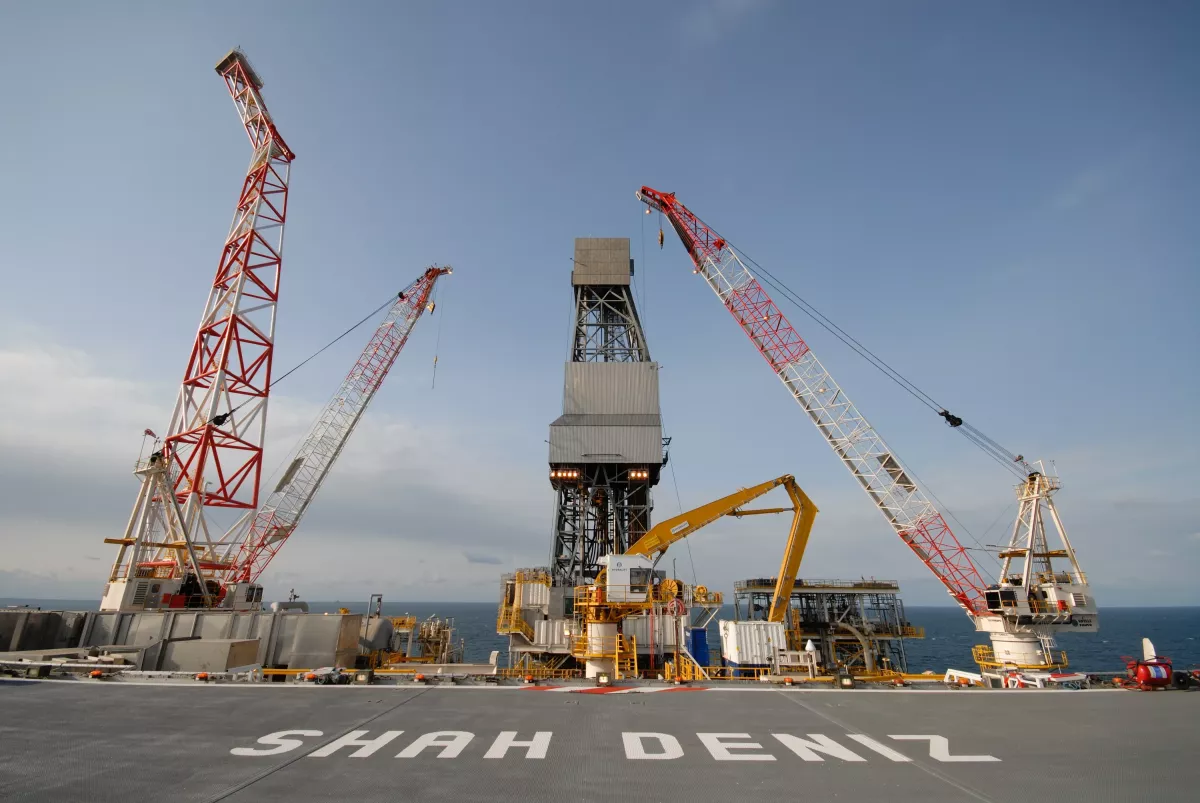
The country’s potential for this is substantial. Thus, gas production (deep gas) from the deepwater part of the Azeri–Chirag–Gunashli (ACG) field is expected to begin around June this year. According to estimates by BP Vice President for Production in Azerbaijan, Georgia, and Türkiye, Stuart Shaw, the reserves of free natural gas amount to approximately 4 trillion cubic feet.
The first production well for free natural gas has been drilled from the West Chirag platform. This well will also provide important appraisal data for determining the next steps in developing ACG’s gas resources.
In turn, full-scale development of the Absheron field is expected to begin within the next two to three years, with a threefold increase in gas production there. It should be noted that the total gas reserves at Absheron—the second-largest gas field in the Caspian Sea after Shah Deniz—are estimated at 350 billion cubic metres.
In addition, gas production is expected to start in the second phase of development of the Umid field. In April this year, Umid-Babek Operating Company completed the first stage of drilling a deep appraisal well at the field.
According to Nobel Upstream, the proven and probable reserves of the Umid field are estimated at around 3.5 trillion cubic feet of gas and approximately 100 million barrels of gas condensate.
In turn, in 2028, the start of production is expected within the next phase of development of the country’s main natural gas source—the Shah Deniz field. In 2029–2030, the construction of the Shah Deniz Compression (SDC) autonomous compression platform project is planned for completion, covering the Shah Deniz Alpha and Shah Deniz Bravo platforms, while the infrastructure of the Sangachal Terminal will also be expanded.
Another promising project in Azerbaijan’s Caspian sector is the development of the Shafag-Asiman gas field. In this regard, planning work is currently underway for future operations, including the drilling of a single well in the Ashaghi Surakhani reservoir.
Speaking in March this year at the Southern Gas Corridor Advisory Council, the President of Azerbaijan noted that the planned production profiles would allow the country, at peak output, to produce an additional 10–15 billion cubic metres of gas.
These additional volumes would cover Azerbaijan’s commitments under the agreement with the European Commission, according to which the country is set to increase natural gas exports to Europe to 20 billion cubic metres per year over the coming years.







 editor@caliber.az
 +994 55 444-88-98
 Азербайджан, Баку, ул. Низами, 203, Af Business House, 5-й этаж