










Turkic integration gains momentum OTS outlines business priorities in Astana
In recent years, member states of the Organization of Turkic States (OTS) have made significant progress in building effective mechanisms of cooperation across political, humanitarian, and economic spheres, increasingly defining the contours of the Turkic world as an emerging geopolitical reality.
Last year, the combined GDP of OTS countries exceeded $2.1 trillion. Today, with the active participation of Azerbaijan, a new architecture of economic cooperation is taking shape—one aimed at strengthening the region’s competitiveness in the global market.
Key trends in the business integration of Turkic states were discussed at a business forum held in Astana on May 13, dedicated to “Economic Integration and Cooperation of the OTS Countries: New Opportunities in Industry, Agriculture, Logistics and Digitalization.”
The foundation on which the regional architecture of the Turkic states is being built is, without a doubt, a solid economic base. In a relatively short period, the countries primarily located in the Caspian–Black Sea region have significantly intensified cooperation in key priority areas, including the energy sector — notably renewable energy sources (RES) — as well as the expansion of trade and transport potential along the Middle Corridor routes.
The efforts of OTS member states have also focused on establishing a preferential trade regime, reducing customs and transportation tariffs, integrating financial systems, and encouraging mutual investment. At the same time, they are advancing joint projects in digital technologies and connectivity.
Another important dimension has been growing business-to-business cooperation, driven by mutual investments and the formation of joint ventures (JVs) across industry, automotive manufacturing, agriculture and agro-processing, as well as tourism and information technology.
The outlined priorities are expected to become key drivers of long-term economic growth across the Turkic states. These objectives are reflected in the “Turkic World Vision 2040” and the OTS Strategy for 2022–2026, both of which are designed to advance the region’s deeper economic integration over the coming years.
Progress toward these goals was highlighted by participants at the OTS business forum held in Astana yesterday. The event was organised by the National Chamber of Entrepreneurs of Kazakhstan, “Atameken,” in cooperation with the International Commerce Chamber of Kazakhstan.
The forum, titled “Economic Integration and Cooperation of the OTS Countries: New Opportunities in Industry, Agriculture, Logistics and Digitalization,” focuses on strengthening business linkages, promoting joint projects, and attracting investment into key sectors of the regional economy.
Speaking at the business forum in Astana, President of the National Confederation of Entrepreneurs of Azerbaijan (NCEA) Mammad Musayev noted that the Turkic world is not only a major regional space but also a rapidly developing economic area that continues to maintain a trajectory of dynamic growth even amid global economic uncertainty.
According to him, alongside discussions of ongoing initiatives, the forum in Kazakhstan is also shaping a long-term economic vision and a shared future for the broader Turkic world.
“By the end of 2025, the combined GDP of the OTS member and observer states exceeded $2.111 trillion, while total trade turnover reached $1.127 trillion,” Musayev said in his speech at the business forum. “The population of OTS countries exceeds 178 million people, which represents enormous economic potential, accounting for 2.8% of global GDP and 3.6% of world trade.”
In 2024, Azerbaijan’s trade turnover with its OTS partners reached nearly $6.9 billion, accounting for 14.5% of the country’s total foreign trade. By the end of last year, this figure had increased further, with total trade turnover with OTS member states rising to $7.3 billion.
At the same time, Azerbaijan’s cumulative investments in the economies of OTS countries are estimated at around $21 billion, with the majority directed toward Türkiye’s economy. In addition, Azerbaijan has established joint investment funds with Uzbekistan, Kazakhstan, and Kyrgyzstan to support the implementation of a range of projects. Financial cooperation through these mechanisms is helping to expand mutual investment in priority sectors, with a clear positive dynamic emerging.
Recently, a decision was taken to increase the capital of the Turkic Investment Fund (TIF) to $600 million. Operational since May 2024, the Fund aims to finance projects in transport infrastructure, energy, sustainable agriculture, and industry. In the future, its resources may also be directed toward industrial development initiatives in the Karabakh region.
In particular, as Kanat Sharlapaev, Chairman of the Union of Turkic Chambers of Commerce and Industry, noted at the forum, the amalgamated territorial communities should not limit themselves to trading raw materials and finished goods, and the time has come to move from trade to industrial cooperation.
“In this regard, it is necessary to focus on several initiatives: first, a unified register of trusted OTS suppliers should be established, which will ensure transparency and speed of transactions within the union,” Sharlapaev believes. “Flagship IT initiatives such as Astana Hub have already proven their viability, but real integration will begin only when a seamless digital environment is created between the Turkic states.
Second, efforts should be made to transform the Middle Corridor from a transit route into a key industrial belt, along which joint ventures, agro-industrial zones, and deep-processing technology centres should be established, so that goods gain added value within the OTS space.”
The third direction, according to the Chairman, should be the acceleration of investments through the Turkic Investment Fund, with priority access to its resources given to innovative projects in the agricultural and industrial sectors.
Sharlapaev also recalled that the Turkic Investment Fund has already begun forming a portfolio of practical projects and is ready, at the initial stage, to allocate up to $20 million for co-financing initiatives within the OTS economic space.
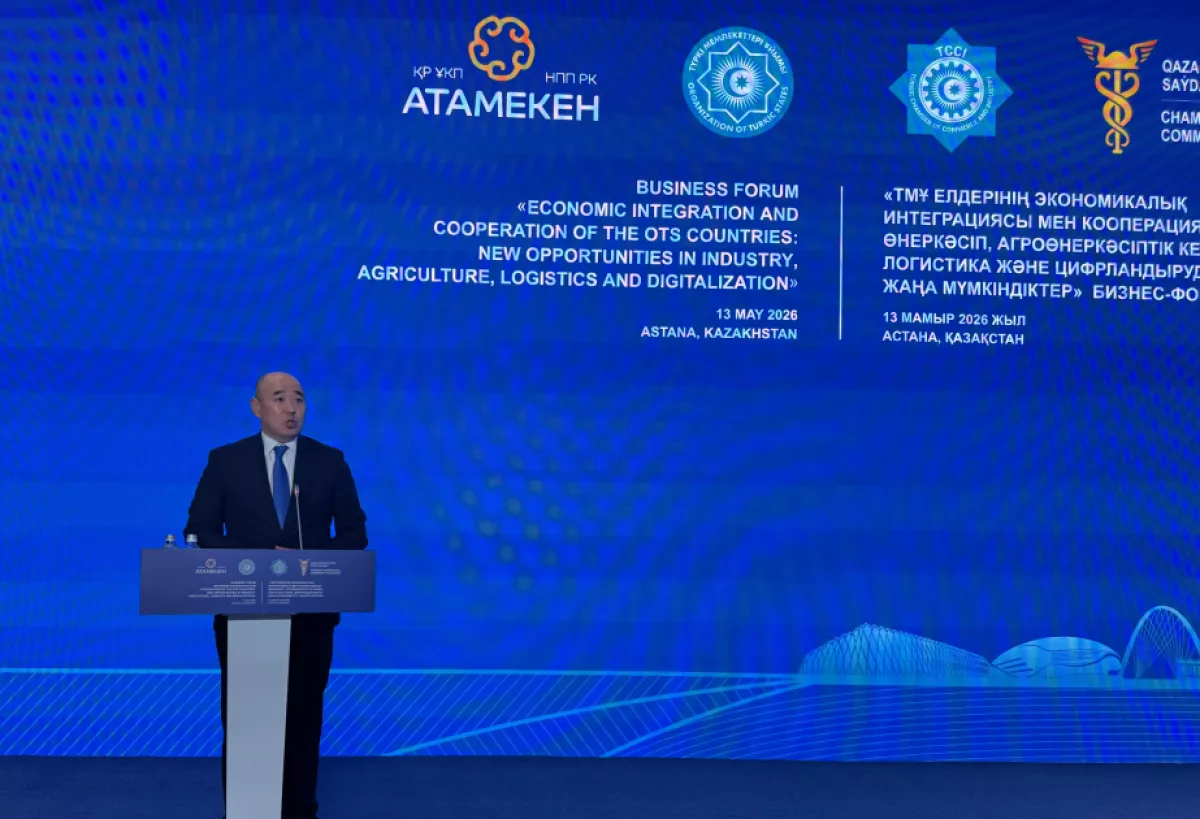
Addressing the Astana forum, President of the National Association of Cooperatives of Kazakhstan, Kazybek Shaikh, said that a new architecture of economic cooperation is emerging in the OTS countries, which should strengthen the region’s competitiveness in the global market.
In this context, he highlighted the importance of developing cooperative mechanisms in agriculture, trade, and other sectors across OTS member states.
“Not long ago, relevant Kazakh structures signed an agreement with the All-China Federation of Supply and Marketing Cooperatives, which provided Kazakh entrepreneurs with free access to trading niches in 341,000 stores. Now there is consideration of extending these conditions to all countries of the Turkic world.”
Moreover, the forum featured a plenary session and panel discussions, as well as B2B meetings between entrepreneurs, along with the signing of bilateral documents.
Among them was a cooperation agreement between the National Chamber of Entrepreneurs of Kazakhstan, Atameken and the Turkic Investment Fund, which provides for expanded investment cooperation and support for joint projects in the region.
A memorandum of cooperation was also signed between the Turkic Chambers of Commerce and Industry Union, the Foreign Trade Chamber of Kazakhstan, and the National Association of Cooperatives and other economic communities.







 editor@caliber.az
 +994 55 444-88-98
 Азербайджан, Баку, ул. Низами, 203, Af Business House, 5-й этаж