










Robert Amsterdam: A retained lawyer behind global political narratives Epstein, Khodorkovsky, and Karapetyan
Since the end of last year, a new figure has appeared in Yerevan — American-Canadian lawyer Robert Amsterdam, hired by Russian-Armenian oligarch Samvel Karapetyan to defend him against criminal prosecution, and who is simultaneously running a public campaign in support of detained hierarchs of the Armenian Church, including Archbishop Bagrat Galstanyan.
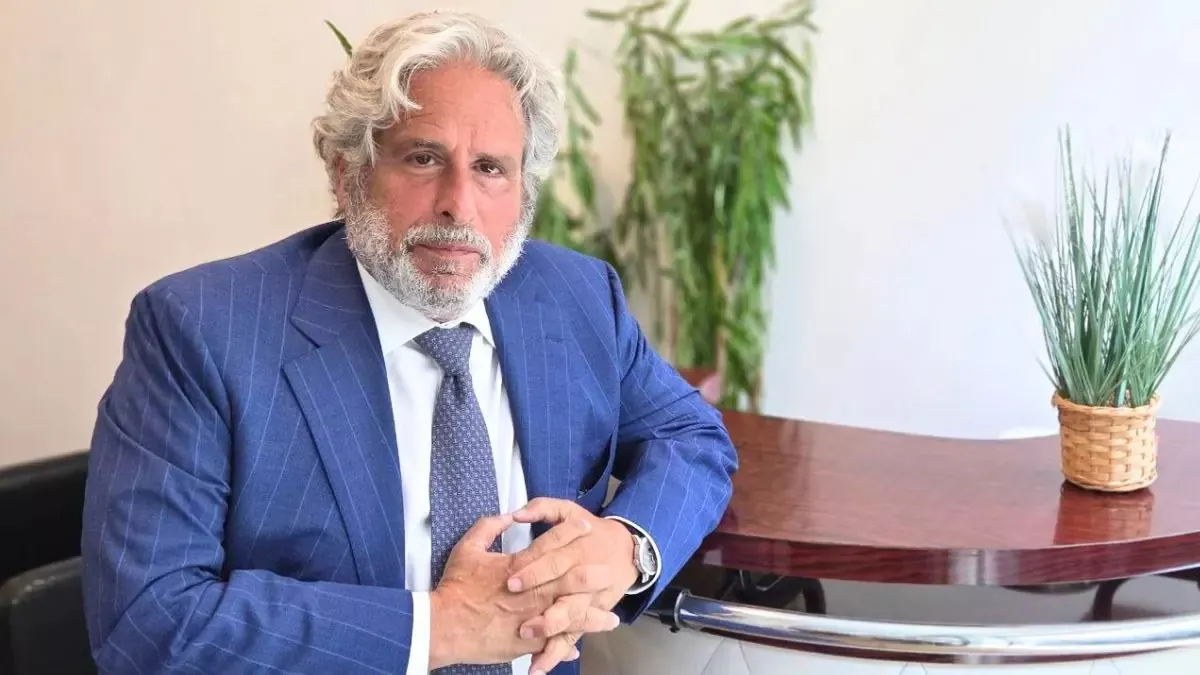
To confirm that he is not merely earning his, or rather Karapetyan’s, bread, Amsterdam meets with Catholicos Garegin II, makes sharp statements against Nikol Pashinyan’s government, accuses the incumbent prime minister of attacking the Church and democracy, demands that international organisations secure the release of “Armenian prisoners held in Baku,” and threatens the Vice Speaker of the Armenian Parliament with a $10 million lawsuit. At the same time, Russian and pro-Armenian media present him as a “prominent Western lawyer who has risen to defend Christian values and violated freedoms.”
However, this “aura” has one, but very significant flaw: it does not align well with Amsterdam’s own professional biography. On April 27, 2016, a letter was sent from the office of Amsterdam & Partners LLP on the eleventh floor of the Homer Building in Washington. The sender was Andrew Durkovic, an employee of the firm co-founded and managed by Amsterdam. The recipient was a certain Jeffrey at jeevacation@gmail.com; Robert Amsterdam himself was copied in. The subject of the email was an Engagement Letter, a retainer agreement.
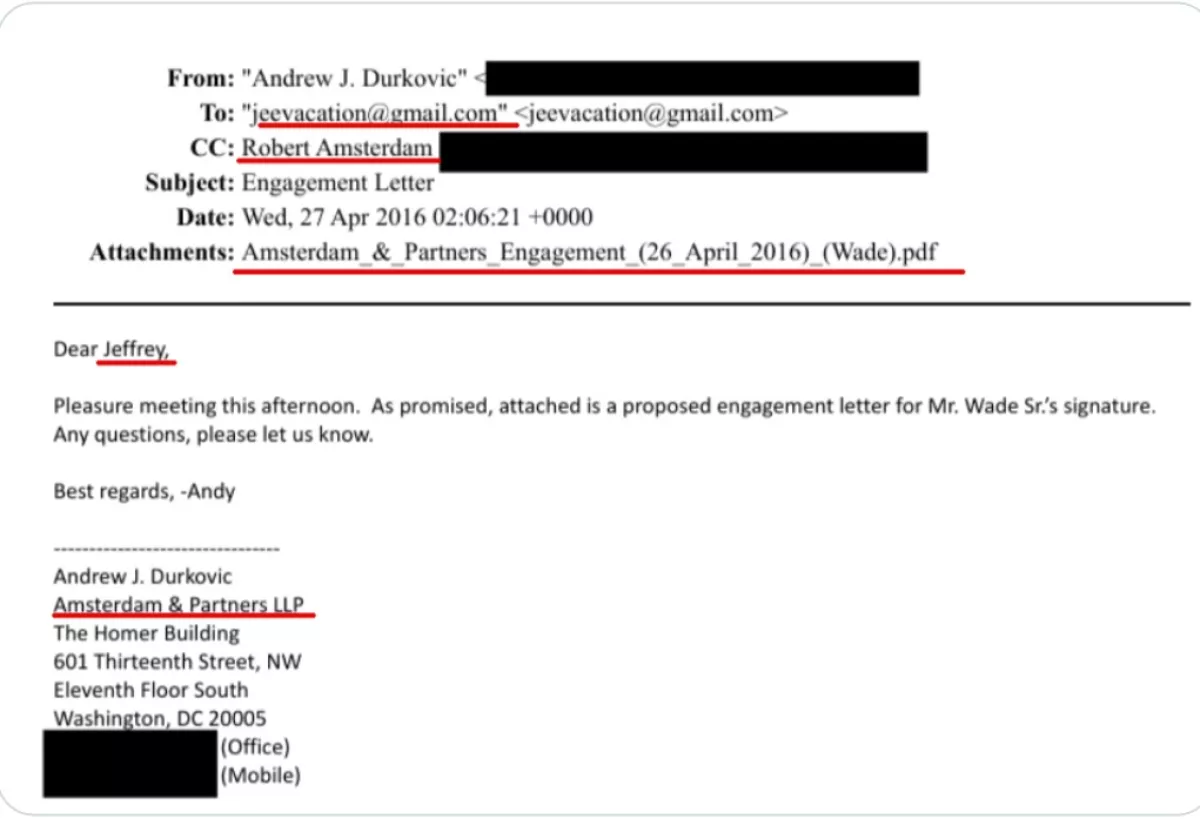
And this message begins with the words “Dear Jeffrey,” noting the pleasure of the afternoon meeting. The document was made public in May 2026 and became part of the public exchange of accusations between Amsterdam and Armenia’s ruling party. In an interview with News.am, the lawyer himself claimed that the attached agreement concerned not Jeffrey Epstein, but Senegalese politician Karim Wade, and that the “Wade” mentioned in the file name referred precisely to the latter, not the former.
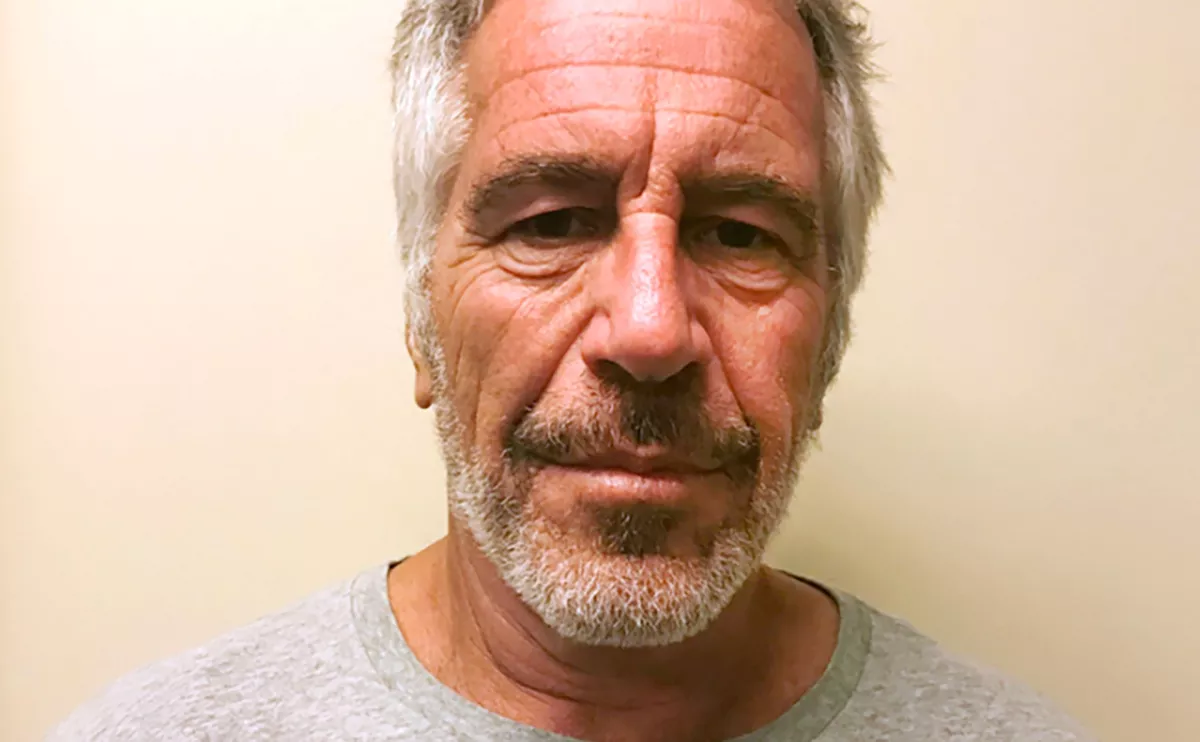
Formally, this is true. However, it leaves out the fact that in April–June 2016, a coordinated lobbying operation was underway surrounding the release of Karim Wade — the son of Senegal’s former president, convicted on corruption charges — and one of the key coordinators of that effort was precisely Jeffrey Epstein. This was later confirmed by emails published by the U.S. Department of Justice and by investigative materials from OCCRP, which mention Larry Summers, Robert Crowe of Nelson Mullins, and several other figures. In June 2016, Wade was pardoned and departed for Qatar; Epstein received letters of gratitude from his contacts; Amsterdam received the fee for the contract signed earlier.
This, of course, does not make Amsterdam Epstein’s lawyer in a technical sense. A letter beginning with “Dear Jeffrey,” accompanied by a retainer agreement, does not in itself prove a contractual relationship with a pimp and paedophile.
In the worst interpretation for Amsterdam, there is only one fact: his firm, in April 2016, became part of the same networked operation that Epstein was involved in, and did so, at the very least, without objecting to the context.
The lawyer himself, in the above-mentioned interview, called the Vice Speaker of the National Assembly, Ruben Rubinyan, who published the letter, a fool and promised to file a lawsuit. This is a predictable rhetorical move. What is less clear is how this aligns with the 18,000 Epstein emails released by Bloomberg in September 2025, in which the Senegal operation is laid out step by step, and in which it is difficult not to notice how closely all the participants were working together.

The Senegalese episode is not an anomaly. It is a recognisable point in Amsterdam’s professional biography. His client list resembles a register of cases in which classical legal defence gave way to international media campaigns. Mikhail Khodorkovsky — the leading Russian oligarch of the 1990s, convicted in the Yukos case, whose name Amsterdam turned into a global brand of a political prisoner — while Western media for years published interviews with Khodorkovsky from prison organised through his legal team, some of which were later contested.
Meanwhile, Khodorkovsky was listed in the flight log of one of Epstein’s aircraft in June 2002 — an overlap to which Amsterdam was not obliged to respond, but which appeared in his client map long before the Senegalese episode.
Thaksin Shinawatra — the Thai prime minister, ousted in a military coup, whose interests Amsterdam has represented before the international public since 2010. Megaupload — the piracy file-sharing empire of Kim Dotcom, dismantled by the U.S. Department of Justice in 2012.
The state of Zambia — in a dispute with investors and the media. The leader of the terrorist organisation FETÖ, Fethullah Gülen, in one of the episodes of his activity directed against the Turkish authorities.
This is an incomplete list of clients, in which the common denominator is not ideology but configuration: each of them, at the time of Amsterdam’s engagement, was under criminal prosecution in their respective jurisdictions and required not a courtroom defence lawyer, but a campaign of external pressure on that jurisdiction.

Amsterdam does not conceal this genre himself. On his firm’s website, it is explicitly described as “human rights advocacy” — a kind of professional honesty. A lawyer of this specialisation does not conduct a case in the traditional sense; he conducts a narrative about the case. His audience is not a judge or a jury, but Western newsrooms, parliamentary committees, and human rights organisations.
The tools of his work are press releases, open letters, speeches before European lawmakers, sharp-formulated tweets, and defamation lawsuits when the former fail to produce the desired effect. It is a lawful and, in some cases, effective way of applying pressure, and in several of the aforementioned cases it has indeed worked.
But this genre has a defining feature that Amsterdam has never denied: in it, clients are not selected on moral grounds, but on budgetary capacity and the political relevance of their case. And within that framework, Karapetyan fits perfectly.
Samvel Karapetyan is a Russian-Armenian oligarch, owner of Electric Networks of Armenia, whose conflict with Pashinyan has led to criminal prosecution on charges he himself describes as political in nature. A parallel case is that of the arrested Archbishop Galstanyan and a group of clerics who found themselves at the centre of an “unarmed war” between the Armenian government and the Armenian Church following the defeat in the Second Nagorno-Karabakh War. At first glance, these two stories are unrelated: business versus the state, and the Church versus the state.
Yet they are united by a single opponent — Nikol Pashinyan’s government — and by a common mode of response: an international media campaign conducted through a Western lawyer with a recognisable name. Karapetyan pays — Amsterdam runs the campaign. The package is accompanied by a set of related public themes: the so-called “prisoners of war,” the defence of Armenian identity, and criticism of the government for “concessions” to Baku. It is a convenient toolkit, simultaneously addressing three audiences — domestic Armenian, diaspora, and human rights constituencies — each of which interprets Amsterdam’s activity in its own way. Internally, it remains a contractual legal service.
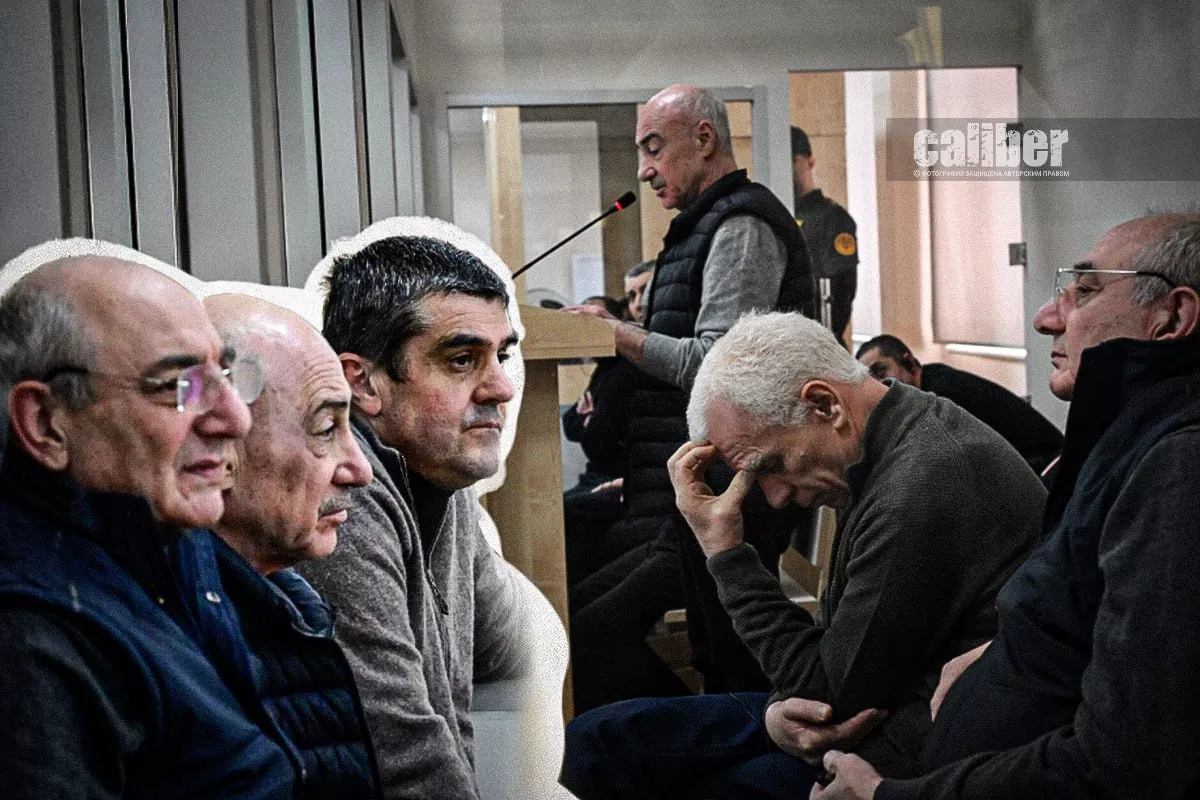
The contract in question also has an Azerbaijani dimension, which Amsterdam develops with particular rhetorical intensity. He describes the “detention” of Armenians — individuals convicted by the Baku Military Court of war crimes — as a “grotesque disregard for the Geneva Conventions,” and calls on European politicians to reconsider relations with Azerbaijan. He links the Karabakh issue with internal Armenian processes against Karapetyan and the Church into a single narrative of threat to the Armenian nation.
This genre requires scale. And scale is created — even if from material for which the term “prisoners of war” is not applicable in an international legal sense, since the individuals in question were convicted by an Azerbaijani court on the basis of evidence and eyewitness testimony regarding their actions, within proceedings that followed all required procedural standards, rather than being captured during active military operations.
This legal nuance tends to disappear in Amsterdam’s campaign, which, in a sense, is unsurprising: his task is not to be precise, but to be loud. There is no personal malice in this — only the professional habit of someone whose income depends precisely on visibility. Amsterdam is a retained lawyer. And as long as the retainer is paid, Amsterdam & Partners will do exactly the job it was hired to do — no more, no less.







 editor@caliber.az
 +994 55 444-88-98
 Азербайджан, Баку, ул. Низами, 203, Af Business House, 5-й этаж