










The South’s new address Baku overtakes Brussels, Paris, and Geneva
The World Urban Forum usually remains in the news cycle as an event focused on social issues — sessions on housing, urban density, and climate adaptation. However, the recently held WUF13 in Baku breaks this familiar pattern. Out of the thirteen forums held since 2002, it became the first where, alongside the main program, an independent civil society platform — the WUF13 NGO Forum — was organised, and where a final framework political document was adopted, initiated not by a UN agency or the host country, but by a network of non-governmental organisations from the Global South. The urban summit thus became a vehicle for the institutionalisation of a platform through which the developing world intends to engage with UN-Habitat, the UN system, and the broader international community.
The permanent headquarters of the Global South NGO Platform — GSNP — has been assigned to the Azerbaijani capital. On the eve of the forum, the organisation’s General Assembly was held there, during which its leadership structure was formally established. Azerbaijan was entrusted with the first-term chairmanship of the organisation, which brings together NGOs from 116 countries. If viewed formally, this decision could easily be dismissed as a gesture of hospitality and the natural advantage of the host country. However, behind it lies a logic that has been taking shape over several years: the chairmanship of the Non-Aligned Movement, COP29, and now WUF13 with its NGO Forum and dedicated platform. Baku has been methodically accumulating institutional functions that were historically concentrated in the capitals of former metropoles — Brussels, London, Paris, as well as Geneva in Switzerland.
GSNP Secretary General Fuad Karimli notes that the main objective of the Platform is to ensure that the voice of the Global South is heard worldwide. According to him, despite limited resources, GSNP has already managed to establish its presence on key international platforms: “The UN has recognised and supported our work.”
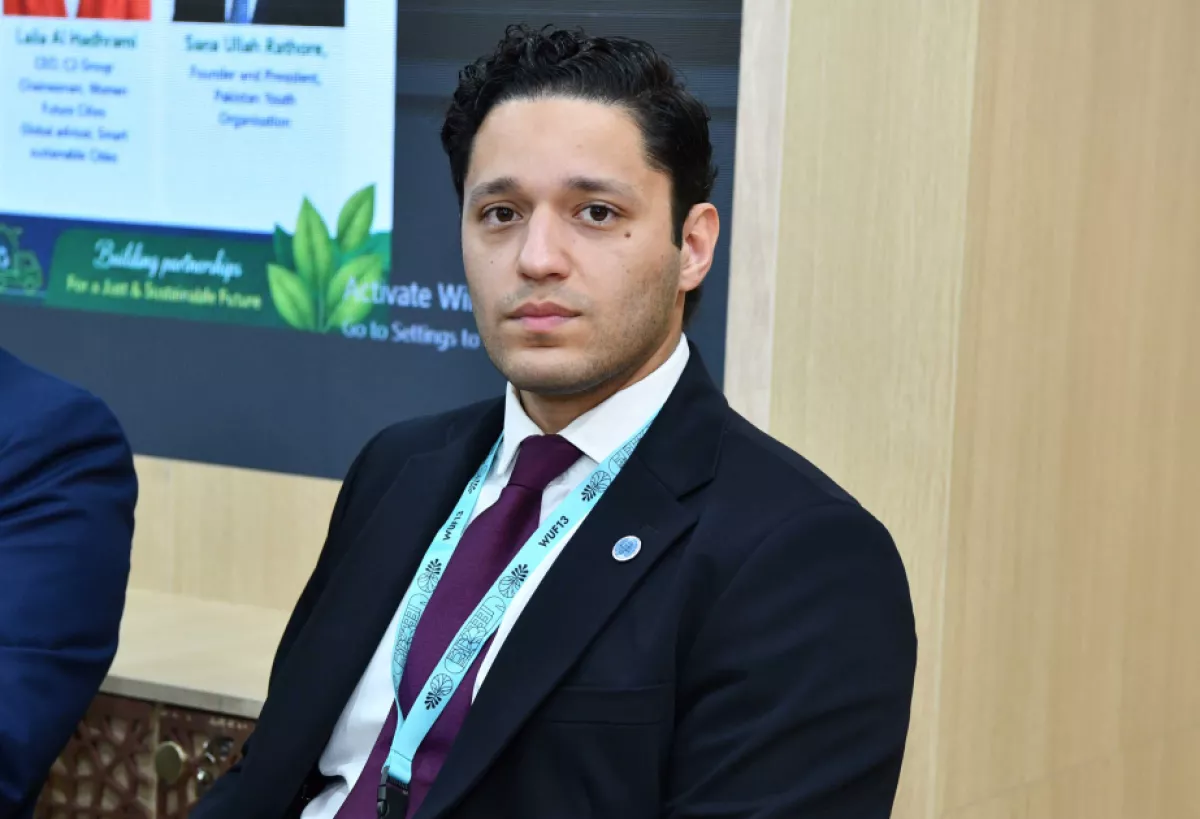
Karimli also noted that the organisation plans to strengthen its headquarters and promote major conferences, political dialogues, regional forums, and capacity-building initiatives through deputy secretaries-general and partner organisations.
“We intend not only to participate in global discussions, but also to create our own platforms, shape our own agendas, and ensure that the voice of the Global South is heard worldwide,” said Fuad Karimli.
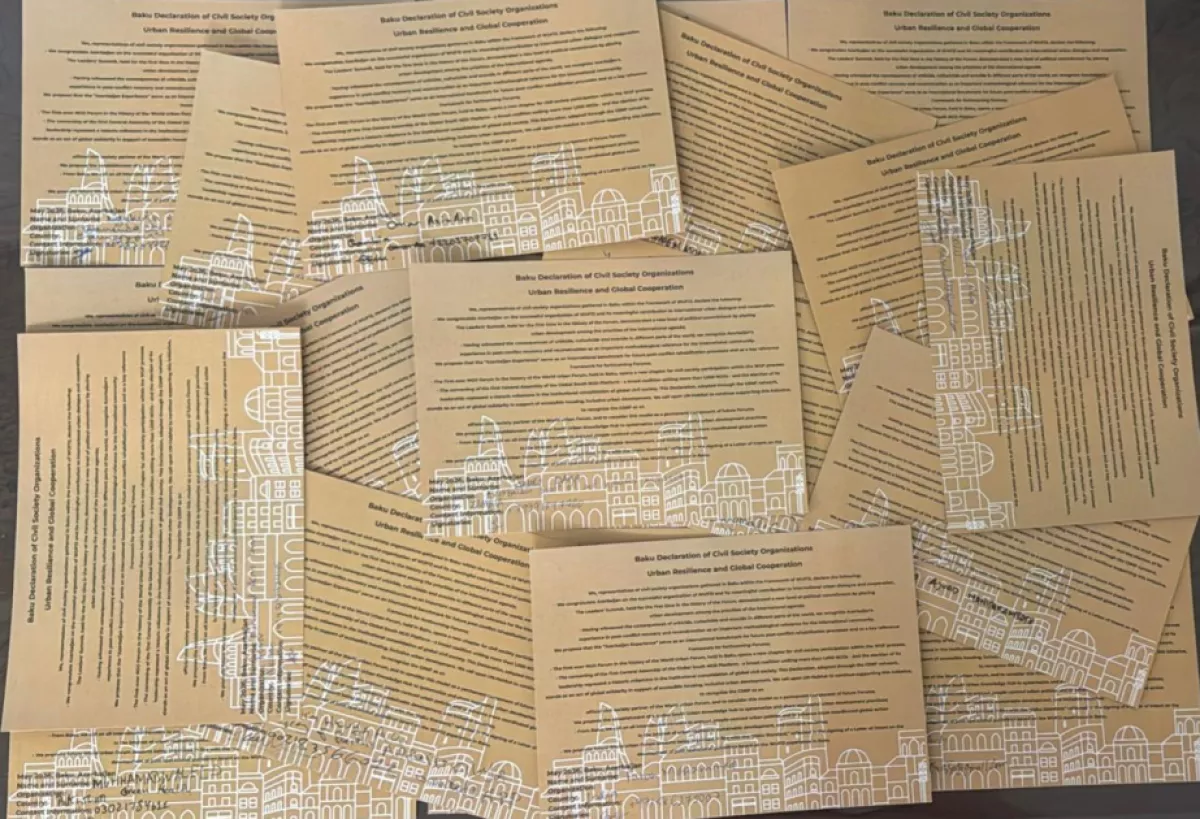
GSNP represents an attempt to create something the Global South has lacked until now: a horizontal coordination mechanism for civil society organisations across the developing world. Despite their activism, NGOs from the South had previously entered international platforms either individually or through Western umbrella structures that shaped the agenda according to their own criteria and vocabulary. The inclusion of 116 countries in the platform is no longer merely a rhetorical figure, but a critical mass. At WUF13, this mass was presented for the first time as an independent force: 569 NGO representatives from 103 countries signed the forum’s Baku Declaration — a document that GSNP introduced at the event as its collective text.
What matters most in the declaration itself is not even the appeal to UN-Habitat to support the initiative and grant GSNP the status of an official WUF partner representing civil society, although this is precisely what institutionalises the outcome. More important is the way its methodological section is formulated. The document brings together concepts that until now existed separately — urbicide, culturicide, and ecocide — and integrates them into a single analytical framework. This is not a decorative triad. It is an assertion that the destruction of cities, cultural heritage, and the natural environment across the developing world is a phenomenon of the same nature and one that can be systematically categorised. Here, the Baku Declaration takes a step that hardly any other document could have made: it identifies Azerbaijan’s post-conflict reconstruction experience as a methodological model.
This move is not ceremonial. For Azerbaijan, the reconstruction of the liberated territories — Karabakh and East Zangezur — is primarily a domestic political issue, yet internationally it has for years remained either a subject of contentious debate or the focus of narrowly specialised expert publications. The document, signed by 569 NGO representatives from 103 countries, elevates this experience into the category of an international methodological standard. It is a formal acknowledgement that countries that have endured war and the destruction of cities and cultural heritage can now rely on a reproducible model — the Azerbaijani one.
In a conversation with a correspondent of Caliber.Az, GSNP Secretary General Fuad Karimli noted that the adoption of the Baku Declaration by representatives of nearly 600 non-governmental organisations marks the beginning of a new success story for the Platform.
“The foundations of the Platform were laid in 2024 at COP29. During this process, members of the NGO coalition proposed the creation of the Global South NGO Platform, which resulted in a unified space bringing together representatives from more than 100 countries. Thus, today we are seeing the results of that initiative. The Baku Declaration — the second stage of the process — recognises the historical achievements of the WUF13 forum held in Azerbaijan. Hundreds of international NGOs congratulate our country on the successful hosting of this session, the first-ever leaders’ summit of the forum, demonstrating a new level of political commitment through the inclusion of urban planning among the priorities of the international agenda, as well as the first-ever World NGO Forum, which we hope will enjoy sustained success,” said Fuad Karimli.
He also noted that WUF13 marked a new milestone for the Global South NGO Platform: “As a result of long discussions and with the support of our member NGOs from developing and least developed countries, UN-Habitat allocated a separate pavilion for our Platform at the Urban Expo exhibition. This may seem like a small detail, but it is a clear example of UN-Habitat’s support for our Platform. We hope that the Global South NGO Platform will closely cooperate with UN-Habitat at future World Urban Forums, representing the realities of the South at major international events.
Our member NGOs once again demonstrated their trust in the Azerbaijani state by voting for the Secretariat. They delegated this mission to us for the next five years, and we intend to develop closer cooperation with international organisations such as UN agencies, expand activities in the regions where we are present through newly elected deputy secretaries-general for Latin America, Africa, Asia and Oceania/the Pacific region, as well as enhance cooperation between Azerbaijani NGOs and NGOs from Global South countries.
Our main goal is to strengthen the presence of Southern NGOs in key international decision-making processes and ensure they are not excluded and that their voice is heard.”
The logic of the next step is evident — it is embedded in the text of the declaration itself. GSNP seeks recognition from UN-Habitat, but not simply as another partner, rather as a permanent component of the architecture of future forums. This is the first attempt, after many years of institutional dominance by Western NGOs within the UN system, to recalibrate the balance of representation.
The demand comes from below — from the 116 countries represented in the Platform — and is formulated in a highly concrete way: status, regulatory framework, and a permanent place on the agenda. If UN-Habitat accepts this request — and it will be difficult to refuse given the scale of signatures behind the declaration — it would create the first precedent of institutional recognition of a Global South structure as an equal actor within one of the UN agency frameworks.
For Azerbaijan, beyond the obvious diplomatic capital, this is also a test of capacity. Chairing a platform of 116 countries is an obligation that requires more than a single successful event; it demands the construction of a permanent working infrastructure: a secretariat, research functions, coordination with UN agencies, and sustained dialogue with NGOs that signed the declaration.
Baku has experience in this regard: its chairmanship of the Non-Aligned Movement was structured as a full-fledged political project rather than a ceremonial role. The same logic applies to GSNP, but the stakes are higher, as this is not an intergovernmental club but a civil society infrastructure, where the criteria for success are different and more demanding.
WUF13 is now closed. The declaration has been signed, the headquarters formalised, and the chairmanship has begun. What follows is work that is less visible from the outside: negotiations with UN-Habitat over status, development of protocols for interaction with signatory NGOs, and the formation of the Platform’s first full program under Azerbaijan’s chairmanship.
If this work is carried out with the same level of execution as the forum itself, then within two to three years, the description of Baku in international reference frameworks will need to be revised. Alongside entries on its role as an energy hub, a post-Soviet rebranding capital, and a venue for climate negotiations, another line will be added: a coordination centre for Global South civil society. And that would represent yet another form of external recognition.







 editor@caliber.az
 +994 55 444-88-98
 Азербайджан, Баку, ул. Низами, 203, Af Business House, 5-й этаж