










Latin American rift: What lies behind Brazil-Argentina tensions? Article by Matanat Nasibova
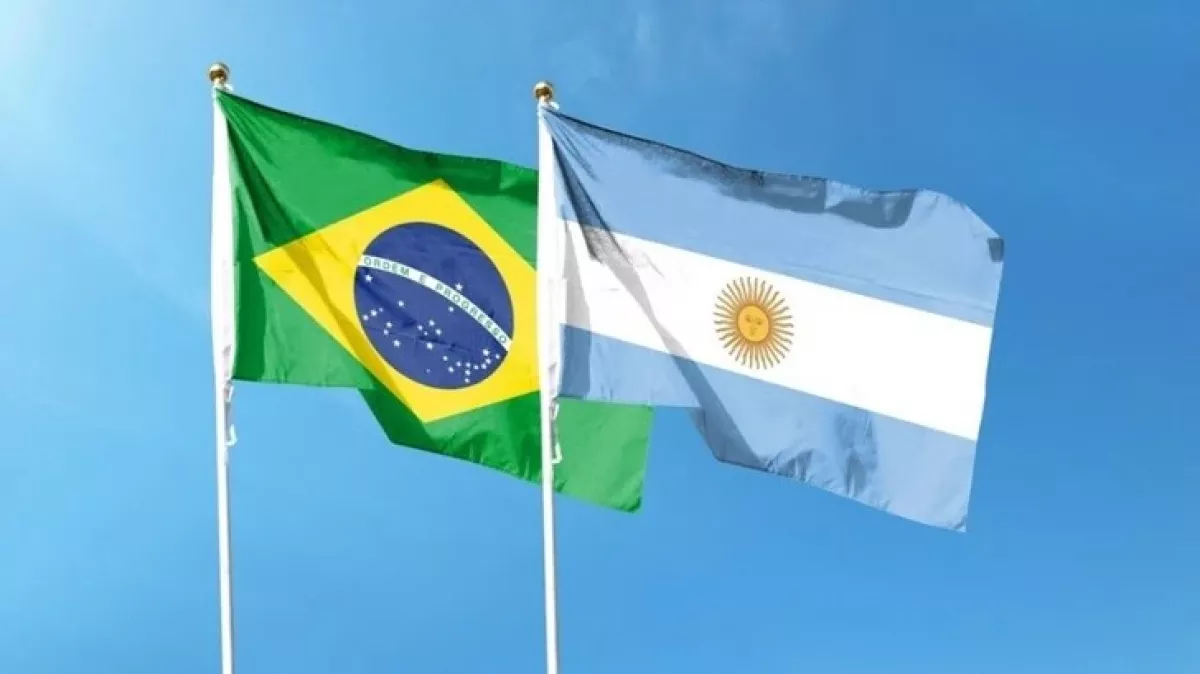
The scandal between Buenos Aires and Brasília, according to the latest media reports, continues to escalate, growing like a snowball.

In particular, according to CNN Brasil, Brazilian authorities have decided not to return their ambassador Júlio Bitelli to Buenos Aires and to downgrade diplomatic relations with Argentina to the level of chargé d’affaires. Brazilian President Luiz Inácio Lula da Silva, in turn, stated that his country would not tolerate interference in its domestic affairs, while a protest note was delivered to Argentina’s ambassador in Brasília, Daniel Raimondi.
The conflict between the two countries began with remarks made in July by Argentine President Javier Milei at an event in support of the son of former Brazilian President Jair Bolsonaro — Flávio Bolsonaro, who is a rival of the current Brazilian president in the upcoming presidential election. Milei referred to Lula da Silva as a “thief,” a “corrupt official,” a “criminal,” and a “convict” over his past legal cases. He also branded him as one of the “damn leftists” while launching a harsh attack on Brazil’s Federal Supreme Court and Justice Alexandre de Moraes.

Against this electoral backdrop, where the main contest is unfolding between the incumbent head of state and the right-wing opposition, and where the campaign process is therefore marked by a high degree of tension, the Argentine leader’s outburst could be interpreted as a publicity move in support of Flávio Bolsonaro and aimed at undermining Lula da Silva. However, a closer analysis reveals facts pointing to deeper underlying causes of the incident, which are difficult to simply classify as a matter of “personal animosity.”
First and foremost, it should be noted that the Argentine president is a far-right politician and an advocate of radical privatisation, a reduced role for the state, and full deregulation — a “shock” dismantling of government control over prices, regulations, and businesses in favour of complete market freedom. The current Brazilian president, Lula da Silva, holds diametrically opposite views, adhering to centre-left principles centred on stronger state regulation, social programmes, and public investment. This fundamental divergence in political outlook was bound to affect bilateral relations sooner or later — and the developments we are witnessing now are a manifestation of that very divide.

The economic factor adds no less intensity to the situation. Brazil and Argentina are the largest economies within MERCOSUR — the organisation established in 1991 to create a common market and promote free trade among Latin American countries. A dispute at the level of heads of state could potentially affect bilateral trade, with consequences that would be far from beneficial for the bloc. That said, there remains hope that pragmatism will prevail over political ambitions and that the situation will not escalate into open trade wars — especially given that the deep crisis of 2026 has already dealt a serious blow to MERCOSUR’s stability and future prospects.
From a geopolitical perspective, it should be noted that the Argentine-Brazilian “clash of ideologies” is effectively dividing Latin America into two camps. Lula views foreign policy as a tool to strengthen Brazil’s regional leadership and expand the role of Global South countries, while continuing to develop cooperation with China and promote BRICS. Milei, by contrast, has built his foreign policy around opposition to left-wing governments in the region, demonstrating maximum proximity to the United States and aligning himself with conservative political forces.
For Washington, however, the situation is a double-edged sword. On the one hand, the US administration has traditionally been interested in maintaining cooperation with both Argentina and Brazil. On the other hand, deep economic and political differences — including trade protectionism and diverging views on regional leadership — have often complicated US relations with these countries.
Thus, the conflict between Buenos Aires and Brasília cannot be interpreted merely as a diplomatic incident. Given the factors outlined above, its repercussions could potentially turn Latin America into an arena of rivalry between two regional giants.







 editor@caliber.az
 +994 55 444-88-98
 Азербайджан, Баку, ул. Низами, 203, Af Business House, 5-й этаж