










Aliyev’s formula for peace How strength and diplomacy reshaped the South Caucasus
The visit of President Ilham Aliyev to the United States on August 8–9, 2025, cannot in any way be viewed as an isolated diplomatic event. It should be correctly regarded as the point where two parallel trajectories converged: the fundamental transformation of relations between Baku and Washington and the initialling of a peace agreement between Azerbaijan and Armenia.
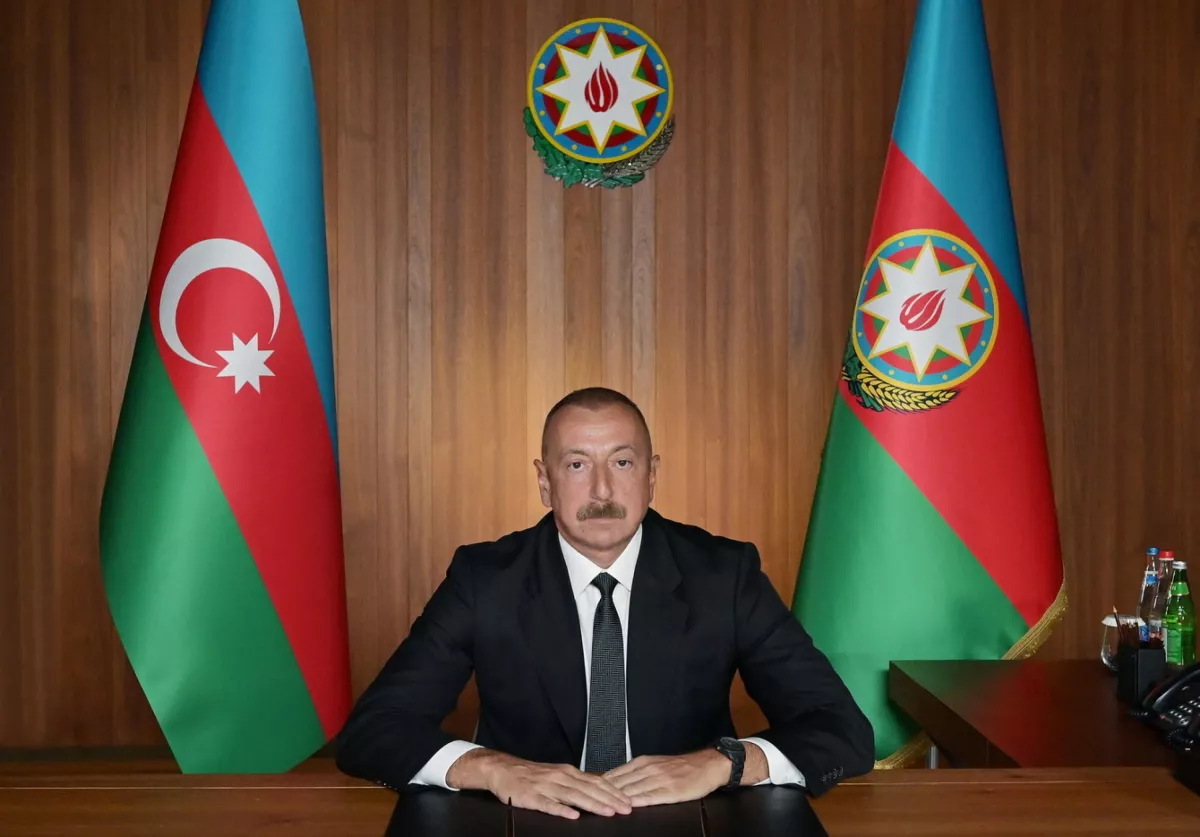
The fact that these developments came together at the same time and in the same place was by no means accidental. Rather, it was the logical outcome of processes that had evolved as two sides of a single strategic vision, built upon Azerbaijan’s consistent, pragmatic, and national-interest-driven state policy. On every issue, President Aliyev has placed and continues to place his country’s interests at the forefront, never compromising this fundamental position under any circumstances. This steadfast approach has led to a result that, only a few years ago, would have seemed impossible to achieve.
To understand the scale of the transformation, it is worth recalling how it all began. The years of the Biden administration inflicted significant damage on relations between Baku and Washington. Even as a senator, Biden was among those associated with initiatives for sanctions pressure against Azerbaijan, and after entering the White House, his team’s approach to the region was shaped around a logic of division, confrontation, and support for one side at the expense of impartiality.
This perspective became one of the reasons why achieving lasting peace in the South Caucasus remained elusive for so long. The US administration, unwilling to acknowledge Azerbaijan as a leading regional state, consistently pursued a policy of cooling relations, engaging with Baku through a language of admonishment and suspicion while overlooking the fact that it was dealing with a country that shapes the regional agenda rather than one that merely follows it.
With Donald Trump’s return to office, the foreign policy course of the United States underwent a shift. As President Ilham Aliyev noted, the new White House administration placed peace and cooperation at the centre of its relations with countries around the world, and this approach proved far more pragmatic than the previous one.
Trump reshaped his country’s relations with Azerbaijan by identifying the development of ties with Baku and the achievement of regional peace as key priorities, and by moving toward their practical implementation. This is precisely why the transformation of US-Azerbaijan relations and the initialling of a peace agreement between Azerbaijan and Armenia complement one another and form part of a single broader process.
Its milestones follow a clear trajectory: contacts and correspondence between Trump and Aliyev even before Trump’s election as president; the August visit to the United States, along with the meetings and statements made there; the agreement to prepare a Charter on Strategic Partnership between the two countries; the decision to suspend the implementation of the controversial Section 907 of the Freedom Support Act; the agreement on the TRIPP project and the implementation of the Zangezur Corridor; continued communication and correspondence between the two heads of state; and, ultimately, Vice President Vance’s visit to Baku.
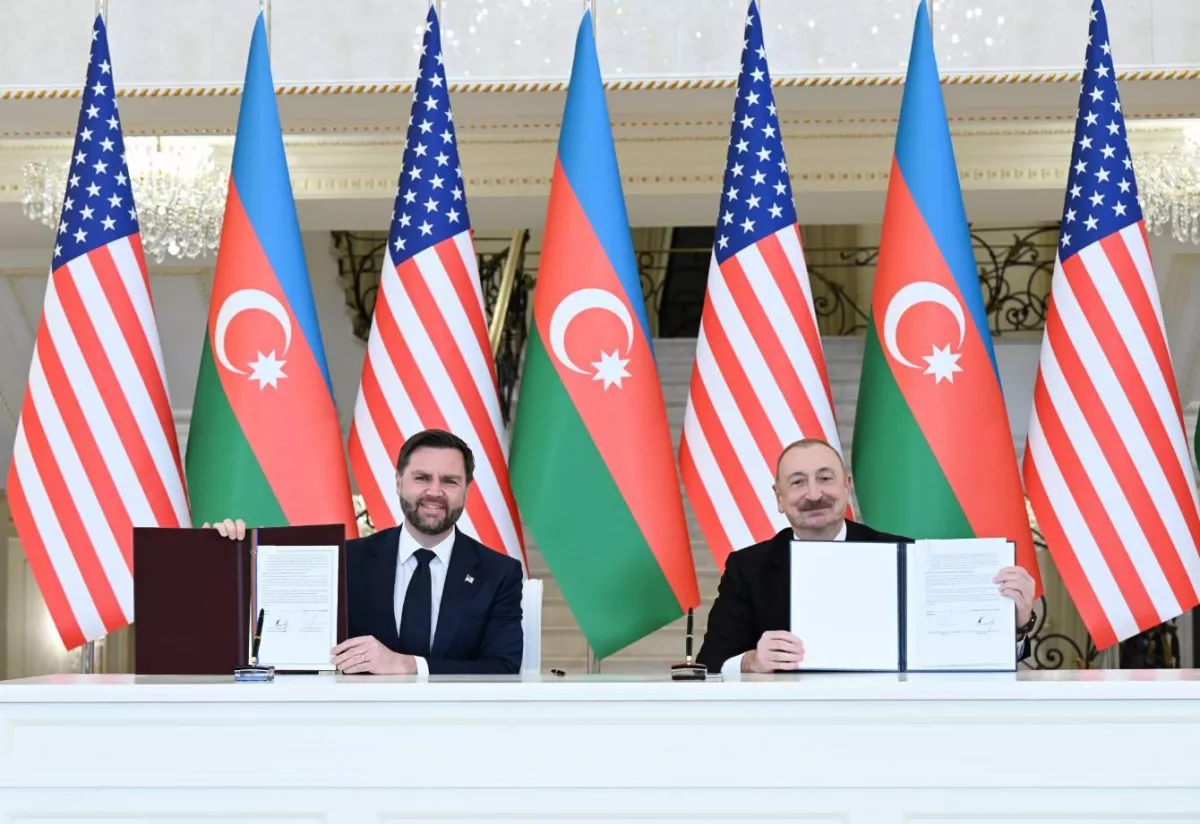
This final point deserves particular attention, as it was precisely this development that transformed intentions into a concrete outcome. On February 10, 2026, US Vice President J.D. Vance arrived in Azerbaijan and, together with President Ilham Aliyev, signed a Charter on Strategic Partnership covering defence cooperation and arms sales, artificial intelligence, energy security, counterterrorism efforts, and civilian nuclear cooperation.
President Ilham Aliyev described the development as the beginning of an entirely new phase in bilateral relations. Ties that, under the previous administration, had been close to the point of hostility were elevated within just a few months to the level of a strategic partnership, formalised by the signature of the US vice president.
At the same time, the second half of this single process was unfolding — peace with Armenia. Here, it is necessary to call things by their proper names, as many convenient myths have been built around these developments.
On August 8, 2025, in Washington, in the presence of Donald Trump, the text of the peace agreement between Azerbaijan and Armenia was initialled — meaning it was agreed upon and given preliminary approval at the highest level. This marked the logical outcome of a prolonged process in which Yerevan was compelled to move toward peace, while US mediation merely formalised what had already been determined on the ground.
The author of the five principles that formed the foundation of the agreement was Azerbaijan — and this, too, is part of the broader picture that many in Yerevan prefer to downplay.
Armenia’s current attempts to portray itself as the peace-seeking side do not withstand scrutiny when measured against its own recent history. Prior to 2020, the Armenian side pursued plans to expand the occupation of Azerbaijani territories; during the 44-day war, the Armenian military launched missile strikes against Azerbaijani cities far from the battlefield; and after the war, revanchist sentiments not only persisted but were also encouraged at the state level.
A moment of reckoning came only after Azerbaijan’s local anti-terror measures in September 2023, when Prime Minister Pashinyan recognised the new reality and was forced to accept it. The peace-oriented stance that Armenia’s leadership frequently highlights today is not the result of a deeply internalised moral choice, but rather a consequence of defeat and pragmatic calculation.
Peace in the South Caucasus became possible not because Yerevan actively pursued it, but because Azerbaijan’s consistent policy and strength left the Armenian side with no alternative.
Historical comparison helps to assess the pace and quality of what has been achieved. The Second World War ended in 1945, yet full reconciliation between Germany and France — two historic antagonists of Europe — was formalised only through the Élysée Treaty of 1963, nearly two decades later.
President Ilham Aliyev needed only two years after Azerbaijan’s 2023 anti-terror operation to bring Armenia to a peace agreement and advance the process to the initialling of the treaty. Where Europe required eighteen years and a change of generations, Azerbaijan achieved the outcome through consistent determination and two years of focused policy.
This comparison is not merely rhetorical decoration; it is a measure of the effectiveness of the chosen course. A peace that takes decades to achieve and a peace reached within two years reflect different levels of governance effectiveness and different degrees of clarity in strategic objectives.
The current security environment in the region is a direct consequence of Azerbaijan’s leader’s consistent policy. This perspective completes the broader picture: the transformation of relations with Washington and peace with Yerevan represent two vectors of a single strategic vision, in which strength and diplomacy did not operate separately but reinforced one another.
The fact that both processes reached successful outcomes almost simultaneously reflects the trajectory of a state that has long learned to determine its own destiny.







 editor@caliber.az
 +994 55 444-88-98
 Азербайджан, Баку, ул. Низами, 203, Af Business House, 5-й этаж