










Weeks that will shape Armenia Moscow’s carrot-and-stick strategy
In recent days, another significant incident has occurred in Russian-Armenian relations. Russian President Vladimir Putin, speaking to journalists after the May 9 parade, responded, among other things, to a question concerning Armenia. More precisely, reporters pointed out that Armenian leaders had frequently travelled to Moscow for Victory Day celebrations in the past, yet this year neither Prime Minister Nikol Pashinyan nor any other representatives of the country’s leadership were present on Red Square.
The Russian president gave a lengthy and multilayered response. First, he stated that Moscow “sees nothing unusual” in Armenia’s plans to move closer to the EU and would support anything that “benefits the Armenian people.” Russia and the Armenian people, Putin said, have enjoyed “special relations for centuries,” and if a particular decision truly serves Armenia’s interests, Moscow “will not oppose it.”
After this complimentary introduction, Vladimir Putin moved on to a polite offensive, listing the benefits Armenia derives from its membership in the Eurasian Economic Union (EAEU), before suggesting that Yerevan should “make up its mind.” “It would be entirely logical to hold a referendum and ask the citizens of Armenia what their choice will be,” Putin said. After that, he continued, Russia and Armenia could draw the “appropriate conclusions” and proceed along the path of a “soft, intelligent and mutually beneficial divorce.”
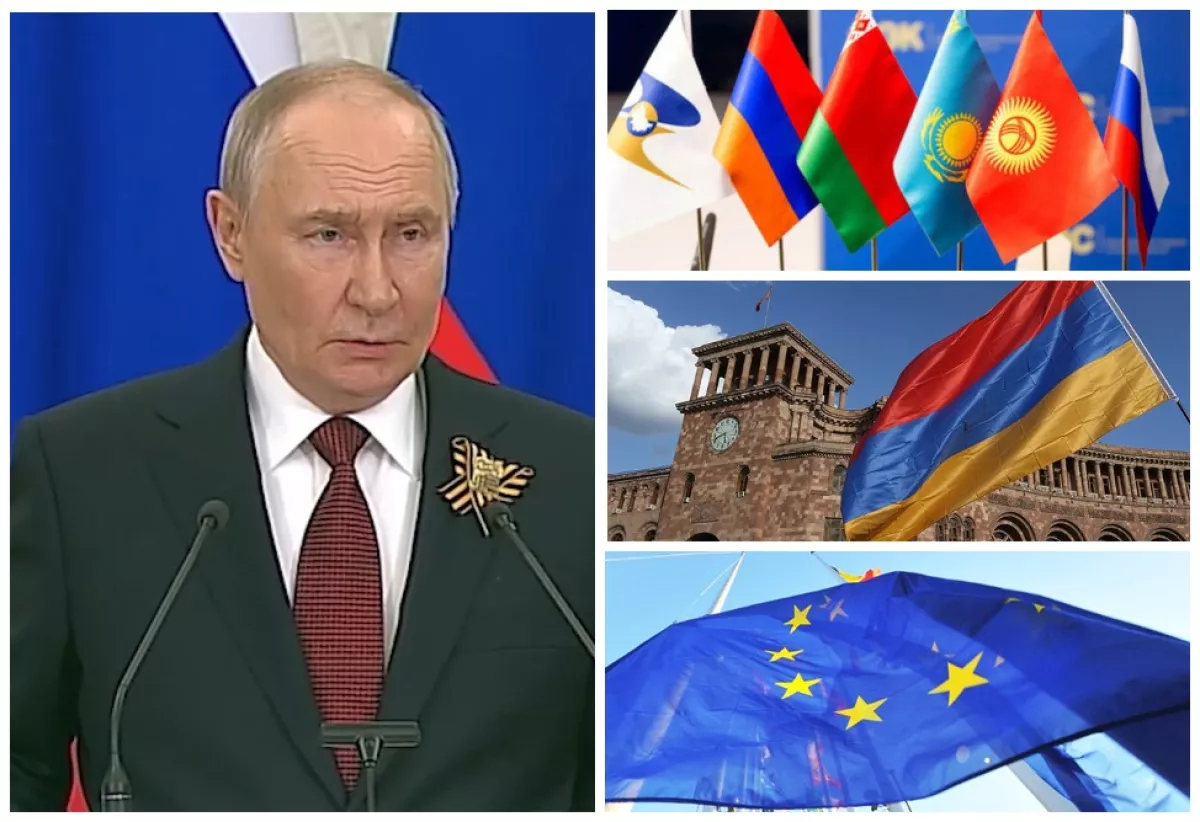
This soothing easing of tensions was then followed by a sharp blow. The Russian president began drawing parallels between Armenia and Ukraine. “And how did it all begin? With Ukraine joining, or attempting to join, the EU!” Repeating in detail Russia’s interpretation of the events leading up to the Russian-Ukrainian conflict in 2013–2014 — including Moscow’s warnings to Europeans that Ukraine’s agreement with the EU was incompatible with its close economic ties to Russia and other EAEU partners — Putin returned to the subject of Armenia. “Therefore, there is no need to push things to the extreme,” he said, prompting many to interpret the remark as an almost undisguised threat.
Most commentators agree that, despite Vladimir Putin’s threats, Russia lacks the resources to pursue a policy towards Armenia comparable to the one it has pursued against Ukraine. First, the war in Ukraine is consuming Moscow’s resources; second, Russia and Armenia do not share a common border; and third, there is no humanitarian pretext remotely resembling the narratives about the “protection of the people of Donbas.”
Why, then, is the Russian president threatening Armenia? The most plausible answer lies in the sphere of Armenia’s pre-election struggle, which is entering its most intense phase. Unsurprisingly, all major stakeholders are stepping up their efforts to secure a majority for their political forces. As is well known, the main contest has unfolded between the ruling Civil Contract party — which has staked its future on peace with Azerbaijan, abandoning the myth of a “Greater Armenia,” and maximum integration with Europe — on the one hand, and pro-Russian forces on the other, represented by three main political groupings: the Armenia Alliance led by the head of the Karabakh clan, Robert Kocharyan, as well as the parties of oligarchs — Russia-based Samvel Karapetyan (“Strong Armenia”) and Armenian businessman Gagik Tsarukyan (“Prosperous Armenia”).
The struggle is centred on the undecided segment of the electorate, which both sides are trying to influence through manipulative methods ahead of the elections by portraying their respective political course as the more attractive option. To this end, Nikol Pashinyan and his team are actively employing the rhetoric of European integration. The recent European Political Community Summit in Yerevan and the EU-Armenia Summit, as well as the state visit to Armenia by French President Emmanuel Macron — complete with its “warm and emotional” component — were aimed primarily at demonstrating the unity between Armenia and Europe.
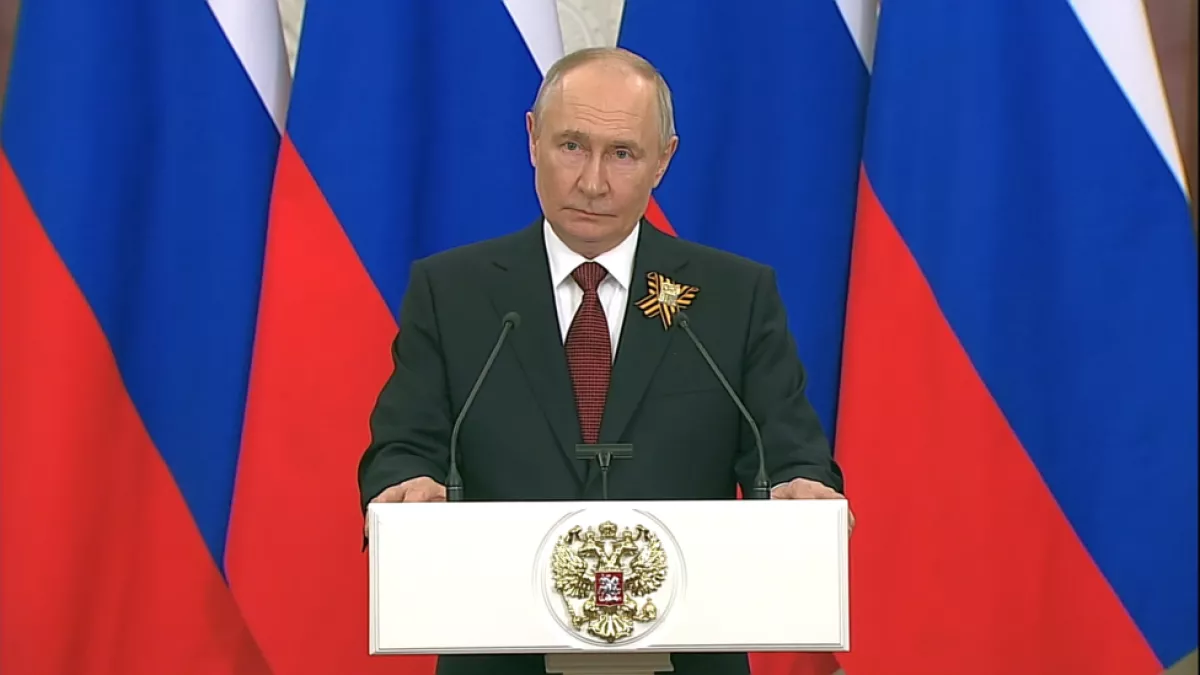
From this perspective, it becomes clear that Moscow’s actions — and in particular Vladimir Putin’s remarks and warnings — serve a goal that is opposite in form and purpose, yet identical in essence. It appears that the Kremlin has decided to intensify its rhetoric in order to influence the undecided electorate by combining both the carrot and the stick. Calculating that a mere listing of the advantages of Armenia’s membership in the EAEU might pale in comparison to the recent European political spectacle in Yerevan, Putin voiced a scenario of “what will happen if not…”.
The calculation may be that the very same undecided voters will conclude that it is ultimately better “not to provoke” Russia and will cast their ballots for one of the pro-Russian parties. In other words, those who are difficult to influence through economic arguments are now being targeted through fear. It should also not be forgotten that another reason behind Putin’s sharply worded remarks was related to image considerations — in the eyes of Russia’s patriotic community, he needed to respond somehow to the appearance in Yerevan of Ukrainian President Volodymyr Zelenskyy, who had threatened strikes on Red Square.
Armenia’s European integration remains an issue far removed from concrete reality for now. Consequently, the escalation of tensions between Moscow and Yerevan in this context bears the artificial and technological character of pre-election manipulation. And this struggle is likely only to intensify in the coming weeks.







 editor@caliber.az
 +994 55 444-88-98
 Азербайджан, Баку, ул. Низами, 203, Af Business House, 5-й этаж