










Dialogue of strategic rivals Aftermath of Trump’s visit to China
The visit of the American president to China for the first time since 2017 is a highly significant event, especially in light of the ongoing conflict in the Middle East, even though its hot phase has been put on pause.
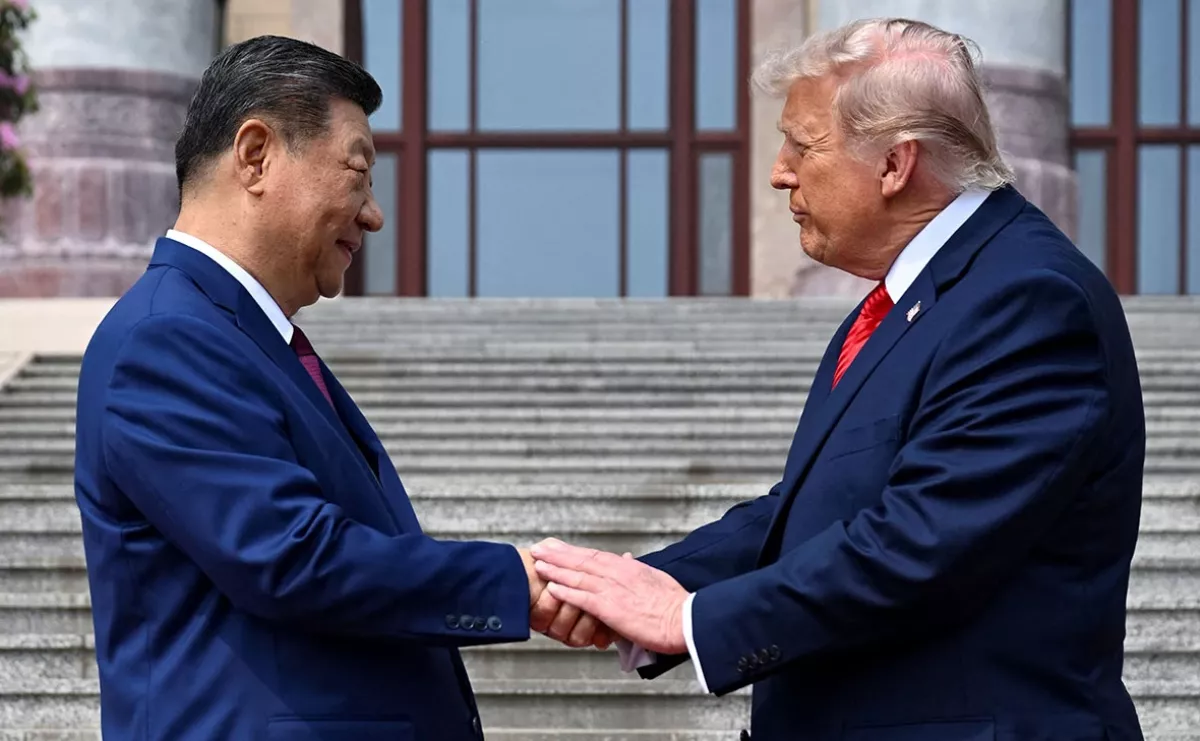
The Chinese arranged an emphatically ceremonial reception for Trump, complete with military honours, formal ceremonies, banquets, and personal talks with Xi Jinping that lasted more than two hours. The main topics of the meeting were US–China trade relations and American tariffs. Naturally, the situation around Iran, the closure of the Strait of Hormuz, and Taiwan were also discussed. On these issues, both sides only agreed that they are interested in maintaining open shipping routes and preventing a global energy crisis.
After the meeting, Trump, in his usual manner, stated that he has a “special relationship” with Xi and even formally invited the Chinese leader to visit the White House in September this year. Xi Jinping himself spoke about the need for cooperation and preventing direct confrontation between the United States and China. However, there is no reason to harbour illusions about any meaningful détente between the two sides, as neither has abandoned its core strategic interests. Washington continues to view China as its principal rival, and will continue to do so, while Beijing still considers Taiwan an internal matter of the People’s Republic of China and firmly rejects US support for the island.
Xi Jinping also stated that the United States and the People’s Republic of China should not fall into the Thucydides Trap. This term may be unfamiliar to many, so it is worth explaining: the Thucydides Trap is a political science concept describing a situation in which the rapid rise of a new power begins to threaten the position of the ruling hegemon, making military conflict between them increasingly likely due to rising tensions. The term was popularised by political scientist and former US Assistant Secretary of Defense for Policy and Planning Graham Allison, who applied it specifically to the US–China rivalry.
However, despite the ongoing political disagreements, the economic component of the talks appears to have been more productive. Following the meeting, global markets reacted with a noticeable rise, as investors saw a potential for a partial easing of tensions between the world’s two largest economies. Media reports also suggested a possible expansion of access for US companies to the Chinese market, as well as new purchases of American goods by China (which can certainly be counted as a success for Trump, as he has consistently highlighted the trade imbalance in US–China relations, where Washington imports far more from Beijing than it exports).
There were also reports of potential contracts between China and Boeing. In addition, Beijing is expected to purchase agricultural equipment from the United States.
Donald Trump did not travel to China alone; he was accompanied by a number of business leaders, as American companies are highly interested in broader access to the highly profitable Chinese market. Possible mechanisms for controlling investment flows between the two countries were discussed, including the creation of joint trade and investment structures. The negotiations were attended by major American business figures and corporate executives, including representatives of such giants as Boeing, Apple, Tesla, Nvidia, and Mastercard.
At the meeting, the topic of artificial intelligence was also discussed, whose rapid development is currently relevant for the entire world. However, as expected, full mutual understanding on AI between the United States and China was not achieved—and is unlikely to be achieved. The discussion remained at a general level. Yes, both sides acknowledge that artificial intelligence is a strategic, national-security-level technology, but the US still believes that China should be denied access to the most advanced chips and models due to military risks, while Beijing views these restrictions as yet another attempt at containment and technological blockade. Cooperation on AI between China and the United States is therefore minimal and largely limited to discussions of each side’s “red lines” and ways to reduce escalation risks.
Overall, although the meeting is an important event, it will by no means turn geopolitical rivals into friends. Only tactical, not strategic, progress has been achieved. Dialogue may continue, and both sides will keep issuing positive and conciliatory statements, but the fact remains: the United States and China are strategic adversaries, and their confrontation still carries significant risks, which is apparently understood in both Beijing and Washington.
By Riad Hamidov







 editor@caliber.az
 +994 55 444-88-98
 Азербайджан, Баку, ул. Низами, 203, Af Business House, 5-й этаж