










Between Solferino, Heiden, and Azerbaijan The chronology of the ICRC’s institutional decline
On June 24, 1859, by the end of the second day of the Battle of Solferino, around 40,000 wounded lay on the hilly plains of Lombardy. The French and Sardinian armies faced the Austrian forces, and within a few hours, the battlefield turned into a scene of utter carnage. Among those who were not supposed to be there was a 31-year-old Swiss man, who was travelling to seek an audience with Napoleon III on matters related to Algerian concessions.
Henry Dunant found himself stranded in Castiglione delle Stiviere, a small town behind the front line, where the wounded had been placed in churches, on streets, and under makeshift shelters, without doctors or proper care. He was neither a medic, nor a soldier, nor a philosopher. He was a pious Geneva merchant, and the only thing he did was simple: he stopped distinguishing between the wounded French, Italians, and Austrians. To the local women whom Dunant began to assist, he repeated a short phrase — tutti fratelli, meaning “All are brothers.”
From this phrase, uttered in the provincial church of San Maurizio, and from a small book, A Memory of Solferino, written after his return to Geneva, grew an idea that a few years later received its name: the International Committee of the Red Cross.
On October 30, 1910, in the Swiss village of Heiden, in a room of the municipal poorhouse for the elderly, the same man died. He was eighty-two years old, living in poverty and obscurity, dependent on a modest pension provided by the Russian Empress Dowager. Despite the fact that Dunant had become the first Nobel Peace Prize laureate, he spent his final years in an asylum, living in hardship and solitude after his bankruptcy.
He instructed that he be buried without ceremony and without a funeral speech.
Between Solferino and Heiden lies half a century. Over those fifty years, Dunant’s idea evolved into a movement, into the first Geneva Convention, into an emblem that became one of the most recognisable humanitarian symbols of the modern world, and, in parallel, into an institutional structure that regarded its own founder as a liability to its reputation and, in 1867, following his commercial bankruptcy, excluded him from its ranks.
Between these two events — the Battle of Solferino and the poorhouse in Heiden — lies the entire moral scope of the idea and the full institutional story of its betrayal.
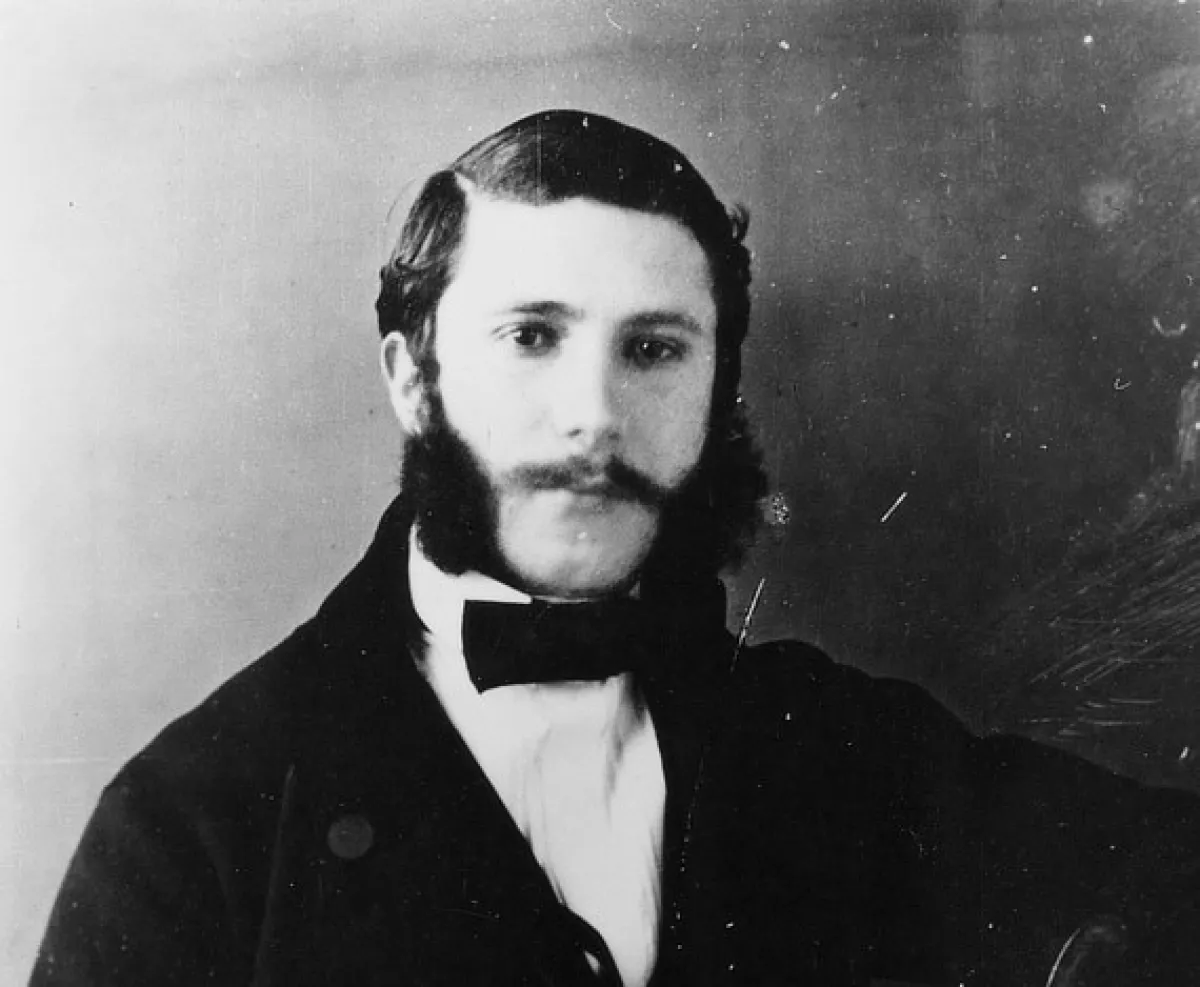
On May 8, 2026, the World Red Cross and Red Crescent Day will be commemorated, established in honour of the founder of the ICRC, Henry Dunant, who was born on this day in 1828.
As every year, the seven Fundamental Principles of the ICRC will be listed: humanity, impartiality, neutrality, independence, voluntary service, unity, and universality. Dunant will be remembered — the man whose name the organisation once preferred to erase from its records.
And none of these ritual principles any longer carries the weight they had when a Geneva merchant wept over the wounded at Solferino.
The story of Dunant’s exclusion from the committee he himself created is little remembered today, though it should be. It encodes many of the organisation’s future characteristics.
Dunant’s business venture in Algeria failed, the Geneva Crédit Genevois collapsed, and a scandal broke out in Calvinist Geneva. Gustave Moynier, a lawyer and president of the Geneva Society for Public Welfare, the de facto architect of the institution’s legal form and a leading figure in the early Red Cross, demanded without hesitation that Dunant leave the committee.
On August 25, 1867, Dunant resigned as secretary; on September 8, he was formally excluded. He spent the next three decades in poverty across various parts of Europe before being rediscovered in Heiden.
When forced to choose between a bankrupt founder and bourgeois respectability, the committee made its decision instantly. This structural preference — institutional reputation over inconvenient humanity — never truly left the Red Cross. It only became less visible as the once small Geneva initiative grew into an organisation with tens of thousands of employees, a budget of around two billion Swiss francs, and a network of delegations across dozens of countries.
What we see today — Ukrainian prisoners of war to whom, according to critics, the organisation has had no access for several years, and ceremonial visits to regimes accused of torture — is, in this interpretation, rooted in the same logic of 1867.
Dunant was not excluded because he had betrayed the idea. He was excluded because he became inconvenient for the institution.
If one strips the seven principles of the rhetoric that accumulates around them every May 8 and applies them to the practice of recent years, one discovers that little more than an empty form remains of each.
Let us take not the most high-profile, but a highly illustrative case for us. According to information provided by the International Committee of the Red Cross itself to the State Commission of the Republic of Azerbaijan on Prisoners of War, Hostages and Missing Persons, during the First Karabakh War, ICRC staff visited 54 Azerbaijani citizens who had been taken prisoner in what was then occupied Karabakh, at places of detention.
These 54 individuals were officially registered. The places of their detention were known. The dates of visits by Red Cross delegates were recorded in accordance with protocol.
What happened next?
The bodies of 17 of the 54 detainees were returned. Regarding 33, it was reported that they had died in places of detention, but their bodies were not returned. As for the remaining four, the ICRC provided no information whatsoever about their fate.
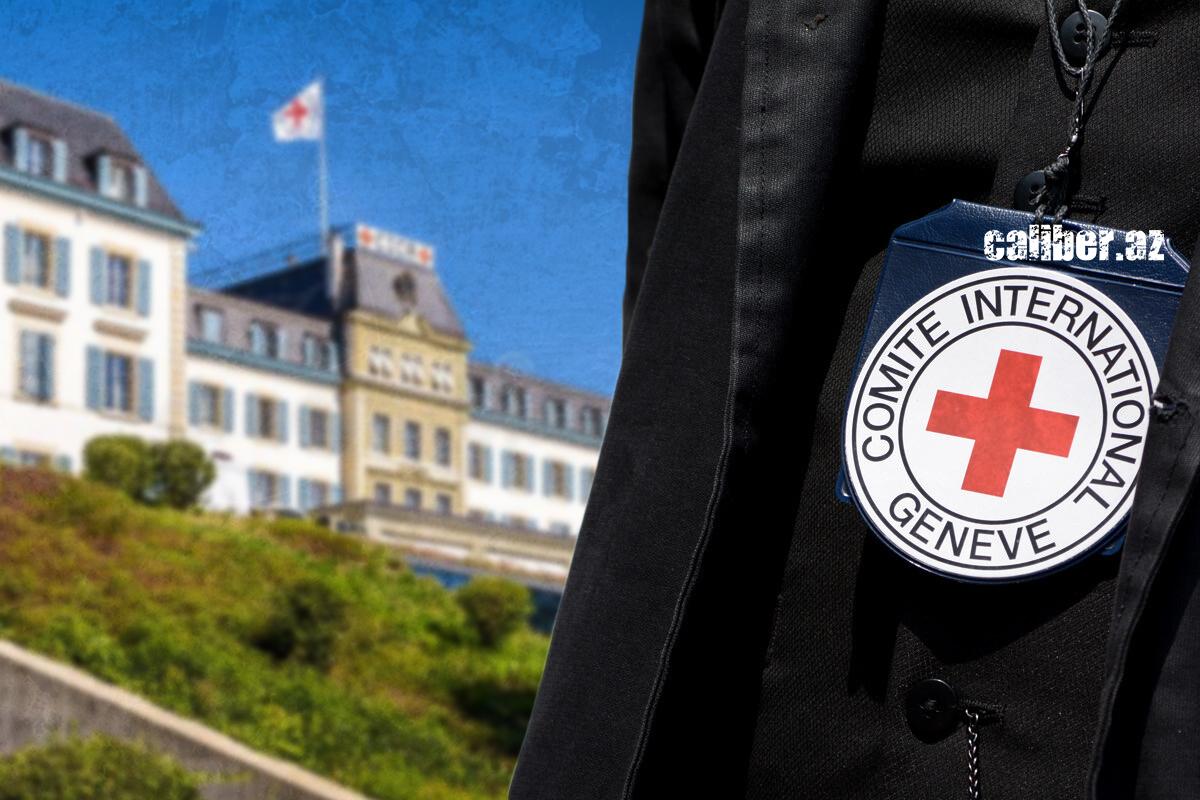
In this grim statistic, responsibility is not attributed solely to the Armenian side. It also implicates the Red Cross itself.
The organisation saw these 54 people, registered them, verified them, and entered them into its lists. None of them returned alive. Thirty-seven people “disappeared” in the detention facilities of Armenian separatists.
What did the “impartiality” of the International Committee mean for these fifty-four people? What did “humanity” signify in a case where the organisation was officially aware of their existence, visited them, confirmed their status — and failed, or rather did not consider it necessary, to secure even the minimum outcome, which would be the return of their remains?
One might argue that the ICRC has neither an army nor sanctions leverage. That is true. But this is not about coercion. It is about a moral voice. After the formally recorded protocol visits produced no results, where was the public statement? Where was the investigation into the causes of the failure? Where was the memory that would keep this case in view for thirty years?
This is a documented institutional failure of the Red Cross, one which the organisation itself prefers not to recall — neither on May 8, nor on any other day.
To understand why such oblivion is structurally possible, one needs to take a closer look at a single fact. The International Committee of the Red Cross, which addresses the world with the tone of an international organisation, is, in legal terms, a private Swiss organisation operating under Swiss law. It is not an intergovernmental agency, not a UN body, and not a structure of multilateral law. It is a Swiss non-governmental organisation endowed by international conventions with operational mandates, yet legally and institutionally remaining a private entity of a single state. This is a legal “technicality” that the organisation itself prefers not to emphasise, because it raises uncomfortable questions. The ICRC speaks on behalf of the international community while simultaneously remaining an apparatus of one country.
This duality leads to a rather telling observation. Since its founding in 1863, all presidents of the ICRC—without a single exception—have been Swiss citizens. This is enshrined in the organisation’s statutes. Within a structure that employs around 18,000 staff worldwide and relies on tens of thousands of volunteers of all possible nationalities, people from every conceivable passport background can occupy any position except one—the highest.
It is a form of national monopoly that is difficult to describe in any other way than as discrimination. If any international body—such as the United Nations, the World Health Organization, or the IAEA—were to enshrine in its statutes a requirement that its Secretary-General or Director-General must be a citizen of a single specific country, it would trigger a diplomatic scandal.
For the ICRC, however, this is the norm, often perceived as part of Switzerland’s institutional “decoration”, akin to cheese and watches. The paradox is that an organisation which, in every statement, speaks in the language of universality and equality has nevertheless embedded an exclusive national criterion at the very top of its own structure.
If we keep this framework in mind, everything we see in the news in recent years falls into a single pattern. The so-called “Moscow Conventions”, prepared by Ukrainian human rights activists, directly accuse the Red Cross of complicity.
The appointment in 2024 of Pierre Krähenbühl as Director-General of the ICRC—Krähenbühl himself having been removed five years earlier from the leadership of UNRWA amid allegations of misconduct—his professional rehabilitation through the Geneva “door” of the Red Cross is a separate illustration of how flexible the organisation’s moral standards become when its own personnel and institutional logic are at stake.
Against this backdrop, publications in Caliber.Az on the (in)activity of the ICRC could, in themselves, constitute a case study in institutional behaviour.
During the Second Karabakh War of 2020, statements by the Geneva-based apparatus focused primarily on the situation in Khankendi and in areas under separatist control, while the shelling of Ganja, Barda, and Tartar was consistently absent from the organisation’s rhetorical focus. The same asymmetry was repeated in September 2023, following local anti-terror operations, when the ICRC spoke publicly almost exclusively in the language of the Armenian side, while leaving unaddressed the fact that these actions concerned the restoration of sovereignty over internationally recognised Azerbaijani territory.
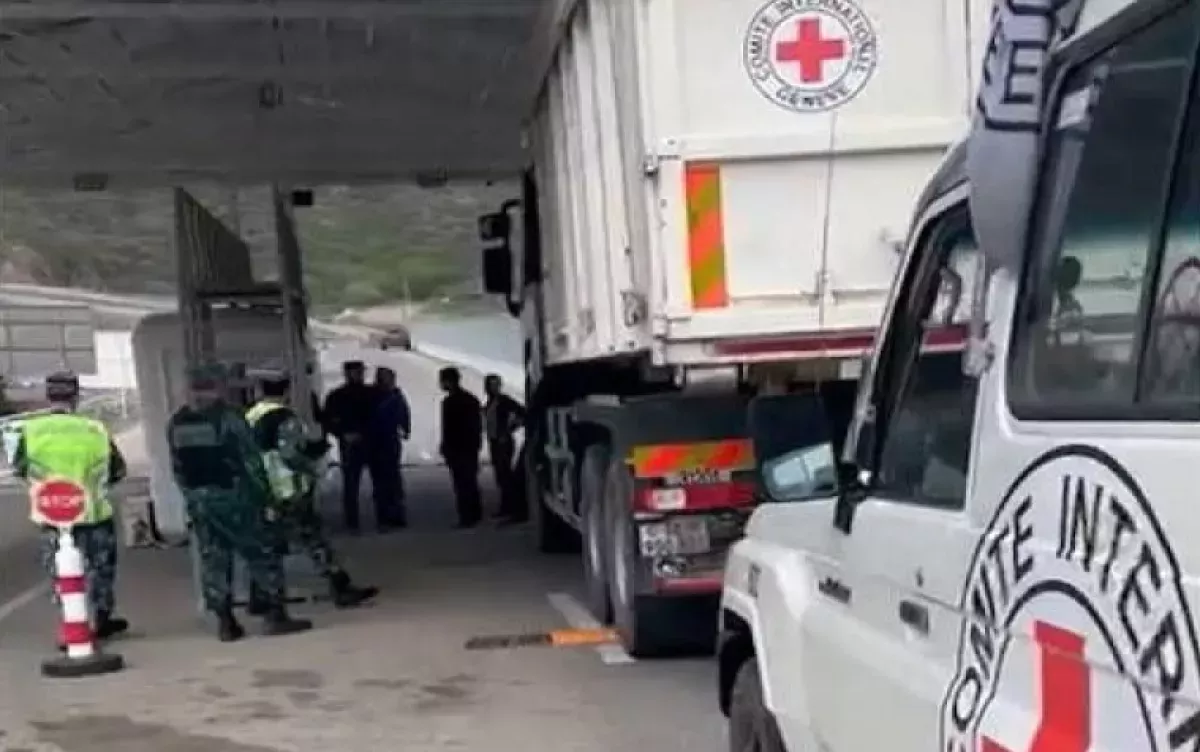
Between these two points in time, there were incidents involving contraband found in vehicles associated with the ICRC. For example, during a border inspection in Lachin, undeclared mobile phones, spare parts for them, power units, cigarettes, and fuel were discovered. The ICRC itself denied any involvement, stating that the contraband had been transported by hired drivers in their personal vehicles, which were “temporarily” bearing the organisation’s emblem. However, the very fact of such incidents—the transport of undeclared goods under the protection of a humanitarian emblem—undermined the foundations of trust and indicated at minimum serious deficiencies in the organisation’s control over its own operations.
Behind all these pages lies an older and carefully avoided chapter, without which it is impossible to understand the essence of the ICRC: during the Second World War, ICRC delegates visited Theresienstadt—a transit camp through which the Nazis sent Jews to extermination—and produced detailed, courteous reports describing acceptable living conditions. Between the Theresienstadt reports and the fate of fifty-four Azerbaijanis—visited, registered, and then lost—lies the same institutional habit: the prioritisation of careful procedural form over substance.
On May 8 in Geneva, the same seven words will once again be pronounced: humanity, impartiality, neutrality, independence, voluntary service, unity, and universality. Not a single word will be said about the 37 Azerbaijanis who were visited by delegates and never returned home—neither alive nor dead. And that is, perhaps, the most accurate thing that can be said about today’s Red Cross.
In the 19th century, Dunant spoke with the wounded. In our time, his successors in Geneva speak about themselves. Between these two periods lies everything that has happened to the organisation over one hundred and sixty-three years.







 editor@caliber.az
 +994 55 444-88-98
 Азербайджан, Баку, ул. Низами, 203, Af Business House, 5-й этаж