










The illusion of choice Summits in Yerevan and the old dilemma
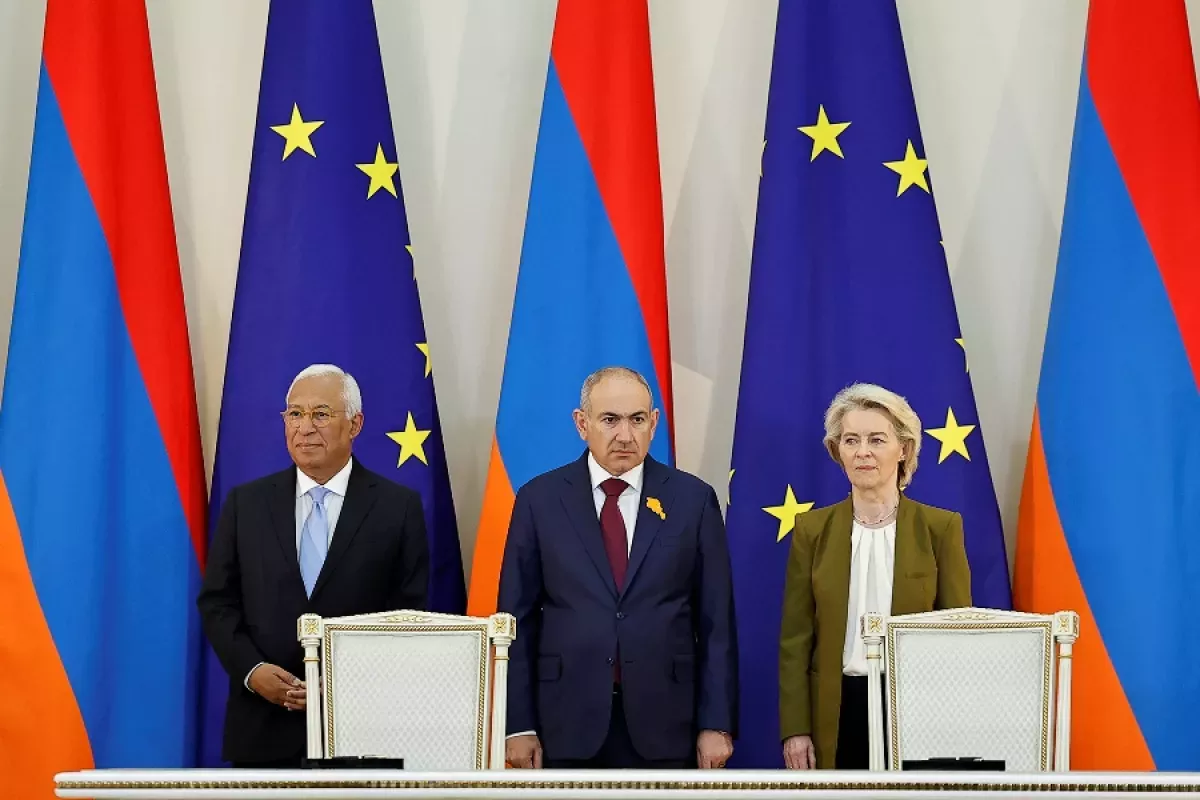
The 8th summit of the European Political Community and the first Armenia–EU summit, recently held in Yerevan, were portrayed by Armenian political and media circles as a historic diplomatic triumph. Across the country, officials and media outlets actively promoted the narrative that Armenia was finally breaking free from Russia’s sphere of influence and becoming part of a “new European architecture.” The very fact that such large-scale political events took place in Yerevan was presented as a symbol of international recognition and a geopolitical pivot.
However, behind the outward glamour of the summits lies a far more revealing picture. In reality, these gatherings became less a confirmation of Armenia’s independence than yet another demonstration that the country is once again turning into an arena for competition among external centres of power. And the louder Yerevan speaks about a “sovereign choice,” the more evident the old problem becomes — the chronic inability of the Armenian state to exist without an external patron.
Throughout its modern history, Armenia failed to develop a fully independent strategy, relying instead on external patronage — first in the form of the Soviet Union and, after its collapse, modern-day Russia. For decades, it was Moscow that shaped a significant part of Armenia’s strategic architecture. The Russian military base in Gyumri, Russian border guards, deep energy dependence, political influence, and the exceptionally close ties between Armenian elites and the Russian system were all presented as part of an “allied model.” In reality, however, this was a classic structure of dependency by a small state on a major power. Moscow viewed Armenia primarily as an instrument for maintaining its own influence in the South Caucasus. Yerevan mattered not in and of itself, but as an element of Russia’s geopolitical infrastructure. This is precisely why Armenian statehood existed for years under conditions of limited strategic sovereignty.
After the “Velvet Revolution” of spring 2018 — and especially following the events of 2020 — this model began to unravel. Disillusionment with Russia started to accumulate rapidly within Armenian society, particularly after Moscow demonstrated that both its capabilities and its willingness to unconditionally defend Armenian interests had very clear limits. Against this backdrop, Yerevan began a sharp political and psychological pivot towards the West.
But here arises a key question that the Armenian political elite prefers to avoid: “Does the West see Armenia as a value in its own right?” Judging by current developments — the answer is no.
Today, France and the European Union view the country primarily as a convenient instrument for weakening Russia’s position in the South Caucasus. Paris is significantly increasing its engagement with Armenia, not because it is ready to assume full responsibility for the security of a “younger sister,” but for a far more pragmatic reason — France needs a new foothold of influence in a region where Moscow is rapidly losing its monopoly control.
This is precisely why, during and after the summits in Yerevan, Western politicians began to speak so actively about Armenia’s “democratic choice,” its “European future,” and a “new security architecture.” The problem is that behind all this rhetoric there is an almost complete absence of real guarantees.
Neither Paris nor Brussels is prepared to fight for Armenia. The maximum the West is willing to offer is diplomatic support, limited military cooperation, the supply of certain types of weapons, intelligence and monitoring missions, political statements, and symbolic visits. However, when it comes to direct security commitments, the enthusiasm quickly fades.
This is where the main risk of Armenia’s current course lies. Yerevan is becoming increasingly drawn into the geopolitical confrontation between Russia and the West, while lacking both the resources and the resilience required to function as a platform for such a conflict.
In effect, Armenia is beginning to replicate the model of states that become front-line spaces for the conflicts of external powers. And here, comparisons with Ukraine are increasingly being drawn. Of course, this is not about a direct replication of scenarios — the scale, conditions, and regional specifics are different. But the underlying logic of the processes looks familiar.
A small state gradually moves into the category of what can be described as a “space of strategic rivalry between major powers.” Society becomes polarised. Foreign policy starts to be built on emotional opposition between one camp and another. Inside the country, a dangerous illusion takes shape — that a new external patron can resolve fundamental security problems.
The Ukrainian crisis clearly demonstrated what can happen when a state is turned into an arena for someone else’s geopolitical confrontation. Massive human losses, a devastated economy, a demographic catastrophe, and years of instability have become the price of a global confrontation in which each side, above all, pursues its own interests.

Today, Armenia is beginning to move in a similar direction — albeit on a significantly smaller scale for now. What is particularly dangerous is that an increasingly strong atmosphere of ideological division is taking shape within Armenian society itself. The so-called “pro-Russian” and “pro-Western” segments of society are increasingly perceiving each other as internal adversaries.
Political debate is being replaced by emotional mobilisation. Any attempt to advocate a pragmatic balance is automatically labelled either as “betrayal of Europe” or “betrayal of Russia.” This is an extremely dangerous trend, especially for Armenia, which remains a country with serious demographic problems, high dependence on external factors, and a highly vulnerable economy. Mass emigration has been ongoing for years. The military system is undergoing a severe crisis after the defeat in the Second Karabakh War.
Within such parameters, the transformation of the republic into a platform for geopolitical rivalry is not a sign of strength, but a symptom of strategic weakness.
It is precisely in this context that the recent EPC and EU summits in Yerevan became important not only as diplomatic events. They also served as symbols of Armenia’s entry into a new phase of external dependence.
Previously, the Armenian elite sincerely believed that Russia was obliged to ensure Armenia’s security by virtue of a “historical alliance.” Today, similar expectations are gradually being shifted onto the West. But geopolitics works differently. Major powers do not engage in charity; they use smaller states precisely as long as it serves their strategic interests.
For many years, Moscow treated Armenia as an outpost of its own influence in the Caucasus. Today, the West is gradually beginning to use it as an instrument of pressure on Russia. The difference lies in the labels, rhetoric, and political language. The essence remains strikingly similar.
Against this backdrop, talk of a “fully independent Armenian policy” appears more like a political narrative than a reality. Genuine independence implies the ability to maintain balance, avoid turning one’s territory into an arena of external confrontation, and pursue a policy driven primarily by national interests.
And for now, Armenia seems to be moving in a closed historical loop: external patrons, diplomatic slogans, and international visitors change, but the underlying pattern remains the same. The country once again becomes someone else’s project. And this may ultimately be the main takeaway from the recent summits.







 editor@caliber.az
 +994 55 444-88-98
 Азербайджан, Баку, ул. Низами, 203, Af Business House, 5-й этаж