










Azerbaijan advancing peace agenda in South Caucasus — presidential aide says
Azerbaijan is now approaching international platforms with a peace-focused agenda, marking a significant shift from previous years dominated by conflict-related discussions, Assistant to the President of Azerbaijan Hikmet Hajiyev said.
Speaking at the panel session “South Caucasus: A Strategic Hub in the Making” during the Antalya Diplomacy Forum, Hajiyev stressed that the war in the region has come to an end and that Baku is committed to long-term normalisation with Armenia.
“Before coming to the Antalya diplomatic forum, some other forums and diplomatic gatherings, we always came with the agenda and luggage of war and conflict. But now I am extremely glad to say that we are coming with the agenda of peace,” he said. “There is no longer war and conflict in the South Caucasus — the war is over.”
Hajiyev underlined Azerbaijan’s adherence to agreements reached within the Armenia-Azerbaijan normalisation framework, noting that progress has already been formalised.
“Azerbaijan is completely committed to the agenda and also the letter and spirit of the Washington Summit, where in the presence of President Donald Trump, we endorsed the Armenia-Azerbaijan normalisation process. The normalisation agreement between the two countries has also been initialled,” he said.
At the same time, Hajiyev emphasised that agreements must go beyond formal documents and be implemented through tangible steps on the ground.
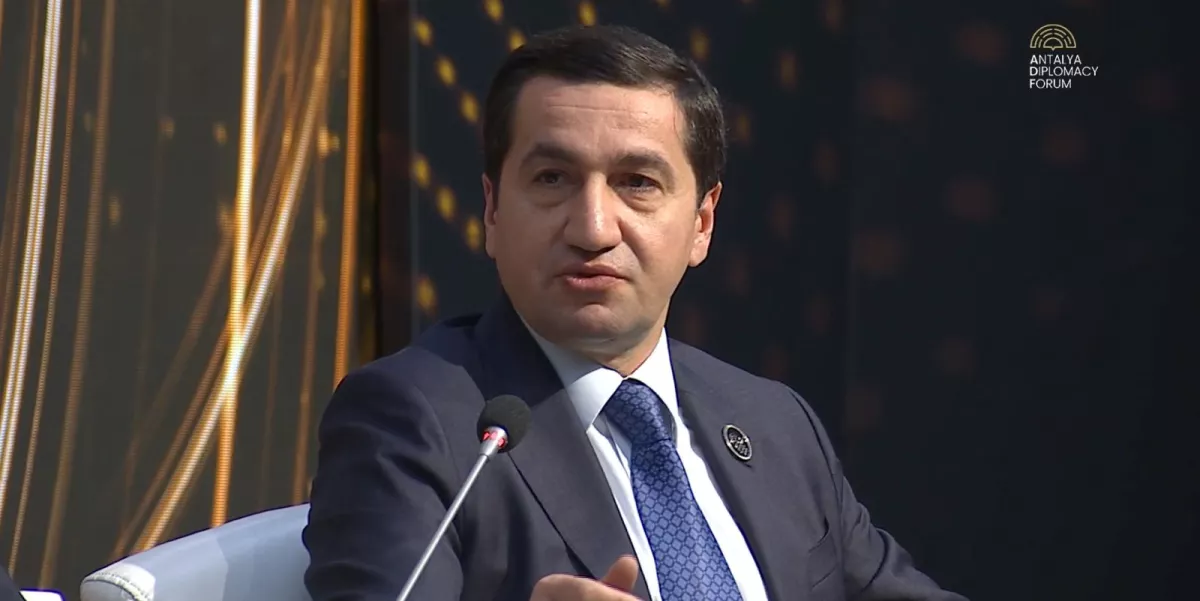
“We also understand that there can be very nice documents between the countries, but they should not be confined to paper. We should take practical actions,” he noted. “Azerbaijan has demonstrated this by implementing pragmatic interaction with the Armenian side to solidify the peace agenda and translate it into concrete steps.”
According to him, progress is being made not only at the official level but also in broader engagement formats.
“In that context, track one is advancing well. We are also trying to catch up track two to track one, including civil society engagement between the two countries,” Hajiyev said.
He pointed to emerging economic interaction as a notable development.
“Trade relations between Armenia and Azerbaijan have already started — something that would have been unprecedented just a couple of years ago. The recent volume of Azerbaijan’s oil products exported to Armenia confirms this, and we are also considering importing certain goods from Armenia,” he added.
Hajiyev said these developments are contributing to the formation of a new regional reality.
“Based on this, we have built a new status quo in the South Caucasus. This new status quo is based on legality and legitimacy and serves the best interests of both countries,” he stated.
He also highlighted efforts to establish a sustainable regional security framework.
“We are building a new regional security architecture that in the long term can provide peace and security to our countries,” he said.
Touching upon the broader geopolitical environment, Hajiyev noted that the South Caucasus is located near active conflict zones.
“The region is surrounded by new hotspots of conflict. In our immediate neighbourhood, we see the Russia-Ukraine war in the north and tensions involving the United States, Israel, and Iran in the south,” he said. “Against this backdrop, real peace on the ground provides a form of immunity and security for both Armenia and Azerbaijan.”
Looking ahead, Hajiyev expressed optimism about inclusive regional cooperation.
“We see an inclusive South Caucasus, with prospects for cooperation between Georgia, Armenia, and Azerbaijan,” he said. “At the bilateral level, we have excellent cooperation with Georgia, and trilateral cooperation between Türkiye, Azerbaijan, and Georgia is also well developed. Ultimately, we believe an inclusive model of regional cooperation will emerge.”







 editor@caliber.az
 +994 55 444-88-98
 Азербайджан, Баку, ул. Низами, 203, Af Business House, 5-й этаж