










Iranian tankers use fake signals to evade detection in Strait of Hormuz
Marine tracking data indicates that Iranian-linked oil tankers are using false location signals to evade detection while transporting sanctioned crude through the Strait of Hormuz, ABC News reports.
Since late February, the strait has been effectively under a military blockade by Iranian forces, following attacks by US and Israeli forces on Iranian targets. European leaders have ruled out sending warships to the area, despite threats from US President Donald Trump that NATO could face a “very bad” future if it fails to help reopen the global supply chokepoint.
ABC News Verify obtained vessel-tracking data from Starboard Maritime Intelligence, which monitors maritime activity. The data shows tankers employing a method called “AIS spoofing” to conceal cargo loading points and movements through the Persian Gulf. AIS, or automatic identification system, uses transponders to track vessel positions, but spoofing allows ships to present false locations, giving sanctioned oil a veneer of legitimacy.
Oil shipment monitoring group TankerTrackers reported that up to 2 million barrels of Iranian crude were loaded at Kharg Island on March 13, describing the operation as “business as usual.” Analysts at Kpler estimated that Iran exported around 12 million barrels between February 28 and March 12.
ABC News Verify examined the movements of the tanker Ocean Guardian to illustrate how AIS spoofing facilitates these operations. According to Starboard Maritime analyst Mark Douglas, Ocean Guardian and a sister vessel completed at least 30 shipments from Iran in 2025. Earlier this year, the tanker sailed under Panama’s flag and is owned by “New Horizon Maritime Co SA,” registered at the Manarat Alkhaleej Marine Services FZE Office. Both the company and the vessel have been designated “Iran-related” by the US Office of Foreign Assets Control.
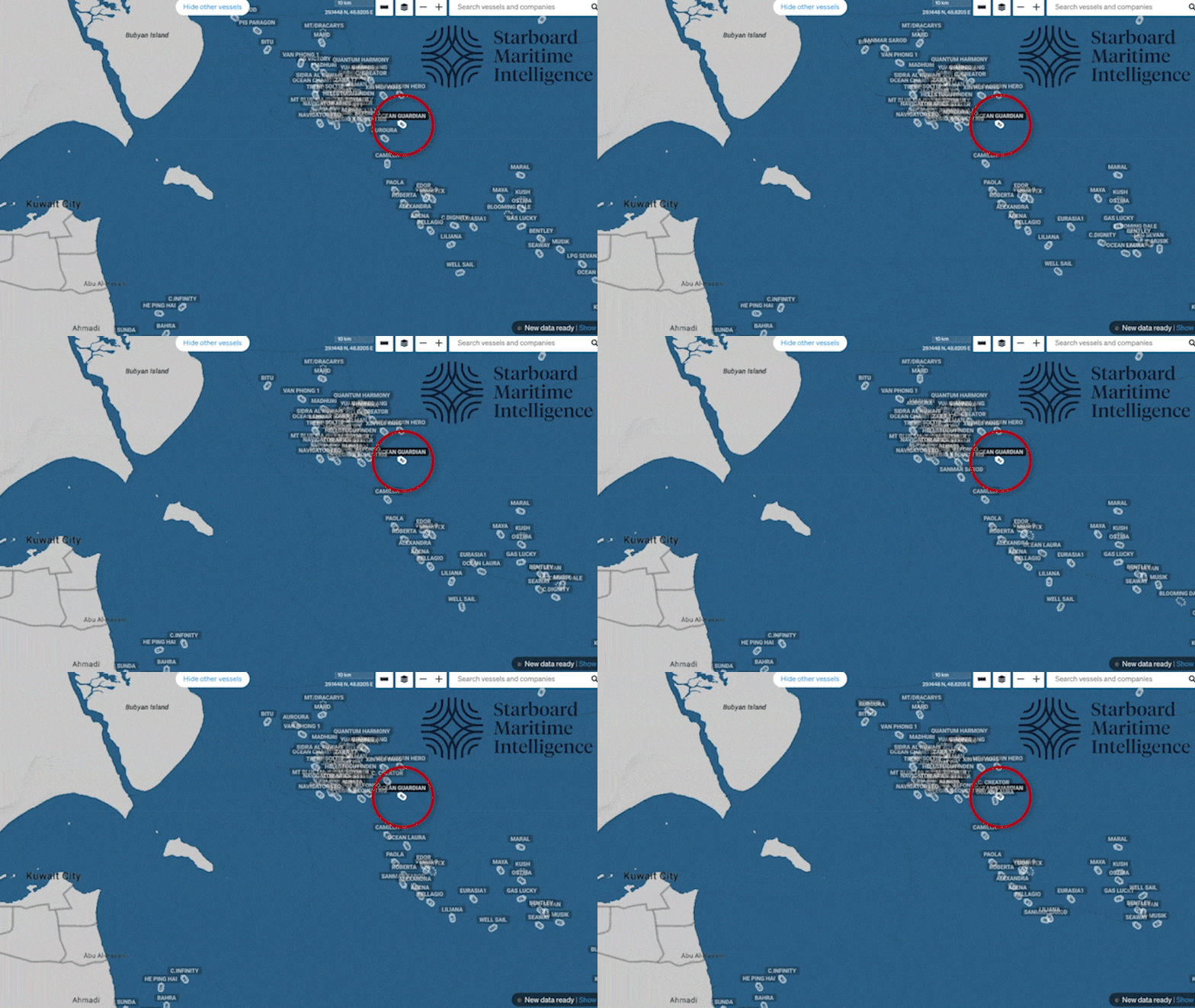
Tracking data shows that in early February, Ocean Guardian appeared completely stationary in the northern Persian Gulf. “All the vessels around it are swinging on their anchors,” Douglas noted. “Vessels don’t stay perfectly still in real life. Even when they’re anchored, they move around as the tide and the wind push them around. But this vessel seems to be completely resistant to all forces of nature.”
Synthetic aperture radar (SAR) imagery further confirmed the vessel was not at the location it claimed. “What you’re seeing is a sanctioned vessel providing weeks of false AIS data as it moves through the Strait of Hormuz and Persian Gulf,” Douglas said. “The vessel is almost certainly doing this to hide the loading of Iranian oil at a terminal in the Northern Persian Gulf.”
Sanctioned tankers often change names, ownership, or flags to avoid detection, a practice that is not illegal but can delay tracing by authorities. Ocean Guardian shares its International Maritime Organization (IMO) number with another vessel, Danube, which underwent a draught increase from 7.5 to 10.5 meters on March 12—indicating it had loaded cargo. Starboard Maritime data shows the tanker then moved quickly south through the Strait of Hormuz, briefly appearing to cross over land, before likely resuming legitimate AIS signals or reflagging to obscure its original location.
Douglas said the vessel is likely heading to Asia, possibly China, to offload its oil. “Tankers carrying sanctioned cargo will continue to use loopholes like AIS spoofing during the war,” he said. “The current pressure on commodities is unlikely to have a significant impact on this practice.”
By Vafa Guliyeva







 editor@caliber.az
 +994 55 444-88-98
 Азербайджан, Баку, ул. Низами, 203, Af Business House, 5-й этаж