










Politico: Four key revelations from Justice Department's Epstein file release
On December 23, a new batch of documents related to onvicted child sex offender Jeffrey Epstein was released, providing additional insight into ongoing investigations by Justice Department (DOJ) and revealing new details about individuals connected to the deceased financier.
The documents include evidence about Prince Andrew, Amazon's non-compliance with subpoenas, a photo of Donald Trump and Ghislaine Maxwell, and a letter from Epstein to Larry Nassar.
Below are the key takeaways from the release, as collected by POLITICO.
1. Prince Andrew’s involvement
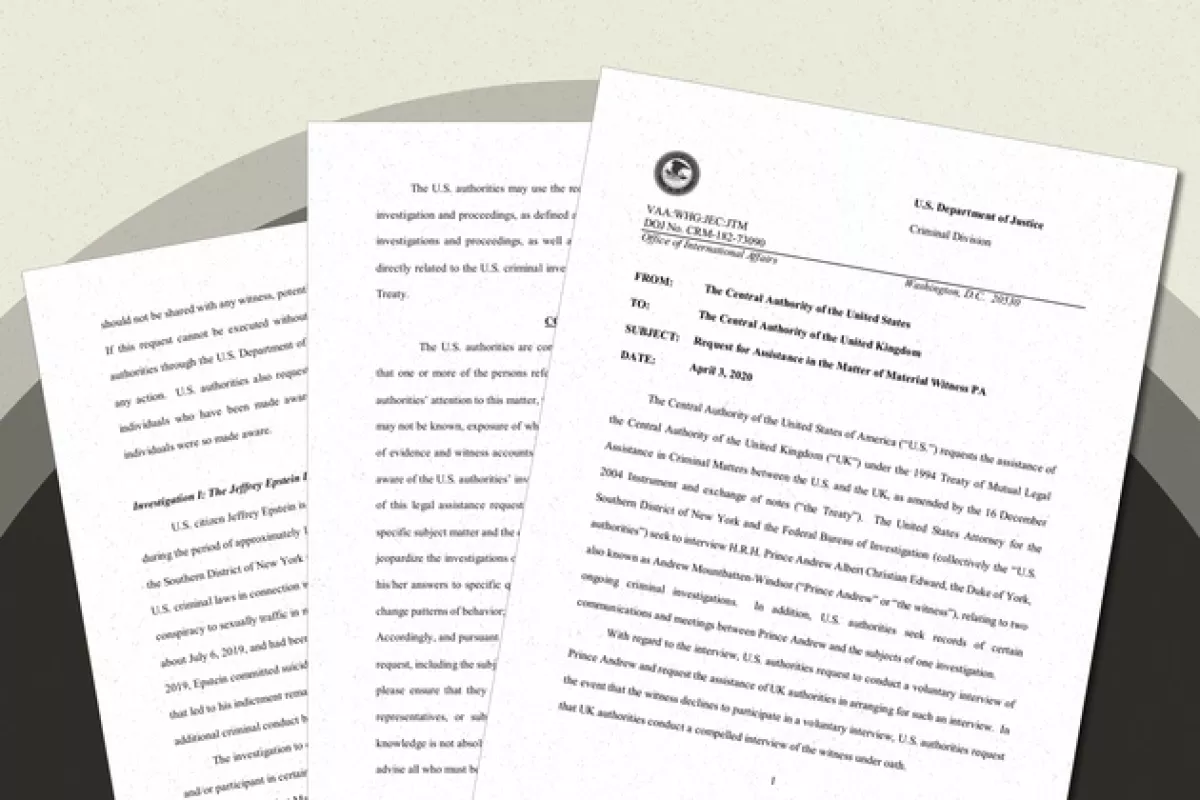
The newly released documents suggest that federal prosecutors had gathered evidence that Prince Andrew (Mountbatten-Windsor) “engaged in sexual conduct” with one of Epstein’s victims, according to a document in the latest batch of Epstein files.
A request from US authorities to UK officials in April 2020 sought to compel an interview with Prince Andrew, stating they had evidence that Mountbatten-Windsor “was present” for “certain” interactions between a victim, Epstein and Maxwell, and of “documentary” evidence that Andrew “had knowledge” that Maxwell “recruited females to engage in sex acts with Epstein and other men.”
Prosecutors also wrote that they had evidence of Prince Andrew’s sexual conduct involving one of Epstein’s victims. The documents reveal that prosecutors sought to question him about a sex-trafficking probe involving fashion mogul Peter Nygard, with whom Mountbatten-Windsor had traveled to the Bahamas.
A 2025 email from a London police official suggests an ongoing investigation into his activities concerning a person, whose name is redacted, and alleged efforts to gather information about her through his protection officers.
2. Amazon’s contempt threat
In August 2019, just days before Epstein’s suicide in jail, the Justice Department threatened to hold Amazon in contempt after the company failed to produce documents related to the investigation. The company had ignored multiple requests from the FBI for documents, the investigator said. When Amazon did respond, much of the information was heavily redacted, prompting further demands for compliance.
FBI investigators indicated that Amazon had ignored repeated requests for documents, and when Amazon responded, the materials were heavily redacted. Investigators demanded full compliance, stating the provided documents were insufficient.
3. Investigators discuss apparent photo of Trump and Maxwell on Bannon’s phone
An investigator discovered an apparent photo of US Presdient Donald Trump and Epstein's accomplice, British former socialite and convicted child sex offender, Ghislaine Maxwell on the phone of Steve Bannon, a former advisor to Trump, during a probe into Bannon’s activities. The investigator flagged the image, but later emails suggested that no further action was necessary in relation to the photo.
Bannon had previously exchanged text messages with Epstein, linking him to the broader investigation, though the significance of the photo remains unclear.
4. DOJ dismisses Epstein note to Nassar, referencing Trump as “fake”
The documents also included a letter that appeared to be a suicide note from Epstein to Larry Nassar, the convicted sex offender.
The note referenced Trump’s lewd comments about women, which were revealed in the 2016 Access Hollywood tape.
However, DOJ officials said in a statement “the FBI has confirmed this alleged letter from Jeffrey Epstein to Larry Nassar is FAKE. The fake letter was received by the jail, and flagged for the FBI at the time.”
Trump and Epstein were friendly in the 1990s and early 2000s, with Trump often socialising with Epstein and flying on his private jet. However, Trump has previously stated that their relationship soured years ago, reportedly over Epstein’s attempt to hire employees from Mar-a-Lago.
The release also includes records showing that prosecutors issued a subpoena for Trump's holiday resort Mar-a-Lago employment records in connection with Ghislaine Maxwell’s sex-trafficking trial in 2021. Details of the subpoena remain redacted.
In response to the release, a White House spokesperson pointed to a Justice Department statement issued on December 23, which asserted that some of the documents contained "untrue and sensationalist claims" about President Trump. The statement further emphasised that if the claims had any credibility, they would have been used against Trump during the 2020 US election.
By Sabina Mammadli







 editor@caliber.az
 +994 55 444-88-98
 Азербайджан, Баку, ул. Низами, 203, Af Business House, 5-й этаж