










Researchers show how web of underwater cables can be used for earthquake detection
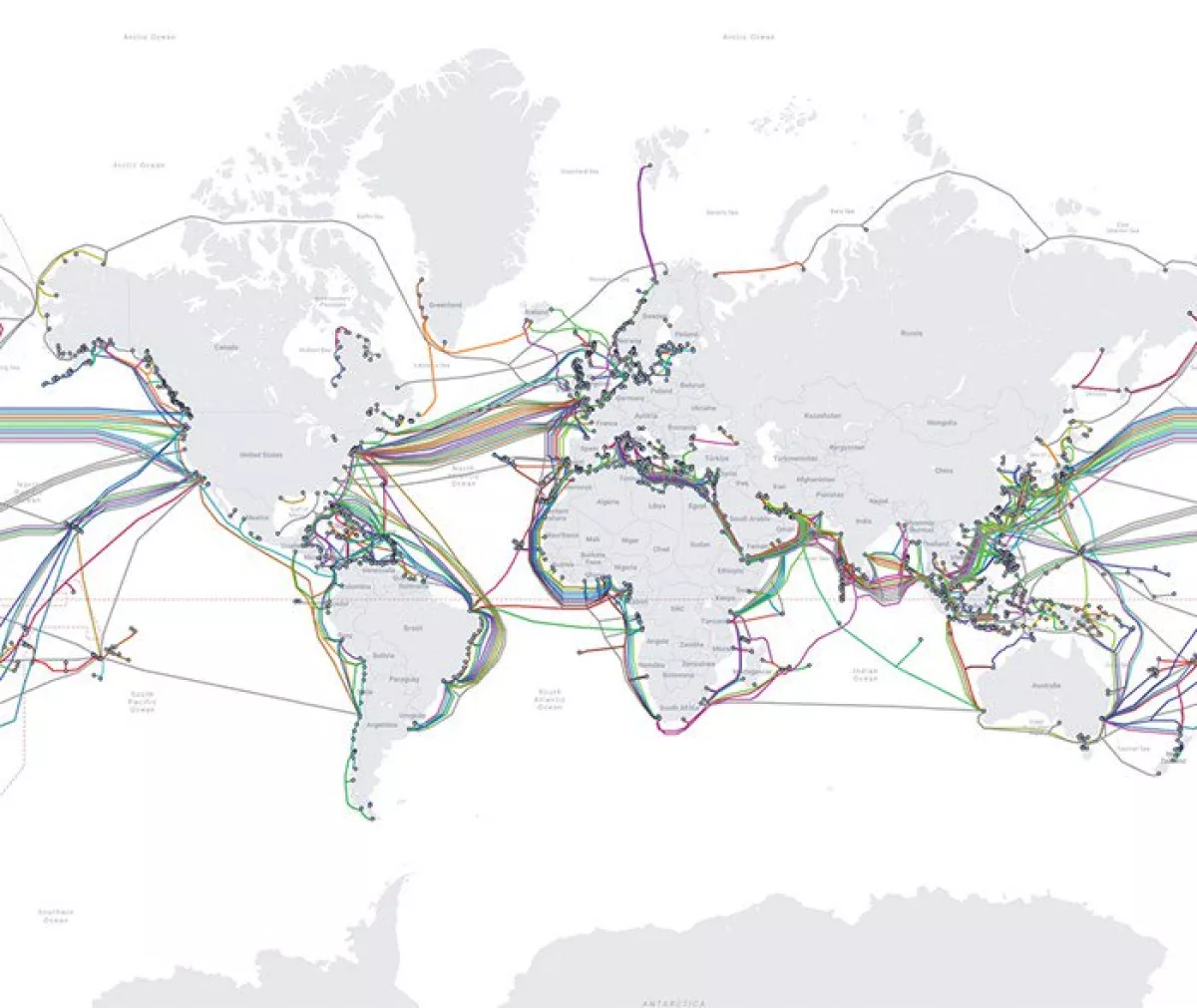
Forecasting earthquakes is a difficult task on land, but in the oceans, which cover around 70% of the Earth’s surface, it has been considered nearly impossible. Researchers, however, are exploring how the extensive network of undersea fibre-optic cables used for global telecommunications could be repurposed to monitor tectonic activity that causes earthquakes and tsunamis.
A project called “Fibre Optic Cable Use for Seafloor” (FOCUS) aims to improve understanding of fault dynamics and the potential for seismic events. The initiative is led by German-French geophysicist Marc-André Gutscher, who shared details of the project in an article on The Conversation.
The project’s primary research area was a recently mapped tectonic fault on the Mediterranean seafloor, roughly 30 km from Catania, Sicily. Situated at the foot of Mount Etna, Europe’s highest and most active volcano, this strike-slip fault—a type of vertical fracture in the Earth’s crust—is particularly prone to triggering earthquakes.
Eastern Sicily, including Catania, which has a population of about one million, has experienced several catastrophic earthquakes over the centuries. The 1908 Messina earthquake and subsequent tsunami, with a magnitude of 7.2, claimed 72,000 lives, while the 1693 Catania earthquake, estimated at magnitude 7.5, destroyed most large buildings in the city and killed approximately 60,000 people.
Catania also hosts the INFN-LNS nuclear physics institute, which operates an offshore cabled seafloor observatory. Originally built as a test site for the institute’s neutrino telescope 100 km away, the southern branch of the 29 km electro-optical cable ends just 2.5 km from the newly mapped strike-slip fault.
The FOCUS project involved deploying a specially designed strain cable across the fault to detect tectonic movements. Even minor shifts would tug on the cable and elongate the optical fibres, which can be measured by analyzing laser light transmitted through the fibres.
In 2020, the team conducted its first marine expeditions at the INFN-LNS site, connecting a 6 km strain cable with specialized sensor fibers to the seafloor observatory. Using an underwater plough, the cable was buried about 20 cm below the seabed, crossing the fault at four locations approximately 1 km apart. Eight acoustic beacons were also deployed—four on each side of the fault—to independently measure any movement. Laser light was fired every two hours through the 29 km electro-optical cable and into the FOCUS strain cable, which incorporated a triple loop to extend the total optical path to 47 km.
About a month later, in November 2020, a natural disturbance in the FOCUS cable was detected, showing an elongation of 1.5 cm at the first fault crossing, most likely caused by a submarine landslide. A second disturbance occurred in September 2021 after the researchers placed 100 weight bags on the cable to test sensitivity. While neither event reflected tectonic activity, both demonstrated that undersea cables could reliably detect seabed disturbances.
A secondary study involved commercial telecommunication cables connecting the islands of the Guadeloupe archipelago in the Caribbean Sea. Between 2022 and 2024, the FOCUS team, in partnership with IDIL fibre optics, performed BOTDR measurements at intervals of 3-6 months. The results confirmed that even standard commercial cables can provide accurate and sensitive readings, capable of detecting mechanical disturbances and serving as tools for long-term environmental monitoring.
According to the project's team, these findings highlight the potential for transforming much of the world’s vast submarine telecom network into a global system of seismological and environmental sensors, offering a new approach to monitoring earthquakes and seabed activity.
By Nazrin Sadigova







 editor@caliber.az
 +994 55 444-88-98
 Азербайджан, Баку, ул. Низами, 203, Af Business House, 5-й этаж