










"Shahed-clones" integrated into Pentagon's latest deployment to Middle East
For the first time, the US military has deployed an operational unit equipped with Low-Cost Uncrewed Combat Attack System (LUCAS) loitering munitions—kamikaze drones reverse-engineered from the Iranian-designed Shahed-136—in the Middle East. The creation of Task Force Scorpion Strike (TFSS) marks a significant milestone and offers a means to, as one US official put it, “flip the script on Iran.”
US Central Command (CENTCOM) announced TFSS as a direct outcome of Secretary of War Pete Hegseth’s “Unleashing US Military Drone Dominance” initiative launched earlier this year, according to a report by The War Zone.
The unit is positioned under US Special Operations Command Central (SOCCENT), which oversees special operations across the Middle East. CENTCOM’s Rapid Employment Joint Task Force (REJTF)—created in September to accelerate new capabilities—was also involved in the deployment.
As previously reported, the TFSS consists of roughly two dozen personnel tasked with overseeing drone implementation and operations, a US official told the publication on condition of anonymity. The delta-wing LUCAS system, measuring about three meters in length with a wing span of approximately 2.4 meters, was developed by Arizona-based SpektreWorks alongside the US military.
The design offers “autonomous coordination, making them suitable for swarm tactics and network-centric strikes,” the official added.
With a price tag of about $35,000 per drone, LUCAS represents a low-cost and scalable capability that provides sophisticated long-range strike options at a fraction of the expense of comparable US systems.
“LUCAS drones deployed by CENTCOM have an extensive range and are designed to operate autonomously,” CENTCOM said in a press release. “They can be launched with different mechanisms to include catapults, rocket-assisted takeoff, and mobile ground and vehicle systems.”
Sources also note that the so-called “Shahed-clones” are capable of launch not only from land but through a variety of platforms.
The core LUCAS design is directly based on the Shahed-136. “The US military got hold of an Iranian Shahed,” a US official said. “We took a look and reverse-engineered it. We are working with a number of US companies in the innovation space.”
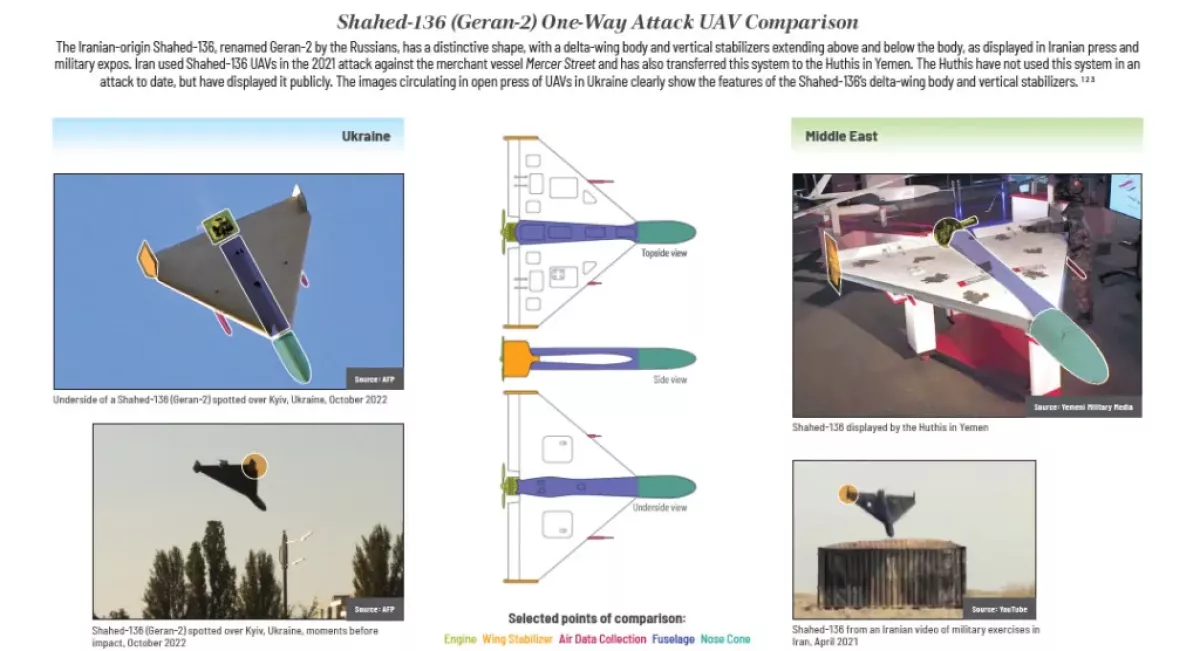
“The LUCAS drone is the product of that [reverse-engineering] effort,” they added. “It pretty much follows the Shahed design.”
For reference, the baseline Shahed-136, powered by a 50-horsepower piston engine, travels at about 185 kilometers per hour and has a maximum range of 2,000 kilometers while carrying a 40-kilogram warhead, according to the US Army’s Operational Environment Data Integration Network (ODIN).
The Iranian system is intended for pre-programmed strikes on fixed targets, though Iran and Russia have progressively introduced variants with additional guidance and dynamic targeting features, including jet-powered derivatives and Russia’s growing Geran series.
By Nazrin Sadigova







 editor@caliber.az
 +994 55 444-88-98
 Азербайджан, Баку, ул. Низами, 203, Af Business House, 5-й этаж