










South Korea fields Hyunmoo-5: non-nuclear “doomsday” missile
South Korea has begun deploying one of the most powerful conventional ballistic missiles ever developed, marking a major shift in its ability to deter North Korea without nuclear weapons. The Hyunmoo-5 missile, armed with a massive 8-ton penetrator warhead, is designed to destroy the most heavily fortified underground bunkers in the DPRK—including shelters used by Kim Jong Un himself.
According to The Korea Herald, citing its own sources, the deployment of Hyunmoo-5 has already begun. While the exact number of missiles entering service remains undisclosed, the process reportedly started in late 2025 and is expected to continue through 2030.
As noted by Defense Express, Hyunmoo-5 was first publicly unveiled in October 2024 during events marking the 76th anniversary of South Korea’s national armed forces. Two launchers were displayed simultaneously, mounted on large 9×9 wheeled chassis equipped with all-wheel steering, allowing lateral maneuvering.
The missile’s first tests reportedly took place earlier that same summer, although its earliest official mention dates back to October 2022, when a parliamentary defence committee transcript referred to a missile carrying an 8-ton payload with a total launch weight of 36 tons.
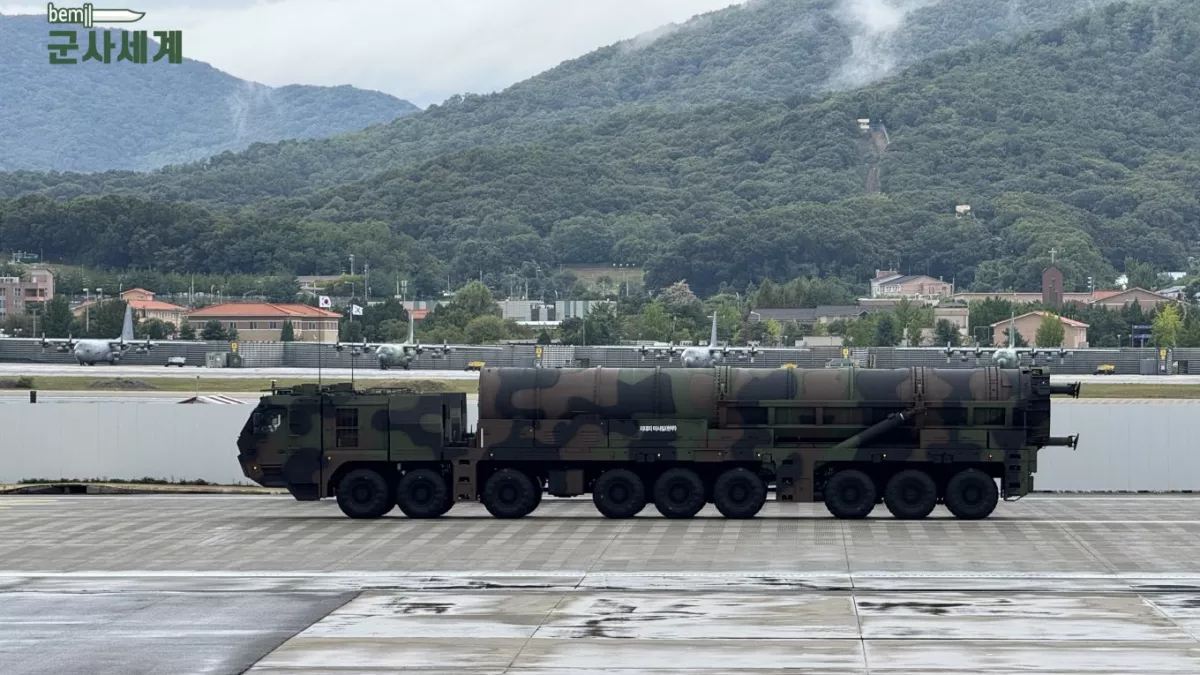
Although this suggests a development timeline of just over four years, Hyunmoo-5 rests on a far deeper technological foundation. South Korea’s ballistic missile efforts began in the 1970s, when US Nike Hercules surface-to-air missiles were converted into improvised ballistic weapons under the Hyunmoo-1 programme.
Fully indigenous missile development only emerged in the 1990s, with major acceleration in the 2000s through the Hyunmoo-2 and Hyunmoo-3 families, which fielded multiple variants with ranges of 300 km and 500 km. In this context, the conceptual and engineering groundwork for Hyunmoo-5 spans decades rather than years.
The missile’s range remains contested. Estimates vary widely, with some sources suggesting just 600 km, others up to 3,500 km, and claims that a reduced 1-ton warhead could extend the range to 5,500 km.
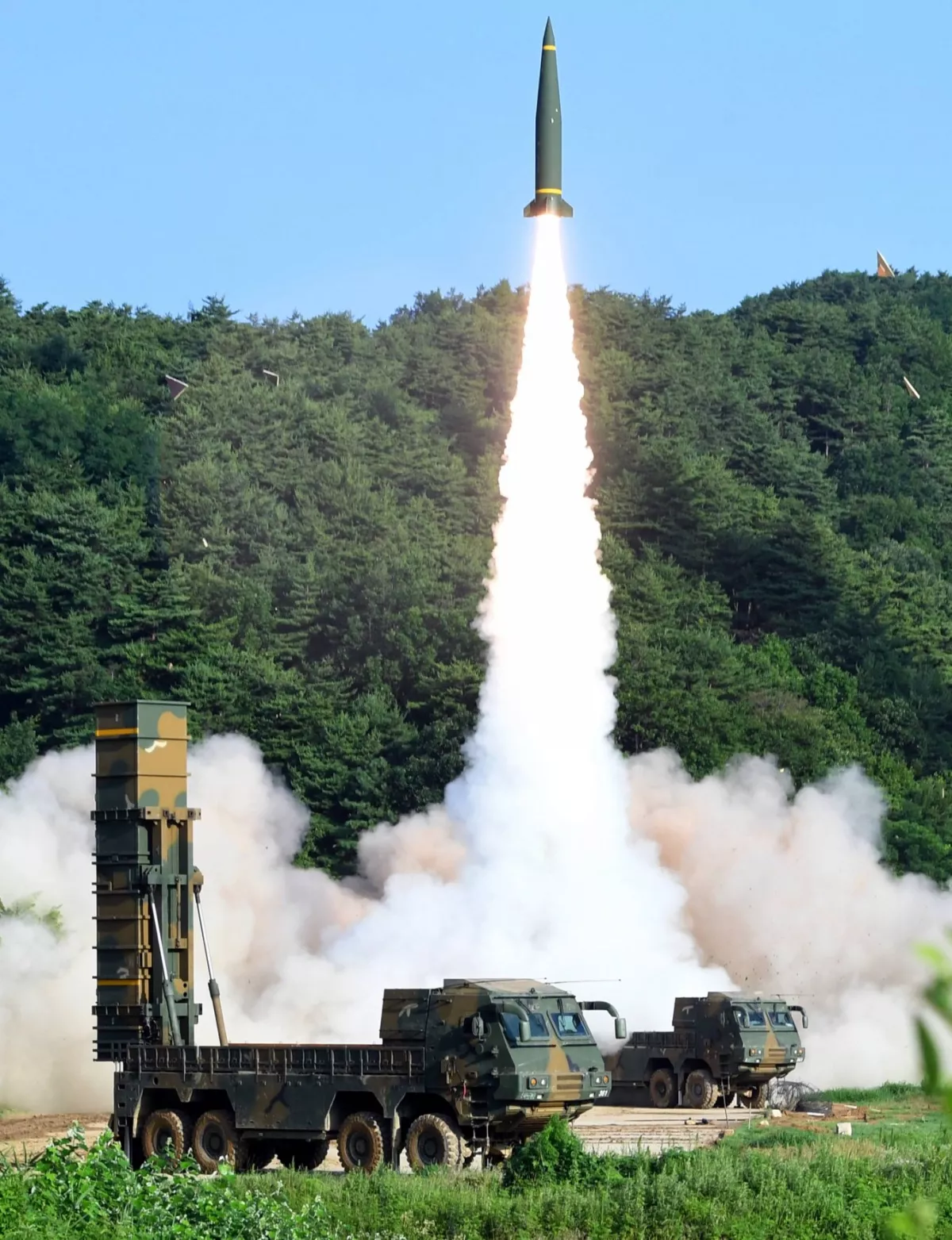
For its primary mission—striking hardened North Korean targets—600 km is fully sufficient. Until 2021, South Korea was constrained by agreements with the United States that capped missile range at 800 km, itself a relaxation of the earlier 300 km limit imposed in 2012.
The defining feature of Hyunmoo-5 is its extraordinary warhead mass, intended to penetrate dozens—or even more than a hundred—meters of soil and reinforced concrete before detonating. For comparison, the US GBU-57 Massive Ordnance Penetrator weighs 13.6 tons, with only 2.7 tons comprising the actual warhead, and has been used against Iranian nuclear facilities.
However, the GBU-57 is delivered by a B-2 Spirit bomber from altitudes of up to 15 km. By contrast, Hyunmoo-5’s penetrator descends from tens of kilometers; a ballistic trajectory implies an apogee well above 50 km, yielding far greater impact velocity and kinetic energy—and thus penetration capability.
Hyunmoo-5 is a cornerstone of South Korea’s non-nuclear deterrence doctrine toward the DPRK, known as “massive punishment and retaliation.” This concept envisions devastating precision strikes against North Korea’s leadership and strategic assets in response to aggression, with the explicit aim of reaching even the deepest bunkers.
At the same time, Defense Express notes that should Seoul ever choose a nuclear path, it would already possess a medium-range ballistic missile platform—particularly relevant given that the distance from Seoul to Beijing is roughly 950 km.
By Sabina Mammadli







 editor@caliber.az
 +994 55 444-88-98
 Азербайджан, Баку, ул. Низами, 203, Af Business House, 5-й этаж