










Armenian fake-making: from San Lazzaro degli Armeni to Karabakh’s Ganjasar
The recent visit by representatives of the diplomatic corps accredited in Azerbaijan to the liberated territories of Karabakh and Eastern Zangezur triggered what can only be described as an inexplicable outburst of hysteria and fiery flare-ups from various quarters of Armenia’s political and public establishment.
Thick smoke and long tongues of flame rose over Armenia especially after Amy Carlon, Chargé d’Affaires of the US Embassy in Azerbaijan, proposed observing a minute of silence in memory of the martyrs who died during the liberation of Karabakh, as well as after video footage emerged showing the guests touring the reconstructed Khankendi, walking through the “Khan’s Village”, and attending a lavish gala reception accompanied, as is customary, by performances from artists and lively dancing in the heart of Karabakh — liberated Shusha — with the active participation, incidentally, of the foreign guests themselves.
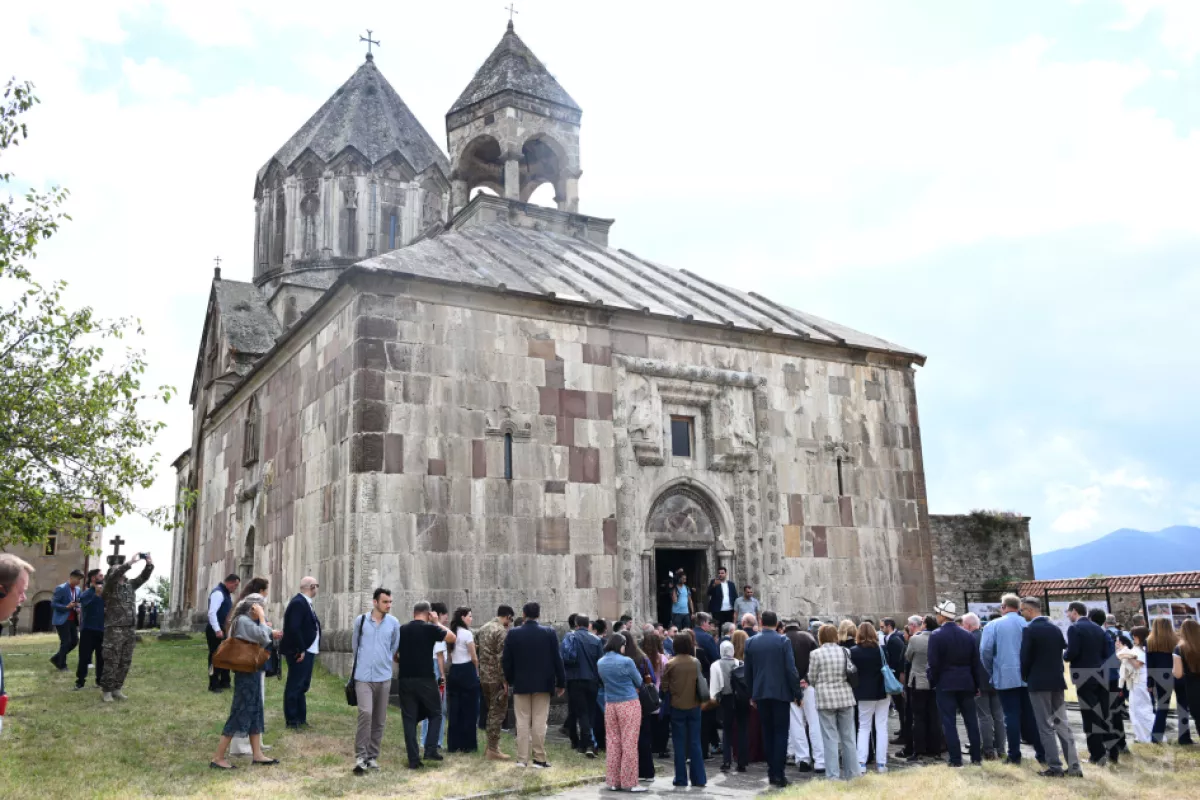
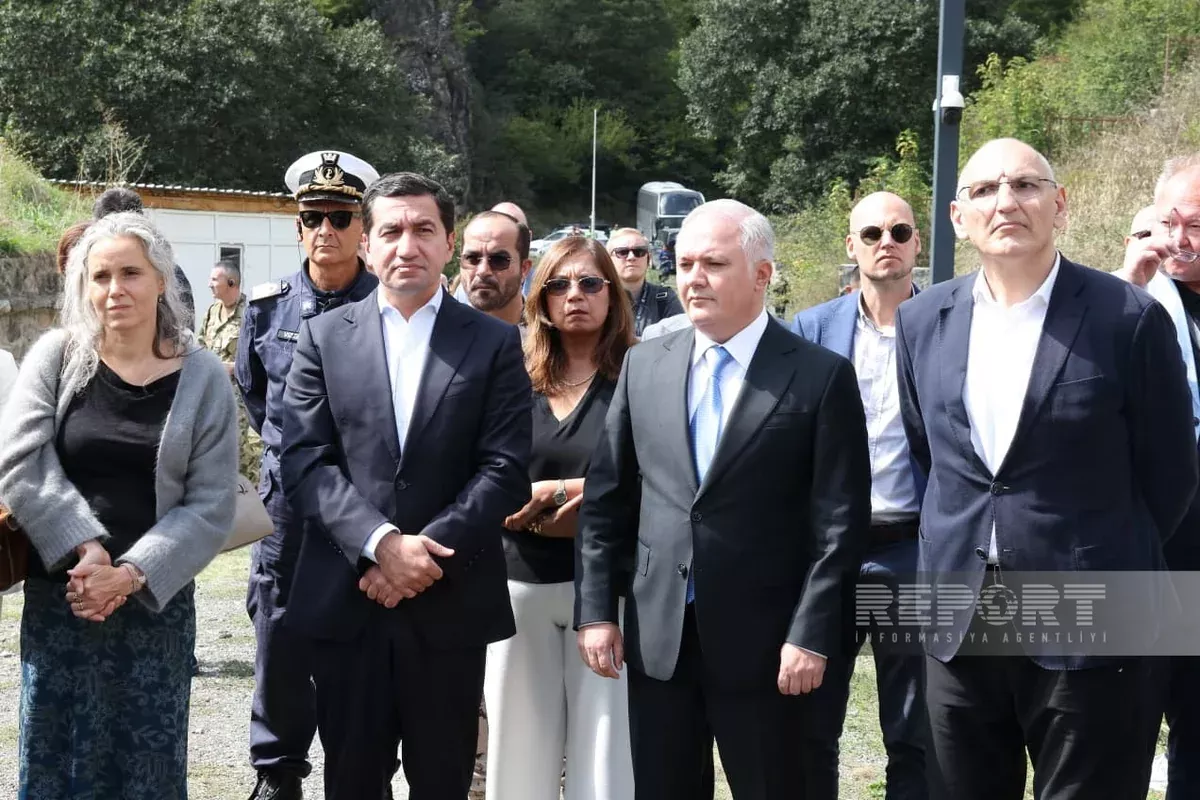
However, the most spectacular bursts of methane fireworks lit up the Armenian sky after the diplomatic corps visited the gems of medieval Albanian architecture — the Ganjasar and Khudavang monasteries. At the former, they also viewed exhibits at a rather unusual museum — an exhibition of Armenian historical fabrications.
Let us not rub salt into the wounds of the authors of these so-called “medieval” books — the quotation marks are, of course, deliberate — who are still alive and have now retreated into their burrows, nor remind the world of that amusing scene that unfolded inside the monastery that day, accompanied by the collective laughter of the foreign diplomats. That scene of laughter will henceforth become the most vivid — we would even say the TITLE PAGE — of the entire edifice of Armenian pseudo-historiography. So to speak, its preface. And even its epigraph!
Instead, let us talk about something else — the reaction that followed that scene in Armenian society, demoralised by such an embarrassment.
Well, let us start with this: first of all, what business is any of this trip of yours, given that you have recognised Karabakh as sovereign territory of Azerbaijan and even initialled a peace agreement based precisely on the premise that Karabakh is part of Azerbaijan? What, have you changed your mind? This is neither the first such tour nor will it be the last. From now on, there will be as many of them as we deem necessary.
Secondly, now that you have been caught red-handed, perhaps you should simply keep quiet and sit tight. Instead, you rushed to concoct all sorts of explanations, each more absurd than the last and, most amusingly of all, each contradicting the other. You might at least have coordinated your “line of defence” so that your stories would sound somewhat coherent.
Because, as it happens, Hayk Demoyan — the former director of another museum of forgeries, the so-called “Armenian Genocide” museum — was the first to sing out, taking it upon himself to speak on behalf of Matenadaran Director Arayik Khzmalyan. He even reproached Khzmalyan, asking why he was keeping silent instead of quickly putting forward the version that had been hastily concocted: supposedly, the items displayed in Ganjasar were merely “copies”, while the “originals”, apparently, were kept at the “Matenadaran”. In other words, he was effectively giving his colleague a prompt.
That is precisely why Khzmalyan remained tight-lipped at the time: he was initially taken aback and, quite simply, had nothing to say until Demoyan threw him a lifeline! There are no originals. They do not exist, nor have they ever existed! The originals are in Ganjasar, but they are originals of an entirely different kind — the originals of the fakes! Everything else can only be a subsequent reproduction of them.
Well, in their haste, they dragged Magdalena Grono into the largest repository of historical forgeries known as the Matenadaran and hurriedly flipped through some book in front of her, presenting it as supposedly the “original” of those very blank-page booklets. But is it really necessary to point out that there are as many as 55 exhibits behind the display cases in Ganjasar, whereas in Yerevan they showed their guest just one book — and, moreover, one that had nothing visually in common with what she had rightly laughed at inside the Albanian monastery?
It is clear that Grono was hardly going to examine the exhibit with a magnifying glass and compare its contents with what she had seen in Karabakh. That is why the statement she made following her imposed visit to the Matenadaran was diplomatically worded, rather than an attempt to disavow her own laughter in Karabakh. That laughter, as we understand it, therefore still stands.
The tactics of the Armenian fake-makers are, in principle, easy to read and decipher: the Matenadaran is far away, and one can say whatever one likes. Something along the lines of: “Come and see for yourselves.”
Yeah, right! It seems these liars have no idea that a multitude of small details gives them away. First of all, why did Bako Sahakyan, who is now sipping tea in an Azerbaijani prison, fail to mention when he opened this exhibition in Ganjasar in 2016, while the area was still under occupation, that the items displayed before the guests were supposedly “copies”? So either Sahakyan himself was being deliberately misleading, or someone lied to him. One of the two!
Secondly, why would “copies” have been kept under thick glass and even protected by an alarm system? What kind of cheap imitation is that?
Thirdly, even if we assume for a moment that these were “copies”, could they not have gathered everything kept under the alarm system three years ago, during the anti-terrorist operation, and taken it with them to Armenia? Could they not? No — by then, there was simply no point. The abbots knew perfectly well that all this waste paper was not worth a penny.
Fourthly, even if we assume that these were “copies”, could they really not have at least scribbled on the remaining pages? What, had they run out of watercolour paint? What kind of penny-pinching is that?
Nevertheless, we are prepared to give the staff of the workshop operating at the Matenadaran for the production of “ancient manuscripts” a unique chance to save face.
Look, we have in our possession everything that your srbazans abandoned and fled, taking only the plumbing with them. You, for your part, claim that you supposedly have the “originals” in your possession.
Fine. Let us assume that this is indeed the case. Bring them out! We are ready to initiate the creation of an international group of impartial experts from the world's most reputable laboratories. They can come, examine these much-touted “originals”, compare them with what is kept here in Ganjasar, and conduct chemical analyses of both the paper and the pigments. Are you ready?
No, you are not ready! Both you and we know perfectly well why you will never agree to this! For the same reason that you have refused for many years to establish a joint commission of historians to study the events of the First World War. You already have a narrative in place which, instead of scientific evidence and argumentation, requires something else — repetition thousands of times and its relentless imprinting on people's subconscious. After all, as the saying goes, a lie repeated a thousand times becomes the truth.
You have no originals, and you never did!
By the way, have you come up with an explanation for the makeshift workshop we discovered in Kalbajar for producing “medieval khachkars” using… what was it, vinegar or manure? No?
Or perhaps you will say that these too are “copies of khachkars”, while the “originals are kept in the cellars of Etchmiadzin”?
It is time for you, our esteemed Armenian falsifiers, to come to terms with the universally recognised historical fact that the medieval principalities of Artsakh-Khachen, Syunik, Paytakaran, Utik and others were part of the state of Caucasian Albania!
Yes, during different periods of history, this state may have experienced a certain degree of spiritual and religious influence from the Armenian clergy of the neighbouring lands. But surely that does not make the principalities listed above “Armenian”, nor does it turn their rulers and populations into ethnic Hayk.
After all, how could ethnic Hayk — that is, people speaking an Indo-European language — bear names such as Hasan, Jalal and, most symbolically of all, Allahverdi Bey? What does the word “-verdi” mean in the Hay language?
The “-yants” ending indicated that the bearer of the surname belonged specifically to the Eastern Christian Church, rather than to the Hay ethnic group! It carried a religious connotation, not an ethnic one.
Otherwise, all Azerbaijanis, Uzbeks, Kazakhs, Kyrgyz, Chechens, Tatars and others whose surnames ended in “-ov” or “-ev” during the Soviet period would, by default, have to be considered ethnic “Slavs”, while those with surnames ending in “-zade” would have to be considered ethnic “Persians”.
And what about Shikhlinsky, Nakhchivansky, Lembaransky, Sarijalinsky, Juvarlinsky, Shakhtakhtinsky, Talyshinsky, Muganlinsky and others? Does that mean they were all ethnic “Poles”?
And what about General Movses Silikyan, whom even you yourselves acknowledge as an ethnic Udi? Does the “-yan” ending in his surname not trouble you in the slightest?
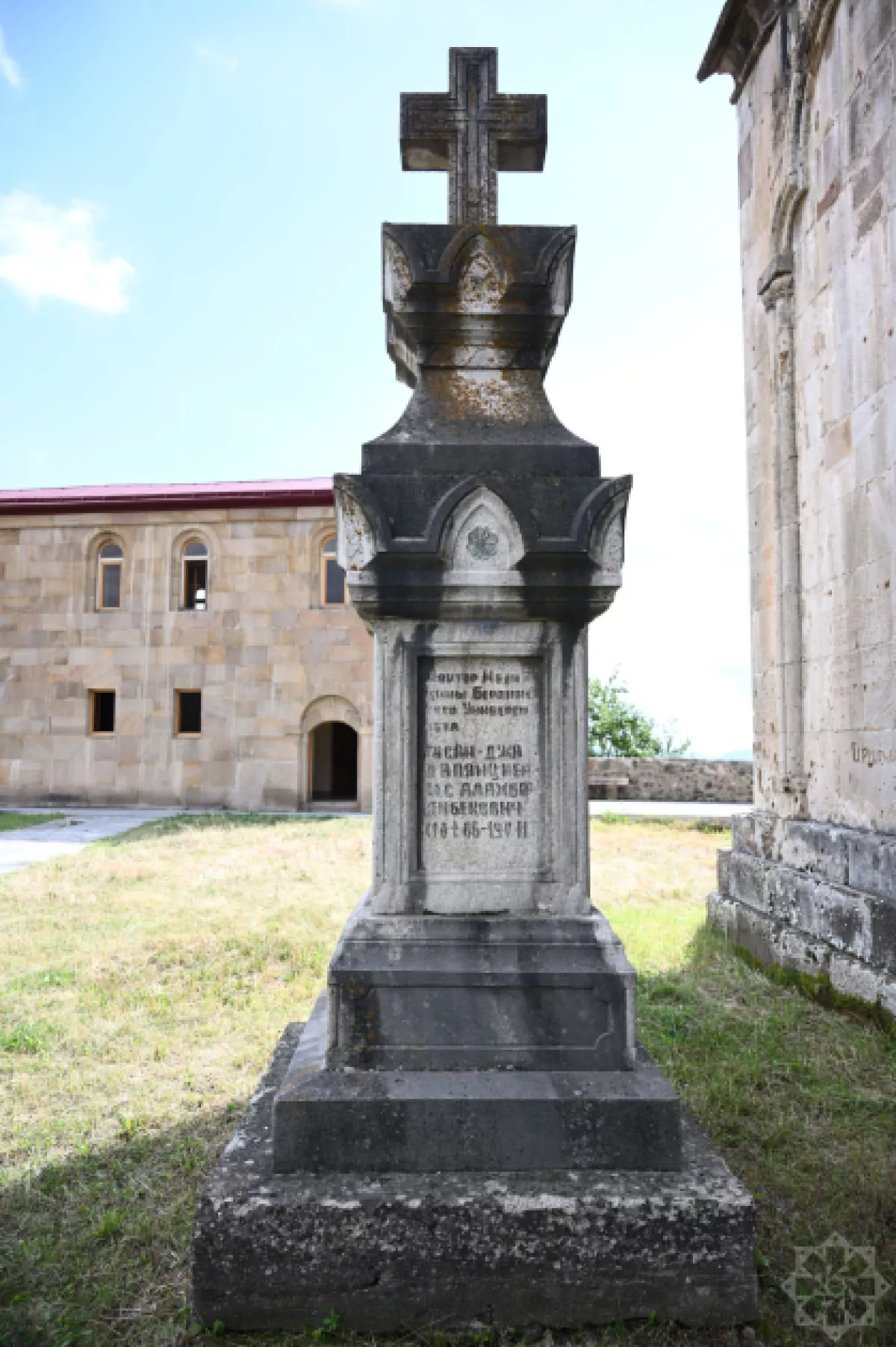
Hasan-Jalal Dawla was an Albanian ruler of the Albanian principality, and the Ganjasar Monastery he founded became the spiritual centre of his Albanian people!
Yes, by the way, if Karabakh — and Ganjasar in particular — was not Albanian but, God forbid, “Armenian”, then why was the Albanian Catholicosate abolished in 1836 and — attention! — Ganjasar placed under the authority of Etchmiadzin? Explain that! How could something “Armenian” be transferred to the authority of Armenians? Where is the logic?
And yet the Imperial Statute “On the Administration of the Affairs of the Armenian Church”, signed by Nicholas I, is an indisputable historical fact. It cannot simply be concealed or refuted!
Here is what Russian historian Vasily Lvovich Velichko wrote in his 1904 book The Caucasus: The Russian Cause and Intertribal Issues, published in St Petersburg:
“The question of Transcaucasian Albania, or Agvania, as it is called in Armenian, is also highly interesting. This country, which included the present-day Elisabethpol Governorate as well as parts of Tiflis and Dagestan, was inhabited by peoples of non-Armenian origin who received Christianity from the Armenians. Until the beginning of the 19th century, there existed a separate Agvan, or Ganjasar, Catholicos who rivalled the Etchmiadzin Catholicos and was at times completely independent of him. Today, the Christians who were once under the jurisdiction of the Agvan Catholicos are regarded as ‘Armenians’ and, having intermingled with them, have adopted their character.”
Well, how much clearer could it be!
A separate Agvan — that is, Albanian — Ganjasar Catholicosate, with its own non-Armenian flock, rivalled the Etchmiadzin Catholicosate! What kind of “Armenians” were these, naturally, who had their own separate, autocephalous Catholicosate in Ganjasar, rivalled the Armenian Etchmiadzin — that is, supposedly, “themselves” — and later even intermingled with Armenians — again, supposedly, “themselves”?
Have you ever encountered “Armenians” who rivalled “themselves”, then intermingled with “themselves” and became “themselves”?
It would be difficult to imagine a greater absurdity than what the British researcher Thomas de Waal did when he sought information about the origins of Hasan-Jalal. And who do you think he turned to? To an American historian — attention! — OF ARMENIAN ORIGIN, Robert Hewsen, who supposedly decided to disguise himself under the surname “Husen”!
That is roughly like entrusting a goat with the vegetable garden! What a person to ask!
And now Armenians cite Thomas de Waal’s sensational “discovery”, supposedly made after consulting an Armenian hiding behind the label of an “American researcher”.
Listen, isn't it time to put an end to this clown show? Isn't it time to accept the principle, widely recognised in historical scholarship, that any monument constitutes part of the historical heritage of the state on whose territory it is located?
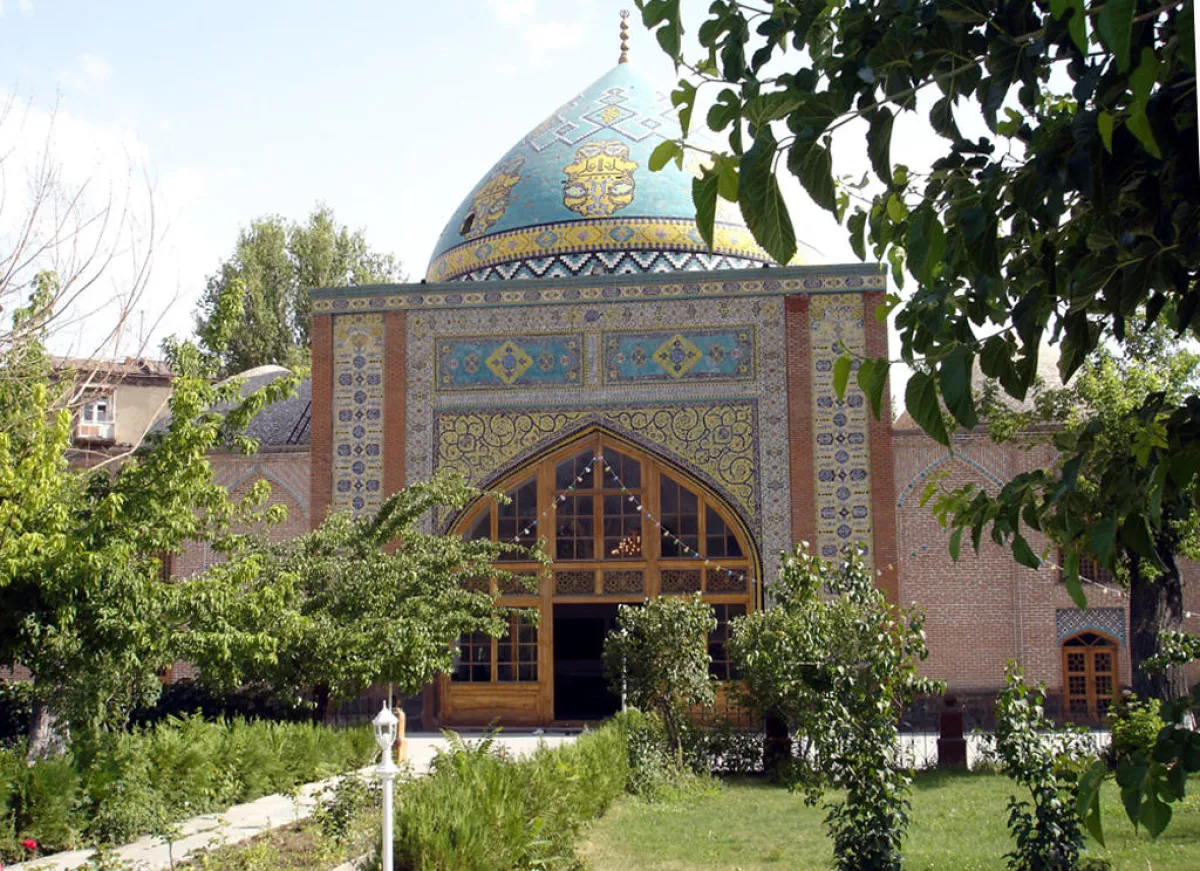
For example, the Armenian church in the centre of Baku is unquestionably part of the historical heritage of the Republic of Azerbaijan and of the Armenian ethnic community. The Blue Mosque in Yerevan and the Mausoleum of Amir Saad in the village of Jafarabad (now Argavand) are part of the historical heritage of today's Republic of Armenia and of the Azerbaijani ethnic community. The Rudas thermal baths in central Budapest, as well as the minarets in Eger and Érd, are part of Hungary's historical heritage and that of the Turkish ethnic community. The Gothic buildings in the Kaliningrad Region are part of the historical heritage of the modern Russian Federation and the German ethnic community. The mosques of Córdoba are part of the historical heritage of Spain and the Arab world.
These are the generally accepted rules! Hagia Sophia in Istanbul, the German church in Baku, the Russian Orthodox Chapel of the Holy Trinity in California, Roman amphitheatres in Jordan and many other monuments are part of the historical heritage of the states within whose borders they are located, regardless of who built them centuries ago!
Likewise, the Azykh hominin, as well as the remains of some of the earliest humans discovered in the Dmanisi area of Georgia, in the Ilsenhöhle caves near Ranis in Germany, and at Qafzeh and Skhul in Israel, had no ethnic identity. Yet these archaeological finds form part of the history of precisely those states within whose sovereign territories they were discovered by archaeologists.
This is a principle widely recognised in the global academic community!
And it is precisely within this framework that the Ganjasar, Khudavang and Amaras monasteries, as well as the churches in Hadrut, Lachin and Aghdara, constitute part of the historical heritage of the Republic of Azerbaijan and of the Albanian people who have since disappeared from the historical stage.
There is nothing Armenian about these historical and cultural monuments!
Yes, as we have already noted, the Albanian rulers may have experienced a certain — and at times quite strong — cultural and spiritual influence from neighbouring Armenian Etchmiadzin. But it is impossible and unacceptable to call the heritage of Caucasian Albania “Armenian” when the principalities of Artsakh-Khachen, Syunik, Utik, Paytakaran and others unquestionably formed part of it.
What is particularly outrageous is the following: those accusing us of calling Albanian things “Albanian” are none other than people who themselves call Azerbaijani things “Persian”. Since when did the mosques in Iravan and Shusha, where ethnic Persians never lived, suddenly become “Iranian”? They look for a speck in someone else's eye while failing to see the log in their own!
Enough already! Keep your eyes off our territory and our monuments!
Karabakh and the territories liberated from occupation were, are and will always remain the historical lands of Azerbaijan! Holding events in these territories, including organising visits by the diplomatic corps, is Azerbaijan's sovereign right, and no one has the right to tell us what to do on our own territory. Karabakh has nothing to do with Armenia, and these issues are not up for discussion. Such visits will continue to be organised, and on an even larger scale.
The Armenian authorities — the government of Nikol Pashinyan — are directly behind the attacks by Armenian circles against the diplomatic corps visiting Karabakh. They are the ones fuelling this issue. If Yerevan has decided to return to a revanchist course, then let it say so openly! Or let it renounce the text of the future peace agreement that it initialled itself. Then we shall see who ultimately ends up on the losing side.







 editor@caliber.az
 +994 55 444-88-98
 Азербайджан, Баку, ул. Низами, 203, Af Business House, 5-й этаж