










Uniting worlds: Azerbaijan enters a new geopolitical orbit Overview by Teymur Atayev
At a meeting on September 15 with members and observers of the Council of Heads of Muslim Religious Boards of the Organization of Turkic States (OTS), co-organizers of the Yahya Bakuvi International Conference, and members of the Supreme Religious Council of Caucasian Peoples, Azerbaijani President Ilham Aliyev once again delivered a series of specific messages that shed light not only on the history of the Azerbaijani state in recent decades, but also on the broader course of world history.
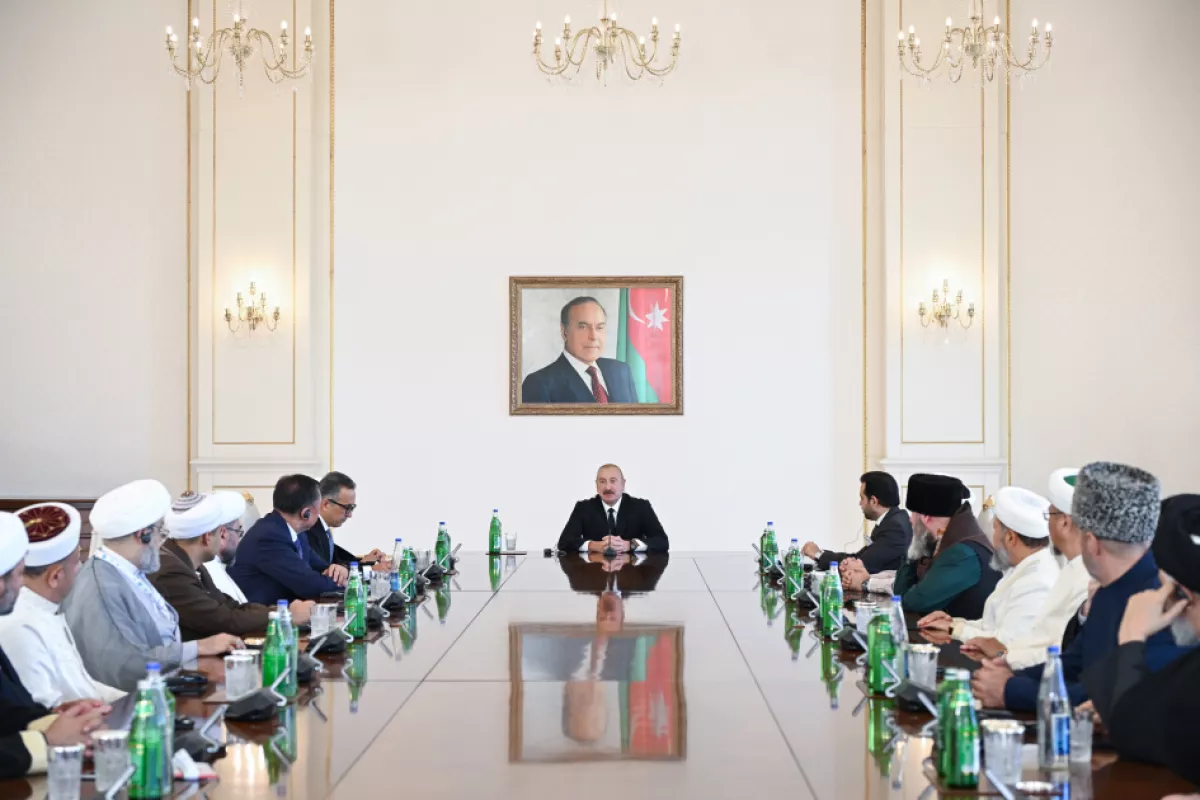
During the meeting, the president spoke about global geopolitics and key aspects of contemporary international affairs, viewing them, to a significant extent, through the prism of the current realities of the South Caucasus. These realities, he said, have become a matter of historical fact as a result of the consistent policies pursued by official Baku, based exclusively on defending Azerbaijan's national interests.
President Ilham Aliyev first drew attention to the ethnic cleansing of our people and the destruction of cities and villages across Karabakh and East Zangezur during the 30-year occupation, which Armenia's external backers sought to make permanent. According to Aliyev, the countries that co-chaired the OSCE Minsk Group sought to conceal these actions, the OSCE remained silent, the Council of Europe effectively supported the occupation, while the European Parliament backed the aggressor state.
However, the Azerbaijani people created a precedent by liberating their ancestral territories from occupation in accordance with all norms and principles of international law — something for which there are virtually no parallels in the 20th and 21st centuries. As a result, “today there is peace, and the war has ceased”, and President Ilham Aliyev expressed confidence that the peace would be long-lasting: “At any rate, such is the position of the Azerbaijani state.”
This emphasis was by no means accidental, as in recent days we have witnessed what was described as an entirely inappropriate reaction from Armenia to the visit by the diplomatic corps accredited in Azerbaijan to Karabakh and East Zangezur. This included statements claiming that visits by diplomats to “occupied” Karabakh constituted “another episode in the legitimisation, in the eyes of the international community, of the [carried out] ethnic cleansing”. The Western Azerbaijan Community described this as both an open disregard for the sovereignty and territorial integrity of our country and a destructive step undermining the peace process. Moreover, the Armenian authorities did not respond in any way to this démarche, which speaks for itself.
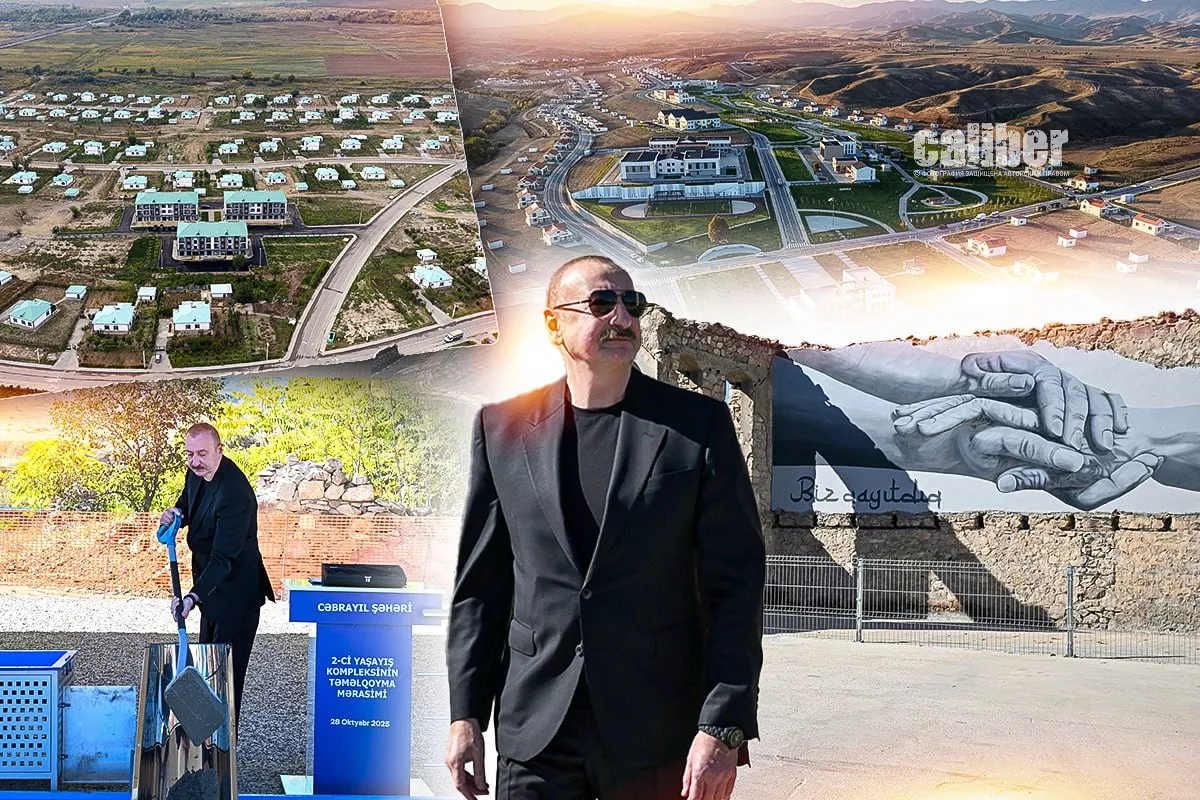
However, regardless of any insinuations, Azerbaijan is confidently pursuing all of its stated objectives. To date, former internally displaced persons have returned to 48 cities and villages in Karabakh and East Zangezur. Overall, more than 90,000 people now live there under the State Programme for the Great Return, marking a significant historic achievement for the victorious state. This course of events has demonstrated the fulfilment of the pledge made by Ilham Aliyev in his 2003 inaugural speech that Azerbaijan would never reconcile itself to the occupation of its lands and would liberate them at any cost: “I believe in the bright future of Azerbaijan; our country will develop and grow stronger.”
At the same time, as President Aliyev stressed, we will never forget the atrocities committed against our people, including the complete destruction of 65 mosques and the use of the two that remained for keeping pigs. According to the Azerbaijani leader, this was an insult not only to us, but to the entire Islamic world — an undeclared war against it. Elaborating on this point, the president described the actions targeting Islamic values and the Holy Quran as deliberate insults. Against this backdrop, and highlighting the importance of unity across the Muslim world, he assured that Baku would make every effort to bring the Islamic ummah together as one family.
The position voiced by the president also provides an opportunity to revisit his address to the participants of the 20th session of the Parliamentary Union of the Organization of Islamic Cooperation (OIC) Member States, in which the head of state equated the crimes committed against Islamic cultural heritage in our lands with an open manifestation of Islamophobia. He noted that, at the current stage of history, the promotion of hatred towards Muslims and the desecration of Islamic values are gaining increasing prominence around the world, while international institutions such as the European Parliament and the Parliamentary Assembly of the Council of Europe (PACE), by fostering anti-Islamic sentiment, portray Islam as a source of danger.
In this context, in his speech yesterday, President Aliyev pointed out that, despite being a member of the Council of Europe, we continue to face this injustice and will probably continue to do so in the future, because Azerbaijan bows to no one, voices its position openly, and defends its national dignity and way of life. As he elaborated, the stronger the Azerbaijani state becomes, the more intense the attempts to discredit it become, including through daily publications filled with lies, insinuations and slander.
There is no doubt that anti-Azerbaijani forces are concerned by the fact that the stability that has become a reality in Azerbaijan is, in Ilham Aliyev’s words, a key factor not only in our own development but also in the development of the region, as Baku has become an important actor in many spheres on the global stage. At the same time, the favourable business environment created in Azerbaijan has made it possible to attract billions of dollars in investment into various sectors, including energy, as well as the construction of pipelines linking the Caspian Sea with the Mediterranean and Black seas and Caspian gas fields with European markets.
At the same time, the East-West and North-South corridors passing through Azerbaijan are playing an increasingly important role as supply routes for many countries.
Highlighting the anti-Azerbaijani, anti-Turkish and anti-Islamic bias of the aforementioned European institutions, President Ilham Aliyev referred to the European Parliament as “a nest of corrupt figures”, citing as an example the seizure of suitcases containing millions of dollars from the home of a vice-president of the institution, saying that “they covered up the entire affair, as if it had never happened”. In this context, he was referring to Eva Kaili, who has been openly hostile towards Azerbaijan and Türkiye and who, in 2022, was charged with “participation in a criminal organisation, money laundering and corruption”.
It is also worth recalling that in late 2025, former EU High Representative for Foreign Affairs and Security Policy Federica Mogherini, who by then had become rector of the EU-funded College of Europe, former Secretary-General of the European External Action Service Stefano Sannino and several other individuals also became subjects of an investigation into fraud, corruption and the violation of professional secrecy. Meanwhile, former EU foreign policy chief Josep Borrell, who has been widely criticised, declined to comment on the developments, although it was he who, after taking over from Mogherini, appointed Sannino to the senior post.
In other words, President Ilham Aliyev once again shared with the world important information that the West prefers to keep out of the public eye.
On the subject of unity, the head of state placed this issue in the broader context of the expanding geography of bloody conflicts, stressing the need for each of us to make significant efforts to preserve peace both across the Turkic community as a whole and in the Caucasus region. As Ilham Aliyev noted, “our unity will strengthen each of us. When each of us stands alone, we may face difficulties. But when the Turkic world, the Caucasus, and the Islamic world stand together, no one can overcome us. No one can commit injustice against us.”
One element of the president’s assessment is the fact that Azerbaijan is both part of the Turkic world and a Caucasian country. The consolidation of the Azerbaijani people, alongside our faith, will, determination and military strength, is presented as the sole guarantee of the country’s sovereignty and territorial integrity, as well as the continued existence of our people as a free and independent nation.
The points outlined above highlight Azerbaijan’s growing standing on the global stage, driven in large part by Baku’s concrete efforts to advance and defend its national interests while avoiding harm to third countries. As an increasingly influential middle power, Azerbaijan draws on its position at the crossroads of the Turkic, Islamic and Caucasian worlds to play an increasingly prominent role not only in shaping the agenda of the South Caucasus but also in extending its influence beyond the region.







 editor@caliber.az
 +994 55 444-88-98
 Азербайджан, Баку, ул. Низами, 203, Af Business House, 5-й этаж