










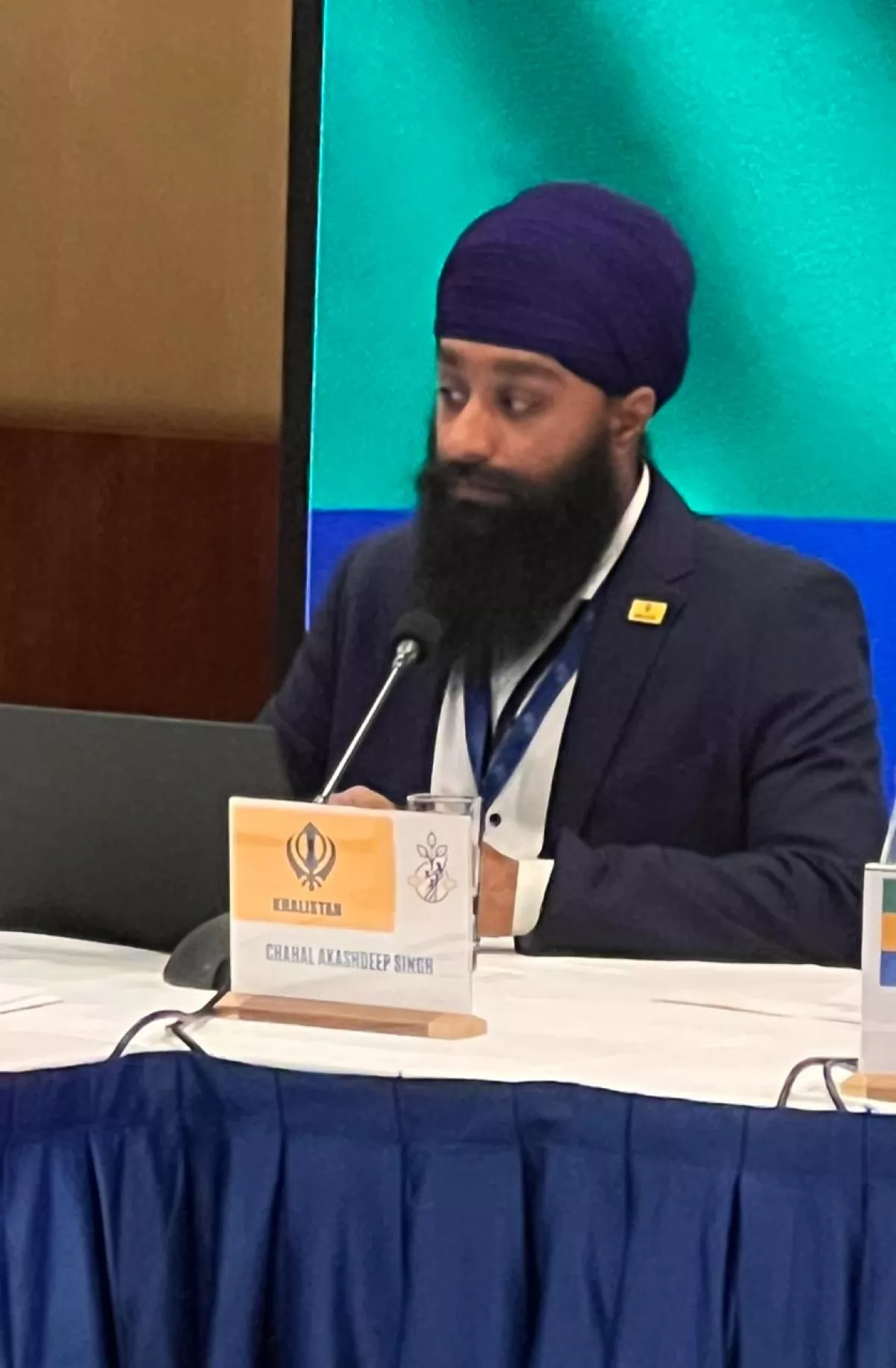
Khalistan representative: Many states are products of colonial rule PHOTO
A representative of the Khalistan movement has said that many modern states are the product of colonial-era processes, arguing that current borders and governance structures often fail to reflect historical identities and traditions.
Speaking at a youth forum titled “Strengthening the Role of Youth in the Postcolonial Era", Chahal Akashdeep Singh said to Caliber.Az correspondent that numerous countries today are “neither natural nor neutral”, but were shaped through colonial boundary-making that brought diverse peoples under centralised authority.
He cited India as an example, arguing that it continues to operate within inherited colonial administrative frameworks. According to him, this has, in some cases, led to the suppression of distinct political identities and the use of force to maintain state structures.
Singh said that discussions on Khalistan and Sikh sovereignty should be understood as part of a broader post-colonial debate rather than purely political demands. He added that empowerment should not be limited to participation within existing systems, but should also include the ability for communities to develop governance rooted in their own traditions.
“For Sikh youth, this is particularly important,” he said, arguing that Sikh tradition does not separate spiritual and political life and is grounded in ideas of sovereignty, justice and responsibility. He suggested that modern classifications often reduce communities to religious minorities within systems that define their political space.
He further stated that young people should play an active role in shaping post-colonial discourse by building connections across different contexts and helping define a more equitable political future.
“The post-colonial future is not something we inherit, but something we define,” he said, adding that youth are not only future leaders but also active participants in shaping how post-colonial realities are understood and transformed.







 editor@caliber.az
 +994 55 444-88-98
 Азербайджан, Баку, ул. Низами, 203, Af Business House, 5-й этаж