










Lufthansa admits: Company exploited forced labour during Nazi regime
This week, German airline Lufthansa publicly acknowledged its historical role during the National Socialist era and announced the commissioning of an in-depth scientific study examining its activities during that period, particularly regarding the exploitation of forced labourers, according to the article by Spanish daily El País.
Until now, the airline had largely avoided revisiting this chapter of its history, arguing that the company that operated between 1926 and 1945 bore no connection to the Lufthansa that emerged after 1953.
“Lufthansa was clearly part of the system,” said CEO Carsten Spohr at a press conference on February 3 at the group’s Frankfurt Airport headquarters, ahead of the centenary of the company’s founding in April 2026. He highlighted the airline’s involvement in the secret rearmament of Germany as a “clandestine air force,” its integration into the Nazi war economy, and its systematic exploitation of forced labourers in workshops and armaments factories.
To coincide with the centenary, Lufthansa has commissioned a new historical study by scholars Hartmut Berghoff, Manfred Grieger, and Jörg Lesczenski. The study, which critically examines the company’s actions during National Socialism, will be published as a book in the coming weeks. In addition, a new exhibition at Lufthansa’s conference and visitor centre will explore the airline’s evolution under the Nazi regime. German companies rarely scrutinise their own history; according to the Business History Society, fewer than 8% of German firms have professionally analysed their role during Nazism.
“Lufthansa was a company of National Socialism,” said historian Manfred Grieger during the press event, describing the airline’s close ties to Adolf Hitler’s administration. “This symbiosis led to Lufthansa’s collapse at the end of the war. The company went down completely with the regime to which it had bound itself.”
While the current Deutsche Lufthansa AG is not the legal successor of Deutsche Luft Hansa AG, founded in 1926, the original company ceased to exist in 1945 with the fall of the Nazi regime and was formally liquidated by the Allies in 1946. However, the new Lufthansa retained the rights to the name, the crane logo, and the distinctive color scheme.
Given the centenary celebrations, Spohr emphasized the need to confront this darkest chapter of German history, which he said had not been sufficiently examined in prior historical accounts of either the first or the second Lufthansa.
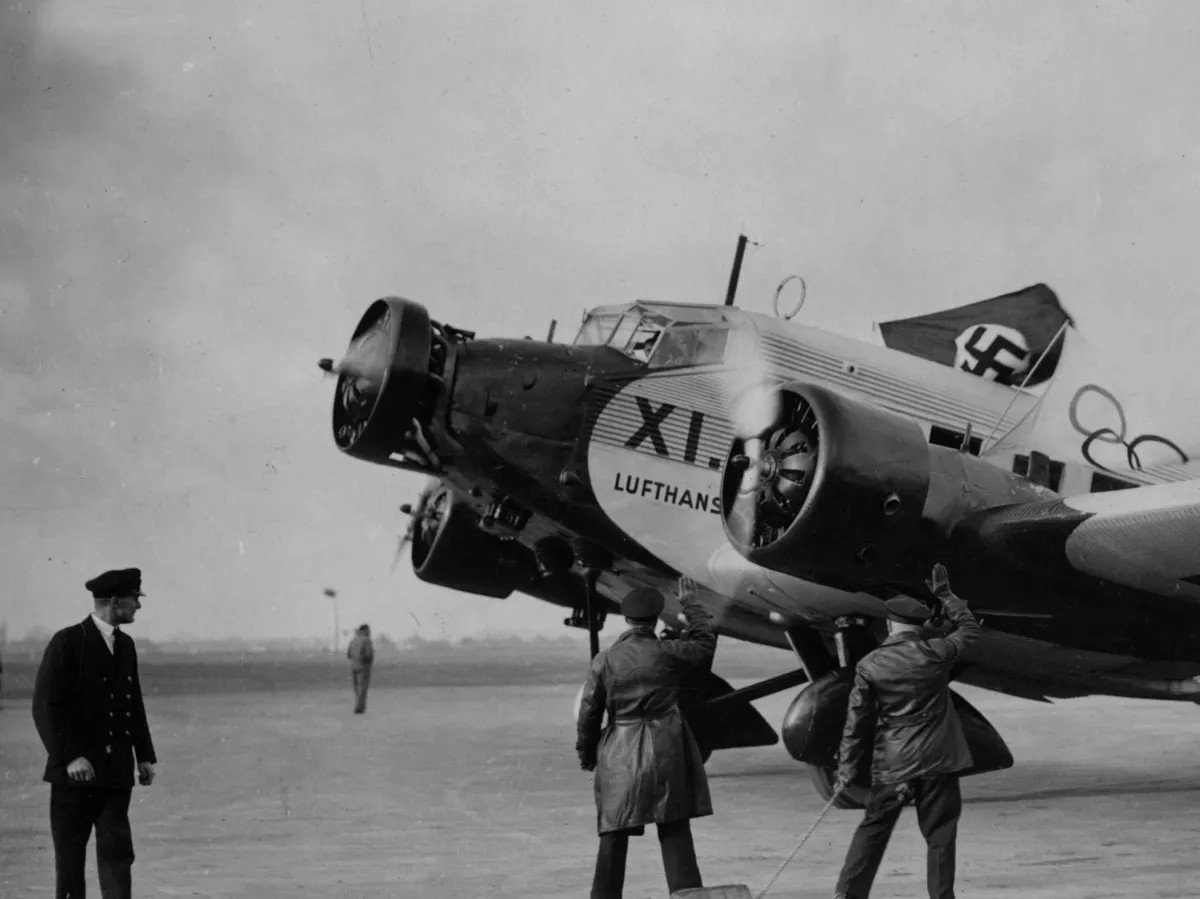
According to Grieger, Lufthansa voluntarily aligned itself with the Nazi regime from 1933 onward. Initially a state-subsidized airline, it gradually shifted from aviation to armaments production during World War II, eventually becoming a structural unit of the German Air Force (Luftwaffe).
Board member Erhard Milch was appointed State Secretary of the Reich Air Ministry in 1933, a dual role that turned Lufthansa — whose shareholders were primarily state and municipal entities — into “the company of National Socialism,” as Grieger described it. That same year, Luft Hansa was reorganised as the joint-stock company Deutsche Lufthansa Aktiengesellschaft.
Grieger stressed that the airline’s alignment with the Nazi regime was driven more by economic motives than political conviction. During the war, the company built a radar equipment plant in Tempelhof (Berlin) and oversaw front-line aircraft repairs. By 1944, armaments contracts accounted for two-thirds of Lufthansa’s total revenue. The company relied on over 10,000 forced labourers — including deported Ukrainians and German Jews — to fulfil these obligations. “No questions were asked when these people were sent to the gas chambers. They were Berlin Jews with whom they could communicate. It is hard to understand,” Grieger said.
Because of its deep involvement in armaments production and the use of tens of thousands of forced labourers, the first Lufthansa became both “a protagonist and a beneficiary of the Nazi war economy,” the historian concluded.
By Tamilla Hasanova







 editor@caliber.az
 +994 55 444-88-98
 Азербайджан, Баку, ул. Низами, 203, Af Business House, 5-й этаж