










Türkiye's ASELSAN showcases mobile KORKUT air defence system in live trials PHOTO / VIDEO
Türkiye’s defence company ASELSAN has demonstrated the operational capabilities of its KORKUT 140/35 short‑range air defence system during live firing trials, showcasing the platform on a new 8×8 wheeled tactical chassis.
Designed to counter low‑altitude aerial threats, the updated KORKUT offers enhanced mobility and flexibility, allowing it to operate across a wide range of terrain and mission profiles, according to Turkish defence outlet.
During the trials, the system successfully engaged and destroyed an airborne target while on the move.
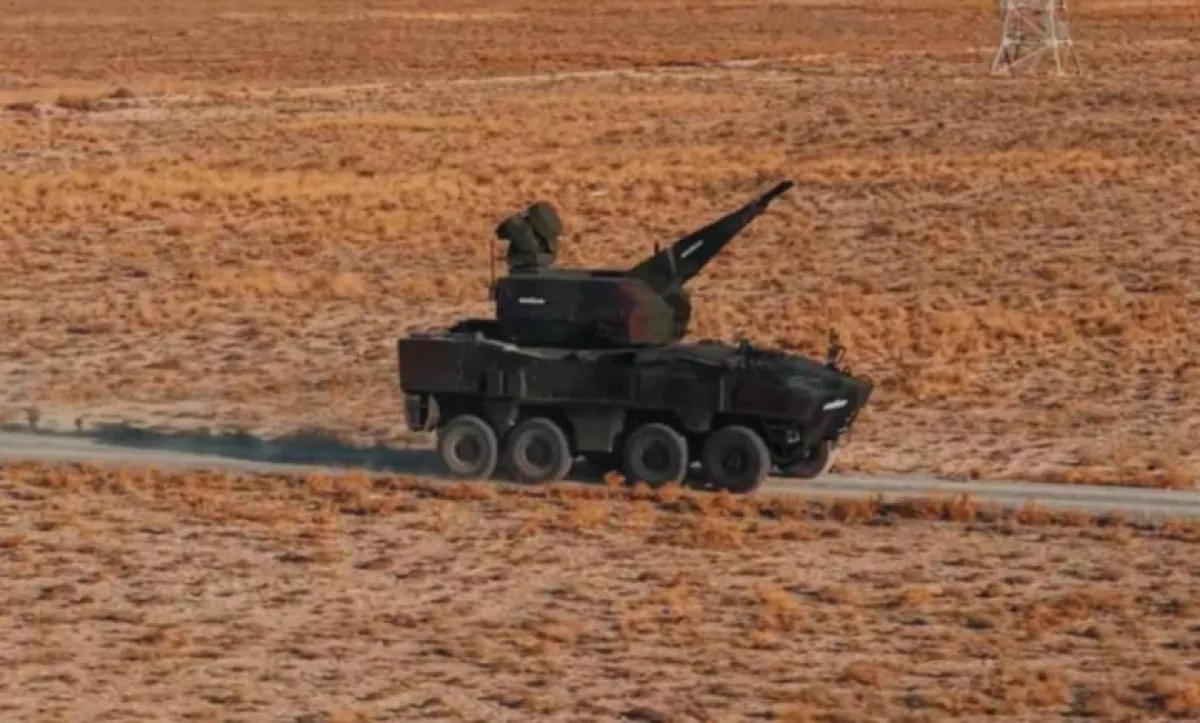
The tracked version of KORKUT is already in service with security forces and has achieved export success. To improve deployability, ASELSAN integrated the system onto a wheeled armoured platform. The 8×8 variant was first unveiled at the Eurosatory 2024 defence exhibition in Paris.
KORKUT 140/35 forms part of Türkiye’s multi‑layered integrated air defence architecture known as the “Steel Dome” (Çelik Kubbe). It is optimised to protect mechanised units and mobile formations against low‑flying threats, including aircraft, helicopters and unmanned aerial vehicles.
A typical KORKUT unit consists of three gun vehicles supported by a command‑and‑control vehicle that coordinates operations within an integrated command system. The platform is armed with a twin‑barrel 35mm cannon capable of firing up to 1,100 rounds per minute, with an effective range of up to four kilometres.
🔴ASELSAN, 8x8 Taktik Tekerlekli Zırhlı Araca entegre KORKUT Yakın Alan Hava Savunma Sistemi’nin atış görüntülerini paylaştı: pic.twitter.com/YEyHf310pC
— SavunmaSanayiST.com (@SavunmaSanayiST) January 6, 2026
The system uses ASELSAN’s programmable ATOM 35mm ammunition, designed to defeat modern aerial targets, including drones, cruise missiles and air‑to‑ground munitions. Detection and tracking are provided by a 3D surveillance radar, fire‑control radar and electro‑optical sensors, enabling accurate engagement even while moving.
By Aghakazim Guliyev







 editor@caliber.az
 +994 55 444-88-98
 Азербайджан, Баку, ул. Низами, 203, Af Business House, 5-й этаж