










Presidential aide outlines Azerbaijan’s vision for regional order at Antalya forum VIDEO
At the Antalya Diplomacy Forum, a senior Azerbaijani presidential aide has set out Baku’s vision for a new regional order in the South Caucasus, centred on “regional ownership” and self-driven solutions.
Speaking at a panel titled “The Role of Regional Ownership in a Transforming World,” Hikmet Hajiyev, Assistant to the President of Azerbaijan and Head of the Foreign Policy Affairs Department, stressed the importance of regional agency amid global instability, Caliber.Az reports.
Amid the current period of global upheaval and turbulence, there is a clear need for gatherings that bring us together to discuss global challenges and problems, Hajiyev said.
He underlined that Azerbaijan sees regional ownership as a fundamental principle of foreign policy, rejecting externally imposed solutions.
“What does regional ownership mean for Azerbaijan? What are the fundamental principles and cornerstone of that? For us, regional ownership is in full regional belonging and to resolving regional challenges and regional problems ourselves with our like-minded partners in our region, not to wait for exposed or imposed solutions towards our region. First, we should build our own order in our region instead of waiting for some others to come in our place to fulfil their own missions in our region. That's one fundamental issue.
Second, for us, regional ownership also consists of the major elements, and one among many other important elements is a full regional shared responsibility to the regional affairs. It should also be complemented with a regional leadership that we are also trying together with our sister and brotherly countries in our region to fulfil. And it's also regional cooperation and regional integration. And all of these components are coming together and fulfilling our mission for regional ownership.”
Hajiyev pointed to Azerbaijan’s diplomatic engagement formats — bilateral, trilateral, and multilateral — as practical tools for implementing this concept.
“In practical terms, what does it mean? Let me provide you with practical examples of how we are fulfilling it. Certainly, we are applying diplomacy and dialogue and also on the bilateral, trilateral, even a quadrilateral level, and applying very sophisticated models of diplomacy in our region. One important component at the bilateral level, because for every and each country, for every region now security matters a lot, because we are living in a deficit at a global level. In our region, Türkiye-Azerbaijan bilateral cooperation is an important cornerstone of regional peace and security. And Türkiye and Azerbaijan, brotherly cooperation and relationship and emotions and values that we are sharing, but leaders of the two countries institutionalised this relationship based on the Shusha Declaration that we have signed.”
He added that this cooperation has expanded into broader regional formats.
“And we didn't stop there, and we have transformed bilateral cooperation into the trilateral model of cooperation, and again, fulfilling the full regional ownership. Here, Türkiye-Azerbaijan-Georgia cooperation, or Türkiye-Azerbaijan-Iranian cooperation, or we have also stretched our hand to our Central Asian brothers. Trilateral or multilateral, we built a mechanism for cooperation at the practical level. It serves the interests of both countries.”
Energy security was highlighted as a key pillar of regional cooperation, with Azerbaijan taking the initiative in developing export routes.
“Then let me also provide you with practical thematic areas of regional ownership and regional cooperation. One of them is energy security and energy cooperation. Again, we didn't wait for somebody else to come and fulfil the mission of energy security in our region. And we started ourselves to bring Azerbaijan's own hydrocarbon resources from the Caspian Sea, first through the Baku-Tbilisi-Ceyhan pipeline to the shores of Türkiye, and currently this pipeline serves for the interest of the global energy security, and certainly it also serves the interests of Türkiye and Azerbaijan. Again, we demonstrated regional leadership. And it also provided cross-regional prosperity and cooperation,” Hajiyev said.
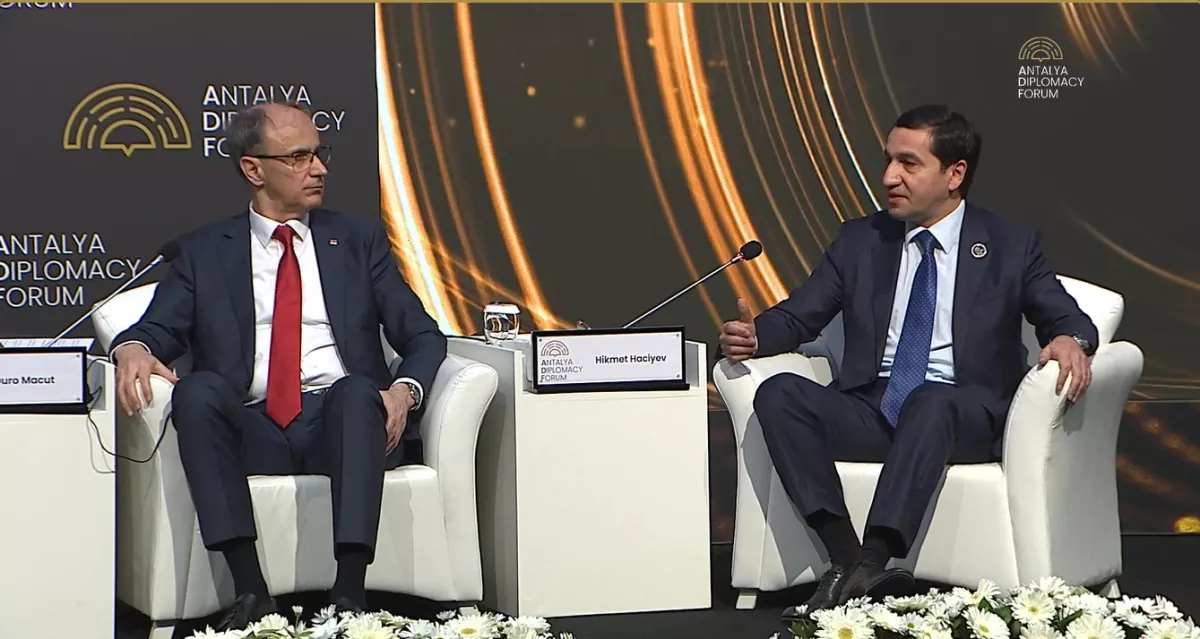
Touching on the Armenia–Azerbaijan conflict, Hajiyev said Baku had demonstrated leadership in resolving the issue and moving towards peace.
“And here again, we demonstrated leadership. This conflict has been resolved. It's now already in the past. And Azerbaijan, in a unique way, demonstrates political, military, military-political means to resolve the conflict. We restored our territorial integrity and sovereignty, and we also now stretched our hand of peace to the Republic of Armenia. And last August, two countries in the presence of the American leadership and we initialed normalization agreement between the two countries.
For 30 years, the OSCE Minsk Group, which was an external imposition of the solution towards the region, provided complete failure for the resolution of the conflict. Once again, it shows that when you are taking full regional leadership and ownership for your region, you can deliver. And we have delivered. There is a new status quo in the region. The Caucasus is peaceful, and nevertheless, in our immediate neighbourhood, we have emergence of the new hotbeds of conflict and outbreaks of war, but the South Caucasus is peaceful.”
He also emphasised the importance of connectivity projects, particularly those linking the South Caucasus with Central Asia.
“And within that also matters regional connectivity projects, where we are a landlocked country, and our brothers in Central Asia are also landlocked, but together with them, we are building Trans-Caspian connectivity. The first step in that direction was a Türkiye-Azerbaijan-Georgia cooperation, Baku-Tbilisi-Kars. Now we are expanding, and we think that the Zangezur corridor model will provide additional connectivity for ourselves and for our brothers in Central Asia.”
Hajiyev concluded by clarifying that regional ownership does not mean isolation, but rather openness to global cooperation.
“But in the meantime, talking about regional ownership, we shouldn't be misunderstood. It’s not about regional isolation. In a sense, again, talking about regional ownership, we're providing the platform for engagement and cooperation for our partners from other parts of the world,” Hajiyev said.
🇦🇿🇹🇷 At the Antalya Diplomacy Forum, a senior Azerbaijani presidential aide has set out Baku’s vision for a new regional order in the South Caucasus, centred on “regional ownership” and self-driven solutions.
— Caliber English (@CaliberEnglish) April 17, 2026
Speaking at a panel titled “The Role of Regional Ownership in a… pic.twitter.com/hEzNSO4c1O
The Antalya Diplomacy Forum (ADF 2026), taking place on 17–19 April in Antalya, is held under the auspices of Recep Tayyip Erdoğan and organised by the Ministry of Foreign Affairs of Turkey.
Against the backdrop of intensifying geopolitical tensions, shifting power dynamics, growing trade barriers, and increasing strain on multilateral institutions, the forum convenes global leaders, policymakers, and experts to address rising uncertainty in international affairs.
Under the theme “Mapping Tomorrow, Managing Uncertainties,” ADF 2026 focuses on anticipating emerging challenges and opportunities, promoting strategic thinking, and fostering practical cooperation to shape a more stable and predictable global future.
Azerbaijan is represented at the event by a high-level delegation.







 editor@caliber.az
 +994 55 444-88-98
 Азербайджан, Баку, ул. Низами, 203, Af Business House, 5-й этаж