










Amaras Monastery: Living testament to Caucasian Albania’s Christian heritage A historical overview on Caliber.Az
The land of Azerbaijan is rich in history and cultural heritage, reflected in monuments from various eras. Among them, the structures of Caucasian Albania — an ancient Christian civilisation — hold a special place, having left a profound mark on the region’s history. Since ancient times, the geographical location and ethnic diversity of the population have fostered the coexistence of multiple religions on Azerbaijani territory. Here, paganism, Zoroastrianism, Judaism, Christianity, Islam, and other religious traditions spread and influenced one another.
Christianity, one of the historically present religions, played a significant role in shaping Azerbaijan’s cultural heritage and left a noticeable imprint on its history and architecture. Archaeological finds — ruins of structures, everyday objects, and tools — testify to the high level of craftsmanship and decorative art. Architectural complexes created by Albanian masters were distinguished by expressive forms, thoughtful spatial planning, and rich artistic ornamentation. This mastery was especially evident in sacred architecture: churches and monasteries built on hills and in valleys impress with their monumentality, precision of form, and harmony with the surrounding landscape, reflecting a deep connection between history and faith.
In the Karabakh region, these monuments occupy a special place, serving as vivid testimony to the centuries-long development of the architectural and spiritual traditions of Caucasian Albania. Their vaults and carved stone crosses preserve the memory of faith, the high skill of the architects, and the continuity of generations, reminding us of the rich historical heritage of our land and remaining an integral part of its cultural and spiritual life.
One of the majestic monuments of the spiritual architecture of Caucasian Albania is the Amaras Monastery. It is not just a monastery, but a place where history, faith, and culture intertwine in a remarkable way.
In the 4th century, a church was built on the territory of what is now the Khojavend District, becoming one of the main religious centres of Caucasian Albania. Over the centuries, Amaras remained a cathedral and held a special place in the spiritual life of the region. Archaeologists have discovered near the monastery traces of an even older temple, built at the turn of the Common Era. This site is associated with remnants of ancient pagan cults, preserved in the beliefs of the local population.
The Christian church was founded in the early 4th century. In the 5th century, the Amaras Diocese was established, and the first school was opened here, where scholars believe children were taught in the Albanian language. At certain periods, the Amaras Monastery served as the residence of the Albanian Catholicosate. Over the centuries, the monastery suffered repeated destruction, yet it was restored each time.
Archaeological excavations have shown that in the 10th century, the church underwent significant reconstruction: its area was expanded and extended westward. Scholars suggest that these changes were prompted by partial destruction of the building during the first Arab invasion. Despite the extensive renovation, the church retained its original shape and key architectural features.
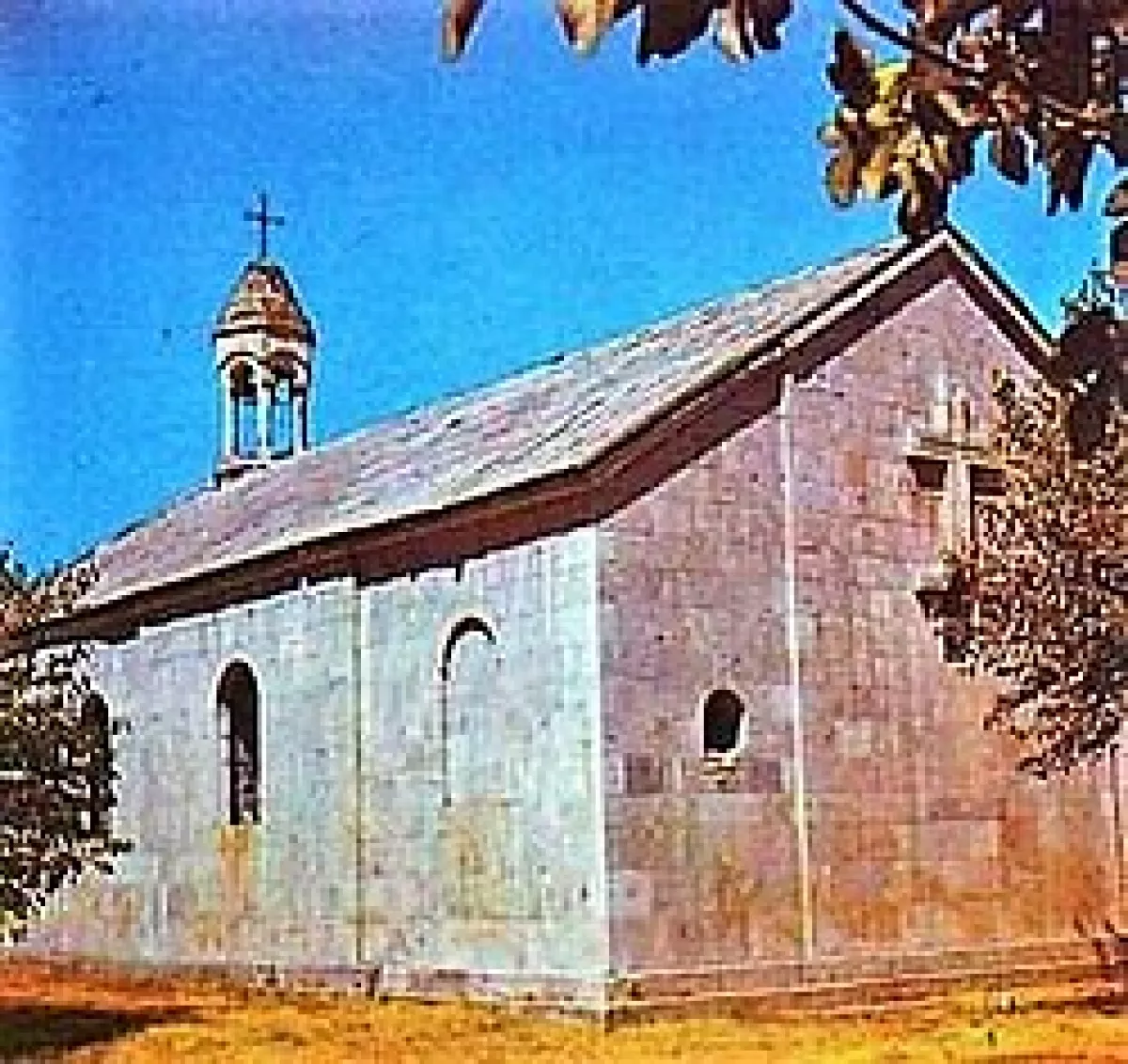
In the 13th century, it was rebuilt again and transformed into a monastic complex, which has preserved its historical significance to this day. The architectural ensemble of Amaras is located on a flat area of about half a hectare and includes the church building, a three-nave basilica measuring 15.9 × 11 m. Four square pillars, connected by arches, support the vaulted ceilings of the naves. The altar area features a semicircular apse with two pastophoria on either side and one window in each of the three chambers.
Although the basilica’s plan dates back to the 5th–10th centuries, the current structure belongs to the mid-19th century, incorporating individual stones with reliefs and inscriptions from earlier periods. Above the central entrance is an arched window topped with a relief equilateral cross, a motif also present on the exterior wall of the altar.
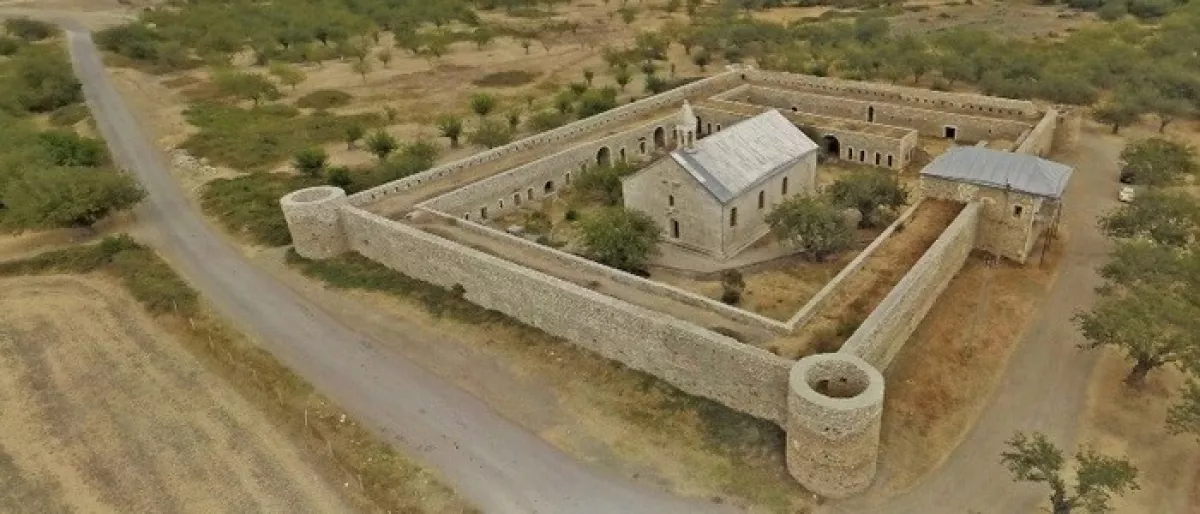
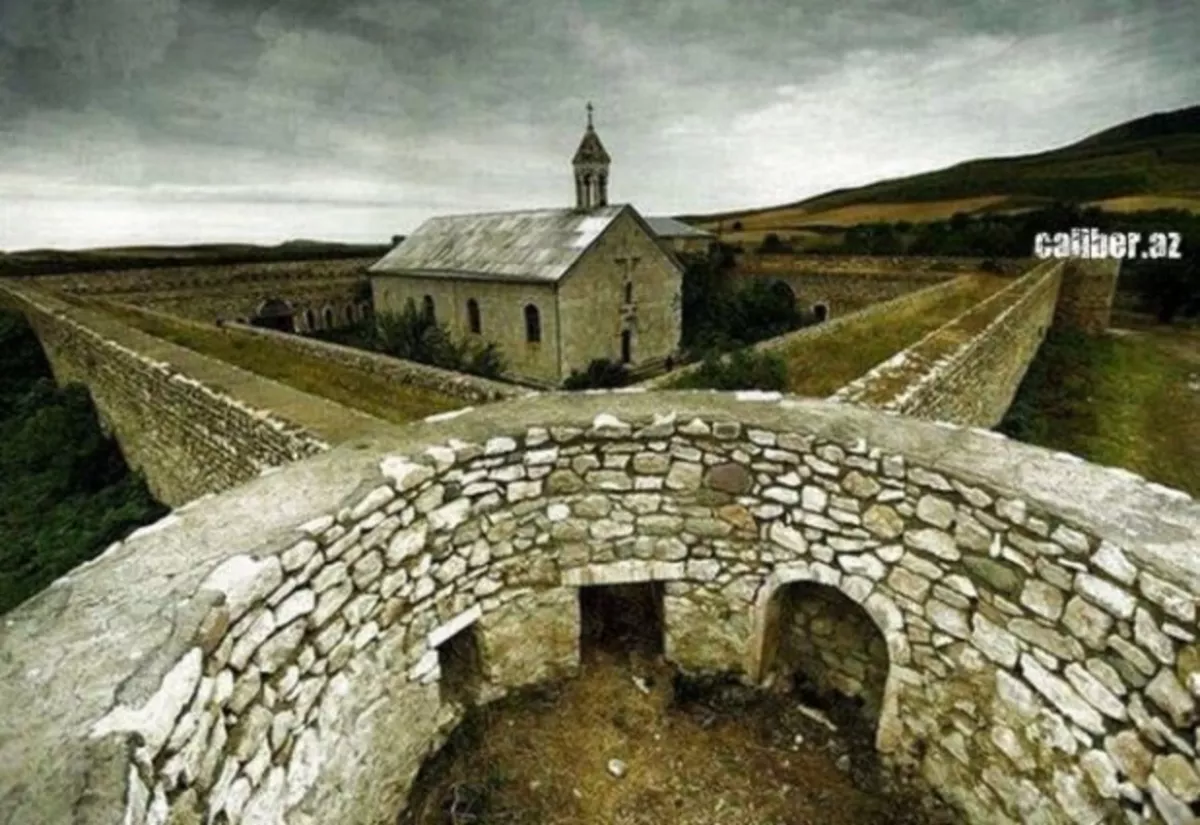
The monastery courtyard is enclosed by massive walls with four round towers, built from roughly hewn stone, giving the complex a stern and cohesive appearance. Along the walls are residential and utility buildings, forming a closed and functionally well-planned space. The church itself, which retains the characteristic features of early Christian architecture, is distinguished by its balanced proportions and high-quality stonework, and remains an important testimony to the spiritual and cultural history of Caucasian Albania.
Amaras Monastery is one of the most significant monuments of the spiritual and architectural culture of Caucasian Albania, reflecting key stages in the region’s history. Its centuries-long existence, repeated destructions, and subsequent restorations testify to the depth of spiritual traditions and the continuity of cultural memory. The architectural appearance of the monastery, incorporating elements from different eras, vividly demonstrates the succession of architectural schools and the high level of craftsmanship of Albanian builders. The preserved forms, details, and spatial solutions allow Amaras to be regarded not only as a religious centre but also as a unique historical and architectural monument. Today, the monastery remains an important symbol of Azerbaijan’s Christian heritage and an inseparable part of its centuries-old cultural history.
By Vahid Shukurov, specially for Caliber.Az







 editor@caliber.az
 +994 55 444-88-98
 Азербайджан, Баку, ул. Низами, 203, Af Business House, 5-й этаж