










The sacred rock of Absheron: tracing centuries of spiritual heritage A historical insight on Caliber.Az
The Absheron Peninsula is home to numerous ancient monuments that bear witness to the rich and centuries-old history of the region. One such site is Pir Garshivaz, commonly known among locals as Gubala or Usta-Shagird.
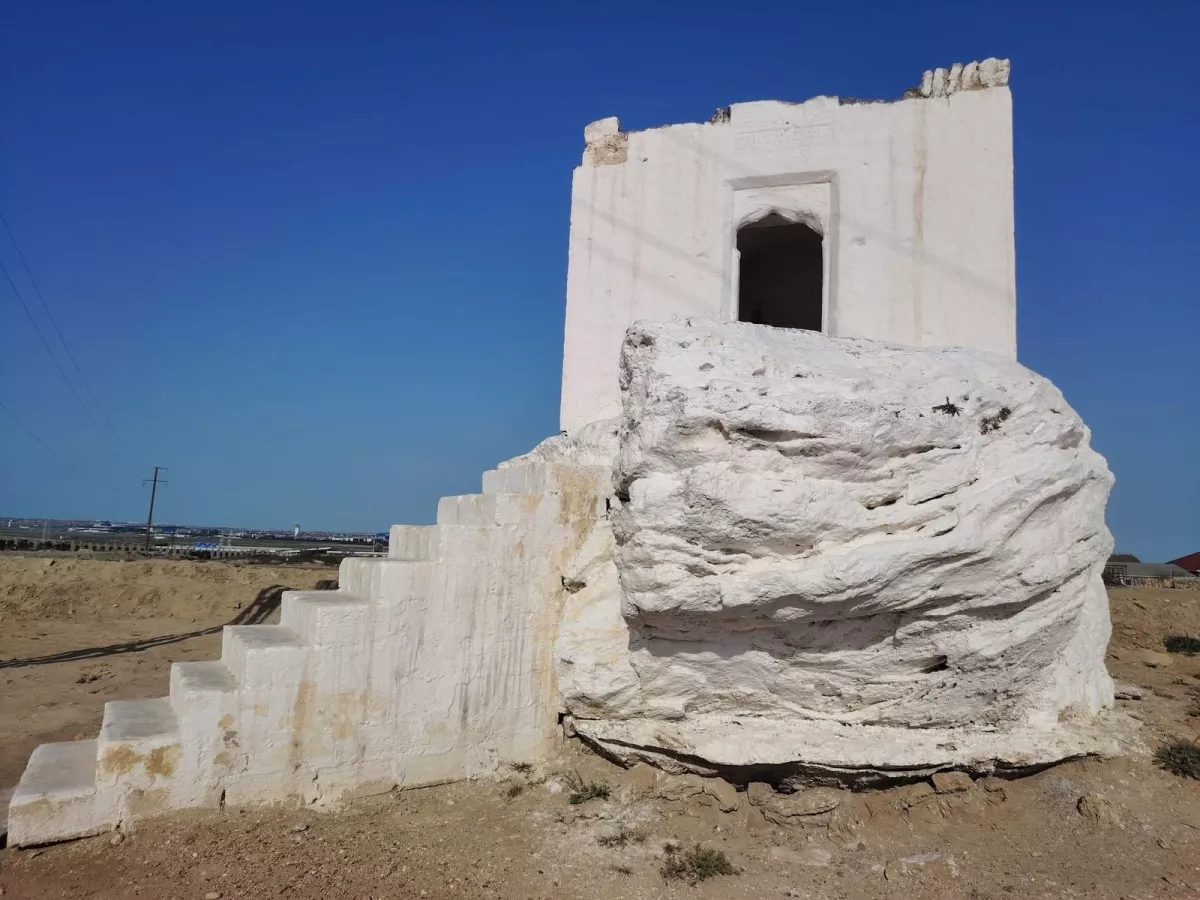
The monument is located in Surakhani, near the Ateshgah Temple, which itself places it within a distinctive historical and cultural context, rich with religious and spiritual traditions. The site represents a unique architectural and sacred complex, attracting sustained interest from researchers. Its shape, location, and epigraphic features allow the monument to be seen as part of the ancient sacred landscape of Absheron. Even today, this place is perceived as a space with a special atmosphere, where historical memory intertwines with popular notions of sanctity.
Very little reliable information about the monument’s origins has survived in written sources. According to local residents, the rock has long been considered sacred. The natural formation itself—a massive stone outcrop—was perceived as a sacred object. Some researchers suggest that the original cult could date back to the Bronze Age. This hypothesis is based on the so-called “cup-shaped depressions” on the surface of the rock—stone hollows or cup-like marks known in archaeology as ritual elements, found from the Late Paleolithic through the Middle Ages. Their presence may indicate the antiquity of the site’s sacred function, although definitive conclusions require further research.
The modern structure is built directly on the rock foundation. It is a small mausoleum of modest dimensions—a simple stone construction in the form of a cube, approximately 3–4 metres in height. A short flight of stone steps, ascending along the slope of the rock, leads up to it. The walls are massive, made of limestone, and coated with whitewash. The main façade is emphasised by the entrance, highlighting the compositional centre and enhancing the architectural expressiveness of the building.
The elevated position of the mausoleum, characteristic of sacred sites in Azerbaijan, reinforces its significance and sacral presence within the surrounding space. Such placement symbolises spiritual elevation while also providing a visual focal point in the landscape.
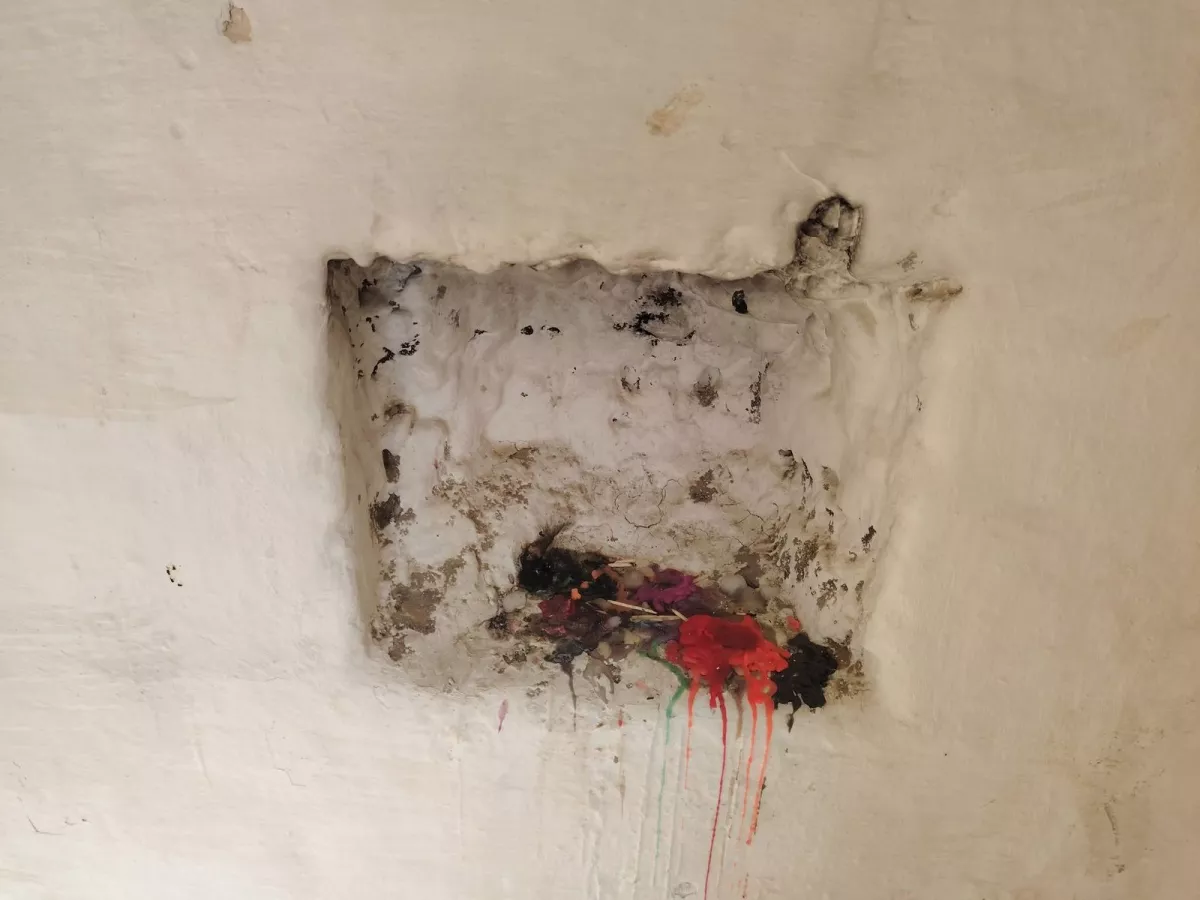
The interior space is extremely simple. On the floor lies a rectangular stone slab, resembling a sarcophagus. It is perceived as a grave marker, corresponding to the name “Usta-Shagird” (“Master–Apprentice”). According to folklore interpretation, it may have been the burial place of a master craftsman and his apprentice. The design allows for the possibility of a double burial (to the left and right of the slab), which indirectly aligns with local legend. In the rear wall, there is a small rectangular niche that may have held a lamp, offerings, or religious objects.
Of particular interest is the epigraphic element—the kitabe above the entrance arch. This is a rectangular panel inscribed in Arabic script. According to scholar M. S. Neymatov, cited in Corpus of Epigraphic Monuments of Azerbaijan (Baku, 1991, p. 57), the inscription is written in Naskh and Thuluth scripts. The researcher noted that due to the poor condition of the text, only the name “Gershivez” could be deciphered.
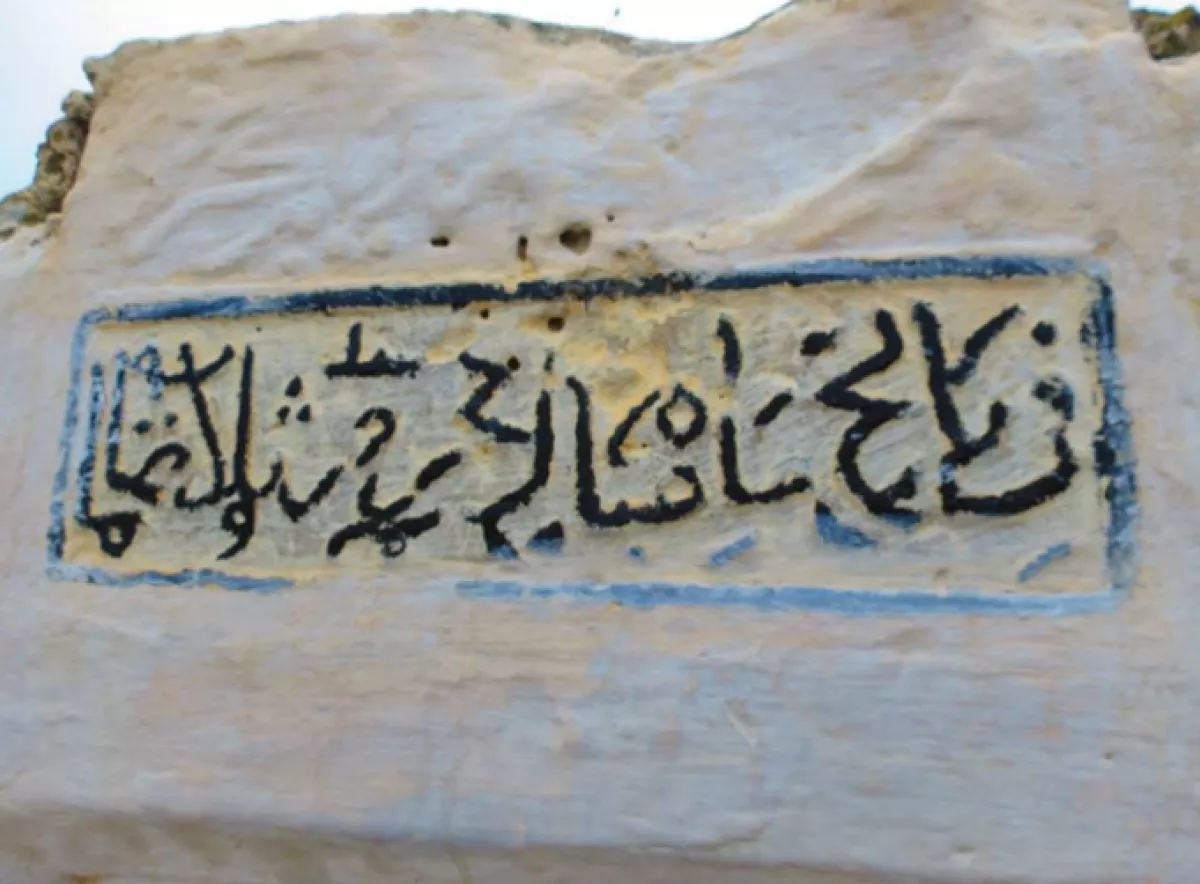
According to other researchers, the inscription “بن گارشواز” is clearly visible, written in Persian–Arabic script. Literally, this can be read as “Bin Garshivaz” or “Pir Garshivaz.” In Sufi and popular Islamic tradition, the word “pir” denotes a saint or spiritual guide, while “bin” in Arabic means “son of.” It is possible that through years of popular veneration and oral tradition, the name evolved into “Pir Garshivaz,” reflecting the site’s function as a place of worship. The script of the inscription belongs to the styles commonly used in Islamic epigraphy of the 14th century. On this basis, it can be suggested that the existing structure atop the rock was built in the medieval period, while the sacred significance of the site itself has much older roots.
Interesting details are provided by H. Sarabsky in his book Old Baku. He describes two stone houses standing on either side of the road from Surakhani to the Mardakan Gardens and recounts a legend about a master and his apprentice. According to the story, a jealous master would not allow the apprentice to work independently. After the elders intervened, a contest was arranged: two houses were built, of which the master’s house collapsed, while the apprentice’s house survived. Researchers note, however, that the distances, locations, and descriptions cited by Sarabsky do not fully correspond to the actual topography of the area. It is also interesting that, according to local residents, the site was once called “Kumaseng” and “Dugubbe”—meaning “two domes.”
Thus, it can be assumed that the sacred significance of this site dates back to ancient times, while in later periods it was reinterpreted and architecturally formalised as a türbe (mausoleum). These conclusions are of a research nature and are based on a comparison of available written sources, local folklore, and visual and architectural analysis of the monument itself.
It is important to note that several similar ancient sites have been preserved on the Absheron Peninsula. In popular tradition, they are considered sacred and continue to be venerated today, retaining their role as living centres of spiritual and cultural significance in the region.
Today, this site is under state protection. Despite its modest size and distance from main tourist routes, it continues to attract visitors. The condition of the interior suggests that people still come here periodically—to experience its spiritual energy, pray, or pay their respects. Such sanctuaries traditionally serve as centres of pilgrimage, where visitors make wishes, seek healing, or commemorate the deceased.
This historical monument is not only an architectural site but also a living testament to the complex interweaving of ancient cultic traditions, medieval Islamic culture, and popular memory. Its study allows for a deeper understanding of the spiritual geography of Absheron and the multilayered processes that have shaped the cultural landscape of the region over the centuries.
By Vahid Shukurov, exclusively for Caliber.Az







 editor@caliber.az
 +994 55 444-88-98
 Азербайджан, Баку, ул. Низами, 203, Af Business House, 5-й этаж