










Innovative cable-car system opens in one of most sustainable Swiss ski resorts “Uber of the Alps” / PHOTO
As warming winters threaten the future of snow across the Alps, one of Switzerland’s largest winter sports destinations is rolling out some of the country’s most ambitious sustainability initiatives, ranging from on-demand gondolas to CO₂-neutral ski lifts.
The ski resort of Laax, located in the country's largest and most eastern canton of Graubünden at an altitude of 2,228 metres, overlooks the Unesco-listed Tectonic Arena Sardona and is owned by the Weisse Arena Group. The resort has become a testing ground for how alpine tourism might adapt to a rapidly changing climate, as the BBC witnessed for themselves during a tour through the Winter destination.
Reto Fry, Laax’s environmental manager, told the British outlet that ski resorts across the Alps are already losing significant portions of their winter seasons as temperatures rise, making proactive adaptation unavoidable. While visitors have enjoyed fresh snowfall during recent cold spells in the 2025–2026 season, long-term data point in a far less reassuring direction.
New climate scenarios from MeteoSwiss, Switzerland’s federal meteorological office, and the prestigious ETH Zurich University show that the country is warming at roughly twice the global average, partly due to its alpine geography. The projections suggest Switzerland will become hotter and drier overall, with heavier rainfall events and, critically for winter tourism, steadily declining snowfall.
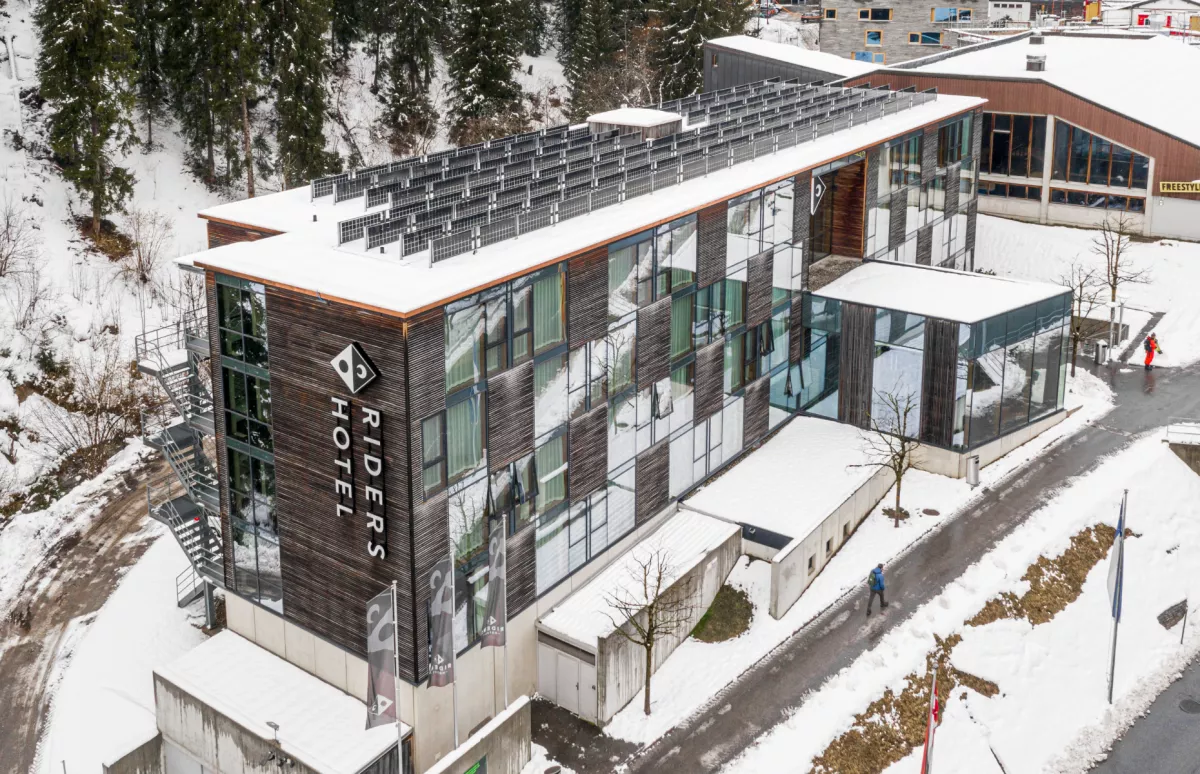
Laax forms part of the wider Flims Laax Falera ski area. At its base village sit the Riders Hotel and the Rocksresort, which was recently named Best Green Ski Hotel 2025 at the World Ski Awards. Fry said sustainability considerations extend across the entire site, from energy and waste management to food systems and biodiversity, and are mirrored throughout the purpose-built eco-village.
Decarbonised buildings clad in solar panels, electric vehicles, and vertical gardens on ski-lift base stations designed to support birds, bees and insects are now defining features of the resort. One of the latest initiatives includes the planting of more than 20,000 flowers and perennials in specially designed gardens to support the endangered black mud bee, which is also being encouraged to nest in the rocky façades of hotel buildings.
“The species is under immense pressure,” Fry explained, “so to help its comeback, we have created a suitable, diverse habitat that optimally meets the nesting and feeding requirements.”
The surrounding landscape is also being positioned as a draw for nature lovers. The Senda dil Dragun, billed as the world’s longest treetop path, winds through one of more than a dozen wildlife protection areas. Visitors may spot mountain hare, ibex and eagles, or traces of red deer, chamois, bearded vultures and grouse. Wolves and lynx are also believed to have returned to the region.
"Uber of the Alps"
One of the most striking technological shifts is unfolding nearby in Flims, where the FlemXpress — the world’s first on-demand cable car system — fully opened this winter. Unlike conventional ski lifts, the gondolas only run when needed, cutting energy use by around 50% in a sector where up to 90% of cabins typically travel empty.
Described as “an Uber of the Alps” by Alicia Martinez, head of business performance at Weisse Arena Group, the system could “revolutionise mountain transport, but also in cities”.
“The Willy Wonka-inspired lift where you push a button and end up where you want to go – we invented it for innovation and guest privacy, but more because of energy consumption,” Martinez said. “Ski lifts everywhere consume a huge amount of energy, so this is our first transition away from the traditional winter sports model.”
The urgency of the climate crisis has also encouraged collaboration across borders. In May, Laax co-founded the Global Sustainability Ski Alliance, bringing together major operators including France’s Compagnie des Alpes, Austria’s KitzSki and Italy’s Kronplatz, alongside resorts in Scandinavia and New Zealand. The alliance represents more than 800 ski lifts worldwide and around 25 million skier days annually.
“We have a responsibility to where we live and work, to preserve it and give something back,” Martinez said. “It’s about showing whoever comes here that we understand what is going on, we’re sensitive to our impact on the environment and we are committed to doing something about it. That’s an attitude. And, really, it’s the most important question we have to answer.”
By Nazrin Sadigova







 editor@caliber.az
 +994 55 444-88-98
 Азербайджан, Баку, ул. Низами, 203, Af Business House, 5-й этаж