










Historic drought creates perfect conditions for second crisis threatening Iranians' health
While large swathes of Iran have been grappling with a severe drought for years, a second, compounding crisis is now intensifying its impact. As lakes, wetlands and riverbeds dry out, vast stretches of exposed land have become major sources of dust, driving dangerous levels of air pollution across the country.
In recent weeks, Tehran has ranked among the world’s most polluted cities based on Air Quality Index (AQI) readings, according to an article published by Iran International.
The prolonged drought, now in its fifth consecutive year, has sharply worsened Iran’s already chronic air quality problems. In November, the national air quality index climbed to 200, a level classified as “very unhealthy” for the general population.
The pollution has disrupted daily life and taken a heavy toll on public health. Schools and offices have been forced to close repeatedly, while Iranian media outlet Hammihan has cited the head of the Tehran Provincial Emergency, who announced over 350 deaths in recent weeks that have been linked to poor air quality.
Emergency services have logged thousands of pollution-related calls, placing additional strain on response systems, and hospitals nationwide have reported growing numbers of patients suffering from respiratory and cardiovascular conditions.
At the core of the crisis is Iran’s ongoing drought which has severely depleted water reserves in the arid country. As water levels fall, fine dust and sediment are left exposed, easily lifted by winds and carried hundreds of kilometres, spreading pollution far beyond the original source areas.
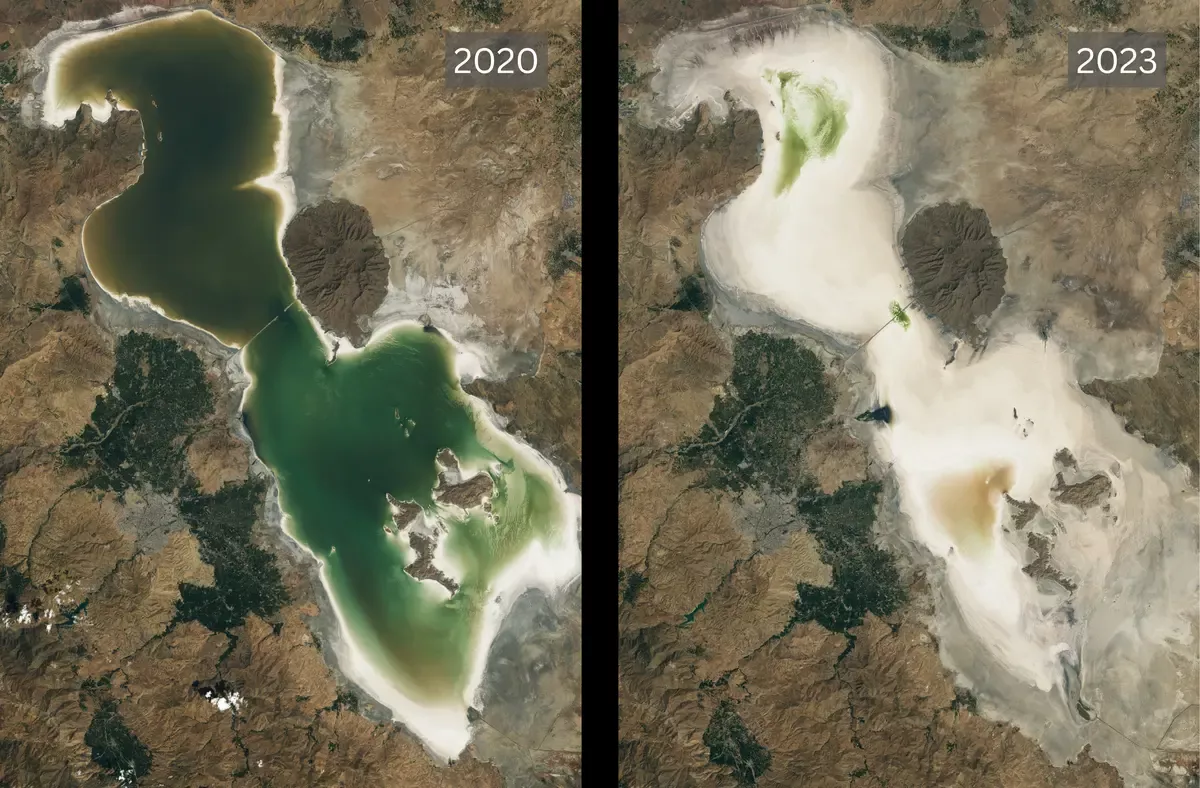
One of the most striking examples is Lake Urmia, once the largest lake in the Middle East, which satellite imagery from NASA shows has almost completely dried up. Research indicates that salt-laden dust from the lakebed can travel hundreds of miles within hours, significantly degrading air quality across wide regions.
Southern regions affected most
According to the National Air Quality MonitoringSystem, air quality readings at nine monitoring stations across Tehran Province were classified as red on December 27. AQI levels in the cities of Damavand, Varamin, Pakdasht, Gharchak and Shahriar ranged between 150 and 170, placing them in the “unhealthy for all” category.
The average AQI across Tehran’s 22 municipal districts stood at 136, categorised as “unhealthy for sensitive groups.” Under the AQI scale, readings above 150 are considered unhealthy for the general population, while levels above 200 are deemed “very unhealthy.”
Conditions were even more severe in parts of southern Iran, particularly Khuzestan Province, where officials reported some of the worst air quality in the country. The provincial air quality monitoring centre said the AQI in the city of Hendijan reached 212, placing it in the purple category and signalling “very unhealthy” air.
This new environmental development is compounding the issue of an already polluted air quality in Iran's metropolises. According to the Hammihan news article, studies show that more than half of the air pollution there is caused by worn-out cars and motorcycles; vehicles that exceed emission standards and continue to burn millions of liters of fuel on the streets of the capital. Power plants, industries around the city, trucks that enter the highway network day and night, as well as household consumption in the cold season, all further contribute to a wave of pollutants that, with the first layer of temperature inversion, hang between the ground and the sky and trap people.
Environmental experts and critics of the government’s response argue that authorities have relied largely on short-term measures, such as temporary closures of schools and offices, despite the recurring nature of winter pollution. As noted in the article, they say no effective or long-term solutions have yet been implemented to address the underlying drivers of Iran’s chronic air pollution crisis.
By Nazrin Sadigova







 editor@caliber.az
 +994 55 444-88-98
 Азербайджан, Баку, ул. Низами, 203, Af Business House, 5-й этаж