










Paris Grand Slam: Can Azerbaijan’s “eight” be magnificent? Forecast on Caliber.Az
Paris will host the first Grand Slam judo tournament of the year on February 7–8. Traditionally dubbed the “mini World Championship,” the 2026 Paris Grand Slam will see competitors from 82 countries take to the tatami.
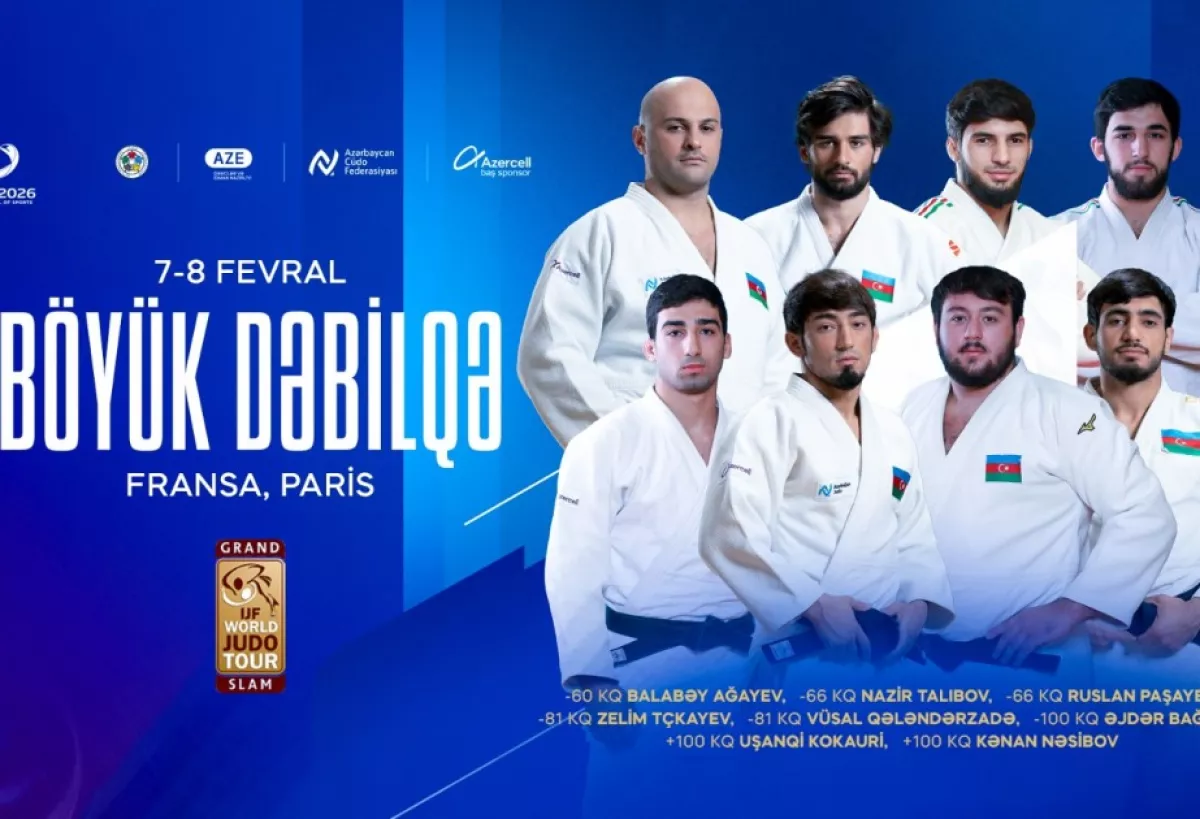
Azerbaijan will be represented in Paris by eight judokas under the leadership of national team head coach Richard Trautmann, with the men’s team competing across five weight categories. The women’s team will skip this tournament, but that’s a story for another time. For now, let’s focus on Azerbaijan’s eight judokas and assess their chances of leaving the tatami with the “magnificent” label.
In the under-60 kg category, two-time Paris Grand Slam champion Balabay Aghayev will step onto the mat. Can he claim gold once again? The truth is, repeating his 2021 and 2023 triumphs looks unlikely. His seeding — sixth in the world rankings for his category — reflects this. Strong contenders like Japan’s Ryuju Nagayama and France’s Luka Mkheidze are favoured, and both hold the upper hand in head-to-head encounters with Aghayev. Compounding the challenge is Aghayev’s relatively limited arsenal of techniques, which his main rivals know all too well. Considering these factors, a bronze medal appears to be the most realistic target for him in 2026.
In the under-66 kg category, Ruslan Pashayev could be a dark horse. His success will largely depend on how he starts the tournament — if he wins his first two bouts, he has a real shot at reaching the final. The favourites, however, are world champion Takeshi Takeoka and Nurali Emomali. French judoka Walide Khyar will also be a formidable opponent, buoyed by the support of the home crowd. For Azerbaijan’s other competitor in this weight class, Nazir Talibov, even advancing through one or two rounds would be considered a solid achievement given the stiff competition.
The under-81 kg category is the one where missing out on a medal would be seen as a setback. Zelim Tckaev enters as the top seed, while youth world champion Vusal Galandarzade has long demonstrated he is ready for senior-level success. In 2025, in Mexico, he confirmed his potential by winning the Guadalajara Grand Prix, and now all eyes are on him to deliver at an even more prestigious stage.
Traditionally, the heaviest weight categories are the most challenging. For recent junior Ajdar Bagirov (100 kg), the trip to Paris is more of an investment in the future. With Zelym Kotsoiev absent, it will be difficult to expect top finishes here. On the other hand, Kanan Nasibov (over 100 kg) has the potential to make an impact both as a competitor against Ushangi Kokauri and as a young athlete eager to prove himself among the elite. There’s a strong feeling that he could make a breakthrough in Paris — and we hope that intuition proves correct.
As for Ushangi Kokauri, he is perhaps the most unpredictable judoka on the team: capable of winning when no one expects it, and losing where medals seem guaranteed. In Paris, he could be eliminated in his first bout or reach the semifinals — anything is possible.
In conclusion, the minimum target for Azerbaijan in Paris is three medals of any colour. But for the “eight” to truly be called magnificent, at least one of them will need to claim gold. Otherwise, more modest adjectives will have to be used to describe their results.
By Vugar Vugarli, exclusively for Caliber.Az







 editor@caliber.az
 +994 55 444-88-98
 Азербайджан, Баку, ул. Низами, 203, Af Business House, 5-й этаж