










Grown in Azerbaijan, sought worldwide: agricultural sector expands its export reach Overview by Khazar Akhundov
Agricultural reforms implemented in recent years, export promotion mechanisms, strengthened quality standards, the development of agro-parks, as well as the recently adopted “State Programme on the Development of Production and Processing of Agricultural, Fishery and Aquaculture Products in Azerbaijan for 2026–2030” are creating favourable conditions for expanding Azerbaijan’s agricultural exports.
Today, in addition to traditional markets in post-Soviet countries, products of Azerbaijan’s agro-industrial complex (AIC) are being exported to the Middle East, North Africa, Europe, and China. As a result, according to data from the State Customs Committee (SCC), in the first half of this year Azerbaijan increased its revenues from fruit and vegetable exports by nearly 19%.

As is well known, in recent years the Azerbaijani government has been focusing its efforts on expanding exports from the non-oil sector. In this regard, work is underway to fundamentally diversify the range of exported goods, while steps are being taken to encourage the development of non-resource-based manufacturing industries. These measures are yielding tangible results: by the end of 2025, the country’s non-oil exports had increased by 8.1%, reaching $3.6 billion. In the first half of 2026, this momentum improved further, with non-oil exports excluding non-monetary gold amounting to $1.8 billion, representing a growth of 16.9%.
Notably, the agricultural export segment has made a significant contribution to the positive dynamics of non-oil exports. According to data recently released by the State Customs Committee (SCC), in the first half of this year, 429,345 tonnes of fruits and vegetables worth a total of $493.955 million were shipped to foreign markets, with export value increasing by 18.8% compared with the same period last year. At the same time, when processed agricultural products and industrial crops are added to fresh fruit and vegetable exports, total agro-industrial exports during the reporting period increased by 26.6%, reaching $759.8 million.
The countries of the post-Soviet space have traditionally been the key markets for Azerbaijani agricultural products. However, in recent years, significant progress has been made in diversifying the agro-industrial export portfolio both in terms of product structure and geography. In this regard, the long-standing efforts of the Export and Investment Promotion Agency (AZPROMO) deserve particular attention.

In particular, through the agency and trade missions, various presentations and seminars have been held in recent years, while Azerbaijani agricultural companies and small and medium-sized enterprises have been supported in participating in international exhibitions and forums. The agency also provides consulting services on exploring export markets and obtaining international certification, while actively promoting the Made in Azerbaijan brand.
Thanks to these efforts, Azerbaijani agricultural products and wine products are now being sold in countries across Eastern and Southern Europe, Africa, as well as China. At the same time, financial instruments supporting exporters, along with mechanisms such as trade and wine houses, are being actively used to increase export volumes.
Overall, strengthening raw material processing with a focus on foreign markets has become one of the key priorities of agricultural reforms in Azerbaijan. As Deputy Economy Minister Azer Bayramov stated at the 5th Agribusiness Development Forum held as part of Caspian Agro Week, “the key objective in developing the agricultural sector is to deepen the value chain. The main areas of focus include increasing the processing of meat, dairy products, fruits, vegetables, and grapes, as well as establishing production and processing clusters, which can directly contribute to the growth of export revenues.”
In this regard, the adoption of the “State Programme on the Development of Production and Processing of Agricultural, Fishery and Aquaculture Products in Azerbaijan for 2026–2030” has marked the beginning of a new stage of agricultural sector reforms aimed at expanding commercial production and increasing foreign supplies of food products and other processed agricultural goods.

In particular, speaking in June at a regional meeting in the Nakhchivan Economic Region dedicated to the implementation of the new State Programme, Azerbaijani Agriculture Minister Majnun Mammadov noted that the development of agro-parks, comprehensive subsidy mechanisms, preferential sales of production inputs, concessional lending, agricultural insurance, and other state support instruments have contributed to increasing import substitution in the food sector.
“As a result of the measures implemented, the country’s current self-sufficiency levels stand at 107% for vegetables, 140% for fruits and berries, and 91% for potatoes,” the minister said. “The volume of vegetable exports amounts to 214,000 tonnes, while fruit exports total around 600,000 tonnes. Azerbaijan ranks fourth in the world in hazelnut exports, second in persimmon exports, and ninth in peach and nectarine exports, and is among the top 20 countries in terms of production volumes of strawberries, cherries, tomatoes, and cotton fibre.”
The situation is also quite favourable in melon and watermelon cultivation, with production reaching 460,000 tonnes, exports amounting to 18,000 tonnes, and virtually no imports. On average, a stable annual export volume of around 600,000 tonnes has been established for fruits and berries. The self-sufficiency rate for grapes is also relatively high at 92%, with production reaching 211,000 tonnes and exports standing at 10,000 tonnes.
The situation in tea production is comparatively positive as well: with output of 11,000 tonnes, the sector covers 86% of domestic demand. Meanwhile, Azerbaijan is 102% self-sufficient in sugar production and exports 96,000 tonnes of sugar.
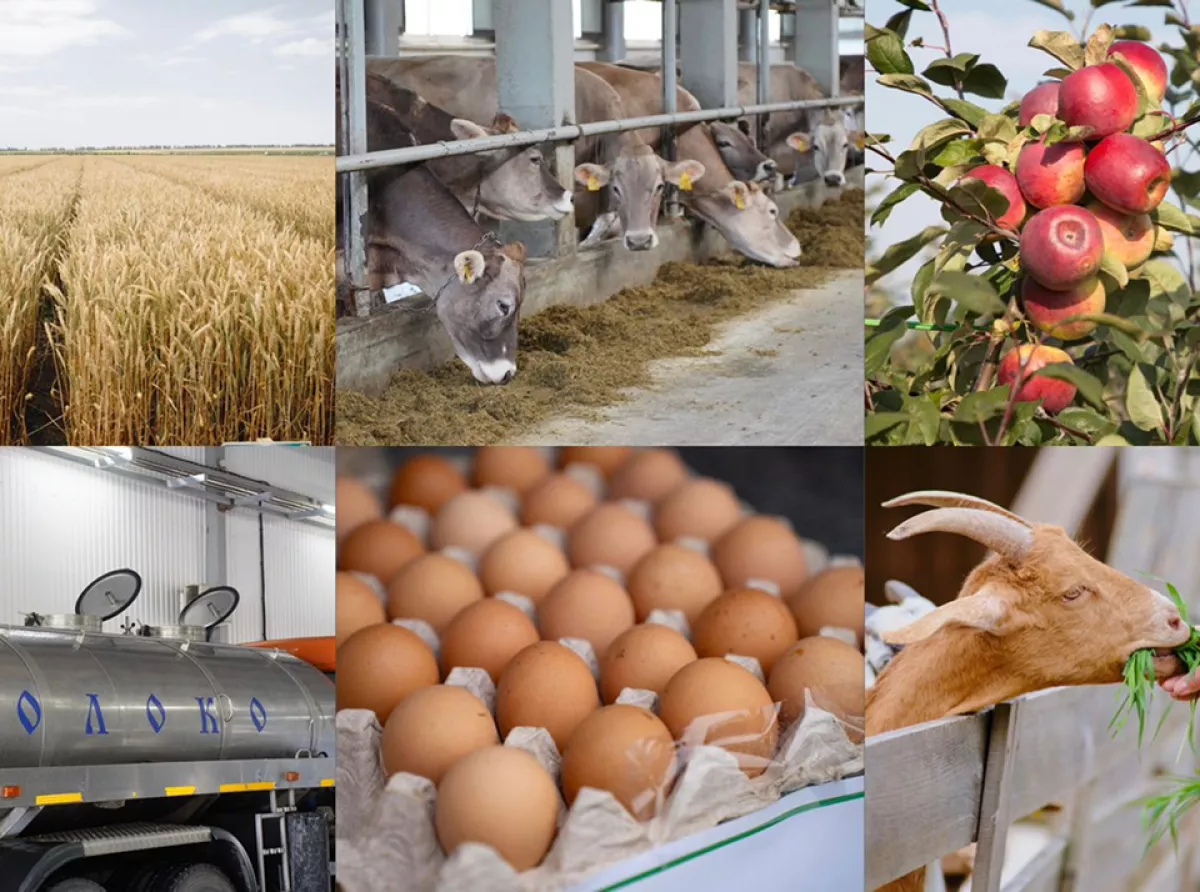
At the same time, over the past two years, the poultry sector has been emerging as a new export driver for Azerbaijan. For the second consecutive year, chicken meat and egg supplies have been shipped to Russia and China, while exports of eggs to the United States began in May 2026. Since April, deliveries have also been made to the Gulf countries, with export supplies to Afghanistan, Gambia, and Sierra Leone being established as well.
This progress is linked to the fact that Azerbaijan no longer needs to import poultry eggs: the country produces 2.34 billion eggs annually, with more than 90 million eggs being exported.
As the State Programme is implemented, the potential for agricultural production and processing is expected to grow further, creating additional opportunities to increase export supplies. At the same time, the Azerbaijani President’s decree on subsidising transportation costs for exporter companies will further encourage local producers to enter foreign markets. Under this mechanism, part of the transportation expenses for non-oil products, including agricultural goods, will be covered through the “export transportation support” mechanism financed from the state budget.







 editor@caliber.az
 +994 55 444-88-98
 Азербайджан, Баку, ул. Низами, 203, Af Business House, 5-й этаж