










SOCAR at energy crossroads: Oil, gas and green future Article by Rovshan Nadjaf at WEF
The World Economic Forum (WEF) has published an article by SOCAR President Rovshan Najaf, exploring Azerbaijan’s role at the energy crossroads and the nation’s pursuit of a sustainable, green future alongside oil and gas development. Caliber.Az reprints the piece.
"We are at a juncture in the global energy landscape. With a global race towards a low-carbon future, the energy transition has become an environmental necessity and an economic transformation, and traditional energy producers must be involved – their infrastructure, expertise and investment capacity are essential for global energy security.
Azerbaijan has followed this logic – demonstrating how a hydrocarbon-producing economy can pursue decarbonization while safeguarding energy security – by scaling renewable electricity generation, modernising transmission networks and integrating “green reconstruction” nationwide.
Global energy trends and imperative for action
Global energy supply has increased, rising 13% during 2014-2023, driven by stable, increasing demand.
Industrialisation, population growth and economic expansion will fuel demand even further over the next 25 years, particularly from emerging and Asian economies outside of the Organisation for Economic Co-operation and Development.
This growth has also fueled 77% more global carbon dioxide emissions since 1990, underscoring the urgent need for coordinated action.
In response, more than 140 countries have committed to net-zero targets, covering most global emissions. A pragmatic approach includes rapidly scaling clean energy and efficiency while reducing the footprint of the existing system.
As climate change recognises no borders, collective collaboration is essential for a just transition.
Amid global economic shifts and geopolitical uncertainty, energy security and climate resilience have become priorities for Azerbaijan, shaping a transition approach that integrates renewables without undermining system reliability or economic stability.
The country has embedded the goal of a "clean environment and green growth" into its Azerbaijan 2030 strategy, emphasising renewable energy development. Its Energy Efficiency Fund supports initiatives that reduce environmental impact and improve sector efficiency, offering loans, grants and subsidies.
While continuing to leverage its hydrocarbon sector, Azerbaijan has pursued a parallel path of renewable development.
As a net electricity exporter since 2007, the country has further strengthened its energy security by modernizing generation facilities and reinforcing the transmission network. By 2023, power generation reached 29.3 billion kilowatt-hours (kWh), a 25.5% increase over the past decade.
According to the 2016 Strategic Roadmap, the government plans to diversify the energy mix and increase renewable energy generation. The technical potential of Azerbaijan`s onshore renewable energy sources is 135 gigawatts (GW) and its offshore potential is 157 GW.
In this connection, the country aims to increase the share of renewables in the power generation to almost 40% by 2030.
Advancing renewable infrastructure and green corridors
Over the past five years, Azerbaijan has made tangible progress in renewable energy deployment:
- Garadagh Solar Power Plant (230 megawatt (MW)): Largest solar facility in the Caspian region, inaugurated in 2023.
- Karabakh and East Zangazur hydropower: 32 plants commissioned with 270 MW capacity; planned expansion to 500 MW.
- Khizi-Absheron wind farm (240 MW): Under development by ACWA Power and SOCAR, reaching full capacity by late 2025.
- Bilasuvar (445 MW) and Neftchala (315 MW) solar projects: Financially closed at COP29, projected to generate over 1.7 billion kWh/year.
- Shafag solar power plant (240 MW): First industrial-scale solar project in liberated territories; expected annual output of 500 million kWh.
According to the State Statistics Committee of the Republic of Azerbaijan, electricity production from hydropower plants has increased 2.8 times, while solar energy generation has grown by an impressive 12.6 times over the past five years.
National transition strategies can generate regional decarbonization benefits beyond domestic borders. Given its strategic geography, existing transmission links and established energy partnerships, Azerbaijan is uniquely positioned to serve as a bridge between the Caspian region and potentially Central Asia and Europe.
As such, Azerbaijan is actively developing three major green energy corridors:
- Caspian-Black Sea-Europe Corridor.
- Azerbaijan-Türkiye-Europe Corridor.
- Central Asia-Azerbaijan-Europe Corridor.
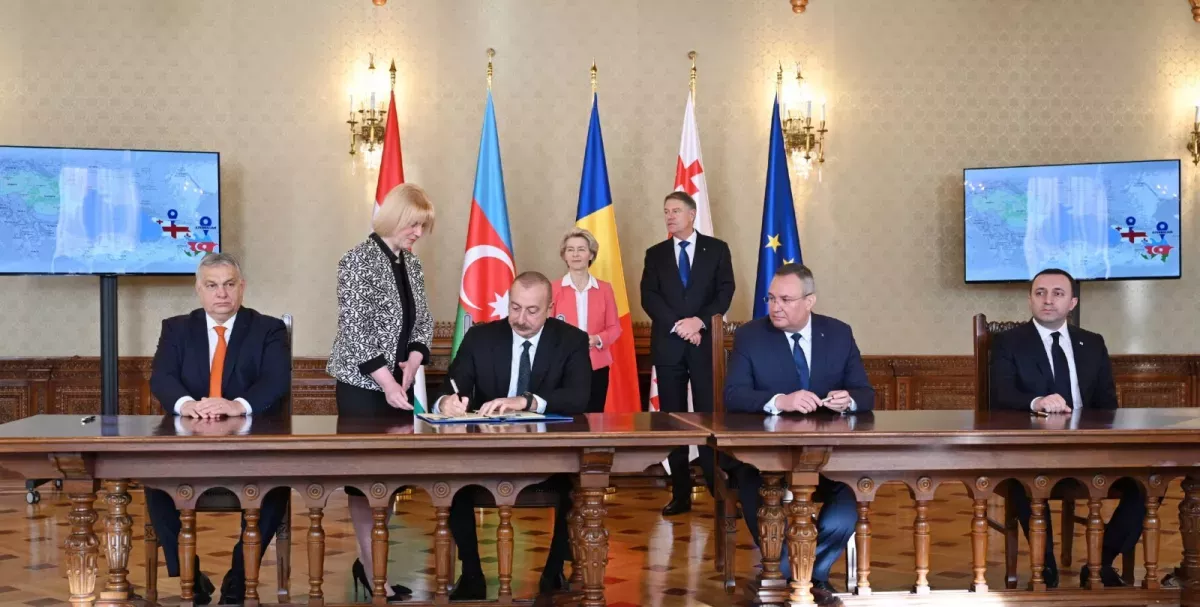
In 2022, the signing of the Strategic Partnership Agreement on Green Energy Development and Transmission between Azerbaijan, Georgia, Romania and Hungary in Bucharest marked a significant step towards opening a green energy corridor to Europe.
Collectively, the three green energy corridors can potentially to carry up to 10 GW of renewable electricity, reinforcing Azerbaijan as a future hub for cross-border clean energy transmission.
State oil’s integrated energy strategy
The State Oil Company of the Azerbaijan Republic (SOCAR) is pursuing a forward-looking strategy that integrates energy security, transition initiatives, digitalization and innovation.
And there is notable progress advancing digital transformation, strengthening data-driven decision-making, optimizing operations and enhancing efficiency across company activities:
- Petkim Petrochemical Complex: Recognized as a “Factory of the Future” by the World Economic Forum Global Lighthouse Network for Industry 4.0 adoption.
- STAR Refinery: The first global oil refinery in the Global Lighthouse network, demonstrating operational efficiency and sustainability.
SOCAR’s decarbonization and green initiatives
At the 2023 United Nations Climate Change Conference (COP28), SOCAR signed the Oil & Gas Decarbonization Charter and joined its steering committee. The company has set ambitious decarbonization targets, including:
- Achieving zero routine flaring by 2030.
- Reducing upstream emission intensity by 30% by 2030.
- Reducing corporate emission intensity by 30% and absolute emissions by 20% by 2035.
- Targeting upstream near-zero methane emissions by 2035.
- Reaching net-zero by 2050.
SOCAR will aid these efforts through digital, data-driven solutions, including through its Methane AI platform, profiled by the Oil & Gas Decarbonization Charter, which integrates multi-source asset data into one system to support reporting aligned with the UN’s Oil & Gas Methane Partnership (OGMP), real-time monitoring and rapid methane abatement.
In 2024, SOCAR joined OGMP 2.0, committing to higher-accuracy methane accounting and greater value-chain transparency. The same year, it established SOCAR Green LLC in 2024 to manage green and low-carbon projects to support its broader transition
In March 2025, the company further strengthened its green financing framework by issuing $200 million in five-year green bonds at a 6% coupon on the Baku Stock Exchange, with proceeds directed to renewable and low-carbon investments through SOCAR Green.
Ensuring a just and balanced energy transition
The energy transition must be realistic, inclusive and equitable. While renewable deployment grows, material constraints and intermittency issues persist, particularly in emerging markets. According to the latest data from the International Energy Agency, an estimated 730 million people worldwide still lacked access to electricity in 2024 – only 11 million less compared to 2023, with preliminary estimates for 2025 indicating a similar trend. What we need are realistic and enabling policies.
Regulations should:
- Encourage innovation, not penalize production.
- Scale clean technologies, including carbon capture, green hydrogen and energy efficiency solutions.
- Promote responsible production and consumption.
A just transition balances decarbonization with economic development, ensuring no communities are left behind. Traditional energy companies have a responsibility to lead this shift toward sustainable, resilient and inclusive energy systems," Rovshan Najaf wrote.







 editor@caliber.az
 +994 55 444-88-98
 Азербайджан, Баку, ул. Низами, 203, Af Business House, 5-й этаж