










European Union: Is a great idea fading away? Nesterov's viewpoint
Any idea tends to change, transform, and adapt to new historical conditions. The European idea is not an exception. In addition, different supporters of the idea try to bring their own interpretation of the basis that was in the beginning. Obviously, a founder of any world religion would be very surprised to see what his ideas and conceptions have become through the centuries.
As we know, the historical origins of the European idea go back to ancient times and the Middle Ages. The concept of a united Europe inspired many philosophers and rulers, from Charlemagne in the 8th century and Abbé Jean Dubois in the 14th to the concept of a universal empire, which Charles V of Habsburg tried - though unsuccessfully - to realize in the 16th century. In modern times, the concept of unity was replaced by the concept of plurality and sovereignty. At the beginning of the 19th century, Napoleon Bonaparte tried to realize the idea of European integration - unification under the domination of one state. The Holy Alliance in the first half of the 19th century was also essentially an integration idea.
One thing all the concepts of a united Europe had in common was that Jacques Dubois, Maximilian de Sully, and Napoleon Bonaparte all saw the task of uniting Europe politically in the first place. The same concept was the basis of the idea of the European Federation conceived by Aristide Briand and Alexis Léger in the 1920s and 1930s.
However, only the concept developed by Jean Monnet and Robert Schuman in the 1940s-1950s shifted the European idea to a new direction - economic cooperation. Its founders brought the economy to a new stage - economic integration. In their view, economic integration should be the basis for overcoming the conflict relations of European countries and create conditions under which a new war in Europe would be impossible. This idea became the basis for the creation of the first Community, and then the other two. Naturally, one could not even imagine that the idea of integration was not tried to be politicized at the first moment: the Pleven plan, then the idea of federalization of de Gaulle aimed to extend integration to the political sphere, but it did not succeed. The basis remained basic: improving the economic well-being of Europe, and raising the standard of living of its inhabitants.
The first obvious threat to the politicization of the concept came in 1981, with the second enlargement of the European Communities (EU), Greece's admission to the EU. Obviously, Athens did not meet any of the economic criteria set forth in the requirements for EU candidates, but Greece was the birthplace of democracy - and they decided to thank it for purely ideological and political reasons. The admission of Spain and Portugal was quite politicized, albeit to a lesser extent.
The apogee of the realization of the idea laid down by Schuman and Monnet was the Maastricht Treaty - the Treaty on European Union, which resulted in the establishment of the European Union (EU) as an international structure. The creation of the EU, consisting of 15 states (EU-15) after the 4th enlargement (1995) was a natural and logical consequence of the integration idea, and Greece, Spain, and Portugal, accepted only for political reasons, did not play an essential role in the Union development.
Everything changed after the collapse of the USSR and the socialist system. The countries of Central and Eastern Europe, which wanted to join the EU, did not meet the requirements for candidates, and initially, the prospect of their accession was not even seriously considered. The end of the 1990s changed everything. The fate of the Union was decided in the crucial years of 1996-1999: whether the integration would continue along the intensive or extensive path, and whether economists or politicians would win in determining the path. In the end, it turned out that politicians won, and the concepts of the EU founding fathers were pushed aside, and then completely discarded. At the forefront were political concepts and ideas, typical rather for another European international organization - the Council of Europe - the problems of democracy, human rights, etc.
However, economic problems only increased: the EU territory grew by a third, population by a quarter, and GDP by only 5%, after admitting 13 new members who did not meet the criteria for admission but were politically expedient. In addition, human rights issues and the export of democracy led to the migration crisis, which peaked in 2015.
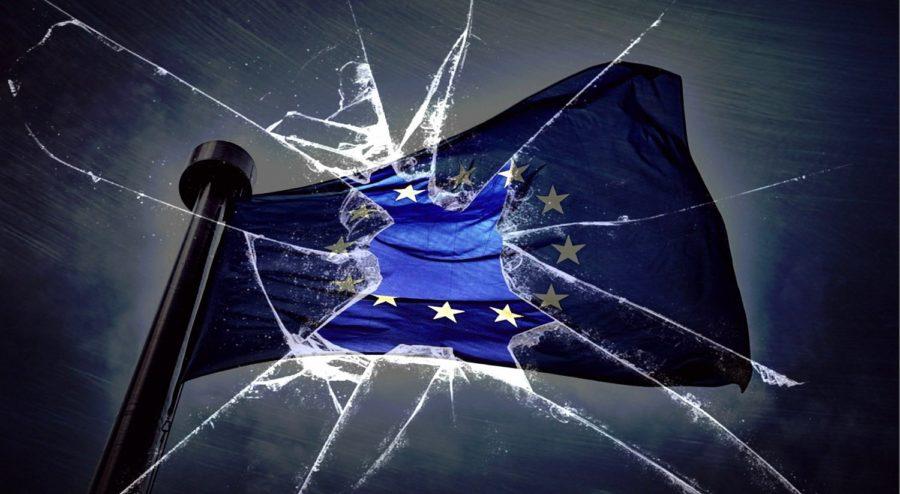
In 2016, the EU disintegration process began with a referendum that caused the UK to leave the EU. Developed countries, such as Norway or Switzerland, despite numerous offers, refuse to join the European Union, but economically dependent countries like Albania, Montenegro, or Northern Macedonia are eager to join it. And there are also Ukraine, Moldova, and Georgia. The EU became a purely political project, highly bureaucratized, and the most economically developed countries that were successfully turned into troughs for the economically underdeveloped countries are ready to get rid of it.
What are the prospects? We know that inertia is a fundamental feature of any international association, it is much easier to create something than to destroy it. So, the European Union can exist for a long time while self-destructing. However, the time of Eurooptimism is over - it ended a quarter of a century ago. The great idea of European integration formulated by Robert Schuman and Jean Monnet has become a thing of the past.







 editor@caliber.az
 +994 55 444-88-98
 Азербайджан, Баку, ул. Низами, 203, Af Business House, 5-й этаж