










Grain course: Azerbaijan strengthens food security Review by Khazar Akhundov
Climate risks, the shortage of irrigation water, and the crisis processes that have intensified in the global agricultural sector in recent years are prompting countries to strengthen food security. Azerbaijan is also consistently pursuing this goal. At the initiative of President Ilham Aliyev, the State Program for 2026–2030 has been adopted, and agricultural reform has been launched, aimed, among other things, at increasing grain production. According to the latest data from the Ministry of Agriculture, the harvesting of winter crops is continuing across the country, with the crop harvested on 78.5 per cent of arable land. And although this spring was rainy and cold, somewhat delaying the start of the grain harvest, the average yield across the sector is nevertheless slightly higher than in 2025, while the final harvest volume will become clear at the end of the summer, after the harvesting of spring crops is completed.
Unstable weather conditions were observed across the country in the spring of 2026, including heavy rains, hail, mudflows, and strong winds, while the rains in early June coincided with the final stage of grain ripening. Not to mention that intensive precipitation and low temperatures create favourable conditions for the growth of wild plants and weeds. These factors postponed the start of the winter crop harvest by one and a half decades.
As Ramin Gurban, Head of the Public Relations Department of the Ministry of Agriculture of the Republic, recently told representatives of the local media, “The unstable weather conditions observed across the country since the beginning of this year have also affected grain farming, one of the strategically important sectors of agriculture. In particular, heavy rains during the harvesting season led to excessive soil moisture in some regions, making it difficult for combine harvesters to enter the fields and carry out harvesting operations. All of this caused the harvesting campaign to begin later than originally planned.”
Nevertheless, despite the vagaries of the weather, the pace of the harvest was successfully adjusted, and as of July 15, the harvesting of winter grain crops in Azerbaijan had been completed on 78.5 per cent of the sown area. In particular, the harvest has been fully completed in Ujar, Agdash, Barda, Bilasuvar, Jalilabad, Kurdamir, Yevlakh, Masally, Neftchala, Sabirabad, Salyan, Kalbajar, and Shusha.
According to the Central Grain Harvesting Headquarters under the Ministry of Agriculture, the crop has been harvested from 755,500 hectares, yielding just under 2.637 million tons of grain, while the national average yield stands at 34.9 centners per hectare, which is 1.4 centners per hectare higher than during the corresponding period in 2025, when it was approximately 33.5 centners per hectare.
Today, it is difficult to predict what total grain harvest will ultimately amount to in 2026. However, it is worth recalling that, according to the State Statistics Committee, the country harvested 3,277,800 tons of grain and legumes (including maize) in 2025, nearly 3 per cent more than the year before. At the same time, the average grain yield increased from 31 centners to 33.4 centners per hectare, approaching the record levels of 2018 and 2019, when the republic harvested 3.3 million and 3.4 million tons of grain, respectively.

At the same time, Azerbaijan is seeking to reduce its dependence on global fluctuations in grain prices, and in recent years the country has focused on expanding specialised grain-producing farms and agroparks equipped with efficient irrigation systems, modern machinery, advanced agricultural technologies, and a high level of chemical treatment, all of which ensure the commercial production of wheat.
Under a number of decrees and executive orders issued by the leader, agricultural companies that use modern irrigation systems are provided with food production subsidies. These subsidies are also available to farms in the Karabakh and Eastern Zangezur economic regions, where the area under grain cultivation is expanding every year. However, the country is only 55 per cent self-sufficient in wheat, and local farms primarily cultivate feed wheat varieties used in the production of compound feed. As a result, imports of bread-making wheat have been increasing in both value and volume in recent years. This is an alarming signal indicating the country's high dependence on imports and the existence of significant risks to food security.
As Ilham Aliyev stated during a meeting devoted to agricultural development, “For many years, wheat production in our country has remained at this level, despite a very significant impetus having been provided and many agroparks established. [...] Domestic production stands at 1,573,000 tons, while imports are at 1,267,000 tons. Look, we must reduce these imports. Naturally, taking into account our geography, our arable lands, and the necessity of cultivating other agricultural products, we should not set a goal to satisfy 100 percent of our food wheat needs ourselves. However, in any case, 55 percent is an unacceptable figure, and it must absolutely increase.”
The president also noted that domestic production of legumes amounts to 23,000 tons, while imports total 15,000 tons, resulting in a self-sufficiency rate of 63 per cent. The situation with other grain crops (mainly feed grains) is generally positive, with the country being 95 per cent self-sufficient and imports remaining insignificant. To reduce dependence on external grain supplies, the recently adopted State Program for the Development of Agricultural Production and Processing, Fisheries, and Aquaculture in Azerbaijan for 2026–2030 also outlines measures to expand domestic production.

Overall, the task of increasing grain self-sufficiency is far from simple, as global desertification processes have resulted in an acute shortage of irrigation water in Azerbaijan, while soil erosion and salinisation have also reduced the area of fertile land. In this regard, during his recent speech at public hearings held by the Agrarian Policy Committee of the Milli Majlis, Minister of Agriculture Majnun Mammadov noted that around 50 per cent of grain crops in Azerbaijan are currently grown on rain-fed (non-irrigated) land, where achieving a significant increase in yields is difficult under the conditions of climate change.
Therefore, the key priorities will be improving water supply, the widespread adoption of water-efficient irrigation technologies on farms, and the introduction of new drought-resistant grain varieties. In particular, a number of advanced farms participating in the implementation of the State Program on Measures to Increase the Level of Self-Sufficiency in Food Wheat succeeded in raising yields to 58 centners per hectare last year, significantly exceeding the national average. Moreover, while the program covered 22,000 hectares of cultivated land last year, the area has been expanded to 29,000 hectares this year.
At the same time, plans are in place to increase the number of modern grain silos at elevators in order to improve harvest storage conditions and minimise losses.
“Today, in various regions of the country, we observe that grain, wheat, barley and corn are still stored in warehouses by pouring, sometimes even without being packed in bags. Under such conditions, the product is subject to losses of 10, 20, and in some cases up to 30 % during storage from one season to another due to humidity, moisture and other factors,” the Minister of Agriculture stated, emphasising that this measure is included in the State Program and that its implementation will also help expand the country's logistics capacity.
At present, Azerbaijan aims to increase its grain storage capacity to 2.5 million tons, while an additional 100,000 tons of refrigerated storage facilities are planned to be established by 2030.
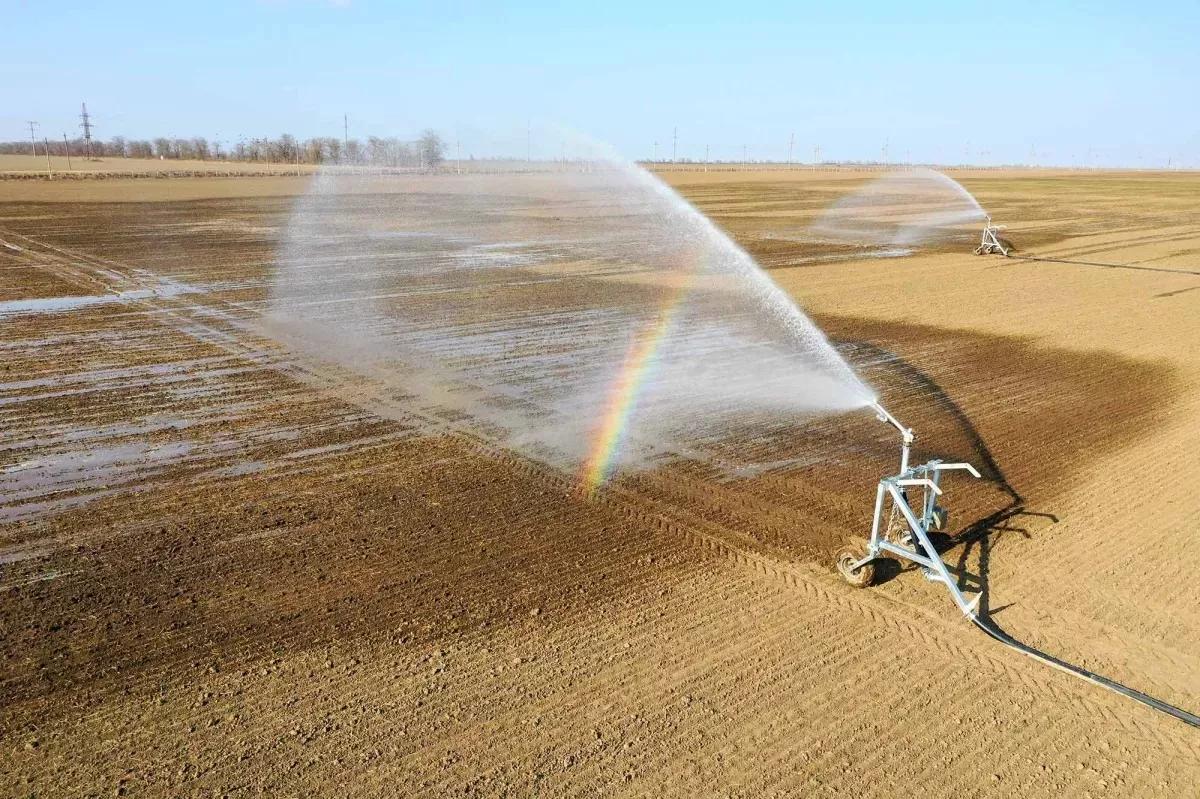
In turn, Deputy Minister of Agriculture Seymur Safarli noted that, in order to increase grain yields, plans have been made to group 22 agricultural districts with the greatest land potential for wheat cultivation according to their capacity for water-efficient irrigation, the application of modern technologies, the existing agropark infrastructure, and the size of farming operations. In addition, the use of high-generation certified seeds will be expanded in these target districts. The State Program also provides for the creation of a subsidy mechanism to support the use of laser land levelling technology, which helps conserve water, increase yields, optimise nutrient use, and reduce production costs.
“For farmers using laser land levelling, an additional production subsidy is planned for every ton of harvest delivered to flour mills, with the subsidy benefiting both the farmer and the mill. This mechanism will not only encourage the adoption of modern technologies but also strengthen the link between producers and processing enterprises. In total, laser land levelling is planned to be introduced on 84,900 hectares across 22 districts,” the deputy minister emphasised.
Another state support mechanism is the subsidisation of loan interest rates: the state budget will cover part of the annual interest rate on bank loans issued to farmers for the production of annual crops, provided that the interest rate does not exceed 19 per cent.
As can be seen from the above, the reforms are aimed at achieving a key objective: increasing the average wheat yield to 50 centners per hectare in the target districts and to 30 centners per hectare in the 31 districts where rain-fed farming predominates, with the goal of raising these figures even further in the future.







 editor@caliber.az
 +994 55 444-88-98
 Азербайджан, Баку, ул. Низами, 203, Af Business House, 5-й этаж