










“Harvest festival”: Azerbaijan’s hidden mosaic gem A historical insight on Caliber.Az
Mosaic is one of the oldest forms of monumental art, with roots stretching back to antiquity. Compositions made from fragments have served for centuries not only as architectural decoration but also as carriers of meaning and memory. During the Soviet period, mosaics became widespread and an important part of the urban environment. They adorned building façades, metro stations, cultural centres, schools, and other public spaces.
In Azerbaijan, this tradition gave rise to a distinct school of mosaic art, combining both the broader Soviet experience and national traditions. Local masters drew inspiration from history, labour, nature, and the country’s cultural symbols, creating expressive and large-scale compositions. Azerbaijani mosaics are characterised by a rich colour palette, dynamic imagery, and a high level of artistic craftsmanship.
Many mosaics in Azerbaijan are located in public spaces and are well known to city residents. However, there are also works that remain hidden from the view of ordinary passersby and are little known to the general public. One such example is one of the largest and most expressive mosaics, located on the premises of a former agricultural machinery repair workshop in Baku’s Mashtaga settlement.
A vibrant mosaic panel adorns the façade of a two-story building. Its rich colours and dynamic composition immediately draw attention, making it stand out among the surrounding structures.
The mosaic was created by artist Yagub Mehdiyev in 1979 and stands as a striking example of the monumental art of its time, where artistic imagery is organically combined with themes of labour and creation.
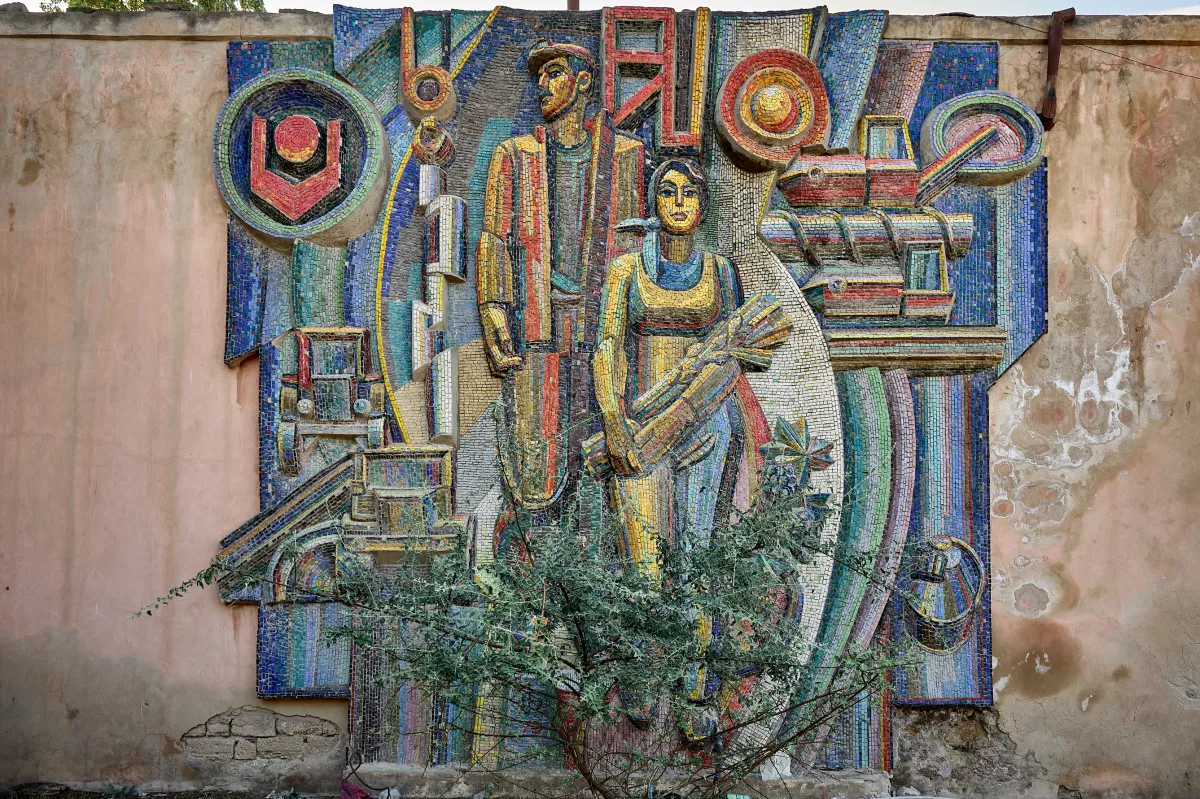
At the centre of the composition are a man and a woman — workers embodying the figures of labourers. The woman holds a bundle of wheat ears in her hand, symbolising the fertility of the land and a bountiful harvest. This gesture emphasises her connection to the land and agriculture. Above her head are clusters of grapes — a traditional symbol of abundance and prosperity.
Both figures in the mosaic have clearly defined facial features, giving the scene individuality and a distinctive character. Their poses convey strength, dignity, and confidence. These images evoke a sense of vitality and pride in work, transforming the mosaic from a mere decorative element into a powerful symbol of the spirit of its era.
The composition also features images of machinery, symbolising progress and development. Tractors and trucks stand out in particular: their massive wheels and sturdy bodies emphasise the importance of agriculture in the country’s life. The relief elements give the panel depth and volume, making it visually rich and dynamic. Bright, vivid colours create a cheerful atmosphere, bringing both the building and its surroundings to life.
Even today, this mosaic makes a strong impression, evoking a time when monumental art was an integral part of the industrial environment and seamlessly blended with it.
Mosaic art is not merely decorative; it is an important witness to its era, preserving the artistic ideas, labour, and worldview of the time in which it was created. Works like this maintain a living connection to the country’s cultural history, and today the mosaic continues to communicate with viewers through the language of colour and form.
By Vahid Shukurov, exclusively for Caliber.Az







 editor@caliber.az
 +994 55 444-88-98
 Азербайджан, Баку, ул. Низами, 203, Af Business House, 5-й этаж