










The Absheron Hotel mosaic: a lost chapter of Baku’s modernist heritage A Caliber.Az historical feature
Baku has always been a city where architecture becomes art, and buildings turn into true masterpieces of their time. It can rightfully be called an open-air museum, where styles from different eras intertwine harmoniously — from historical eclecticism to expressive modernism. A particularly vivid layer of development dates back to the 1980s–1990s, when many bold and aesthetically striking structures appeared in the city. These buildings stood out for their scale, thoughtful design, and a strong drive for architectural expression. Unfortunately, not all of them have survived to the present day. One of the lost symbols is the Absheron Hotel.
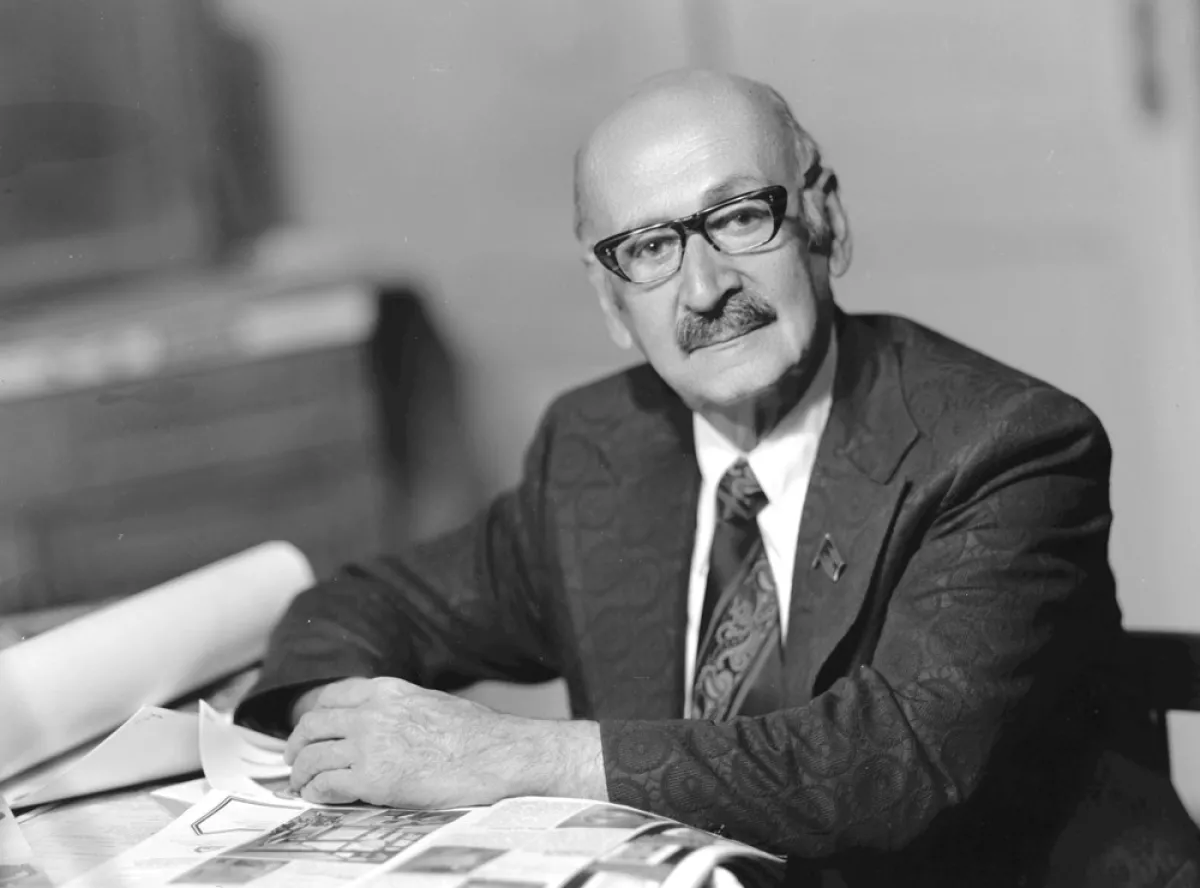
The Absheron Hotel, designed by architects Mikayil Huseynov and N. Akhundova and completed in 1985, stood as a striking example of late Soviet modernist architecture.
The authors of the project—each of whom made a significant contribution to the development of Azerbaijan’s architectural school—succeeded in creating a building where functionality was seamlessly combined with expressive form and a carefully considered urban role. Their approach was distinguished by a keen sensitivity to spatial scale, the interplay of volumes, and a deliberate effort to impart a sense of lightness despite the building’s considerable height.
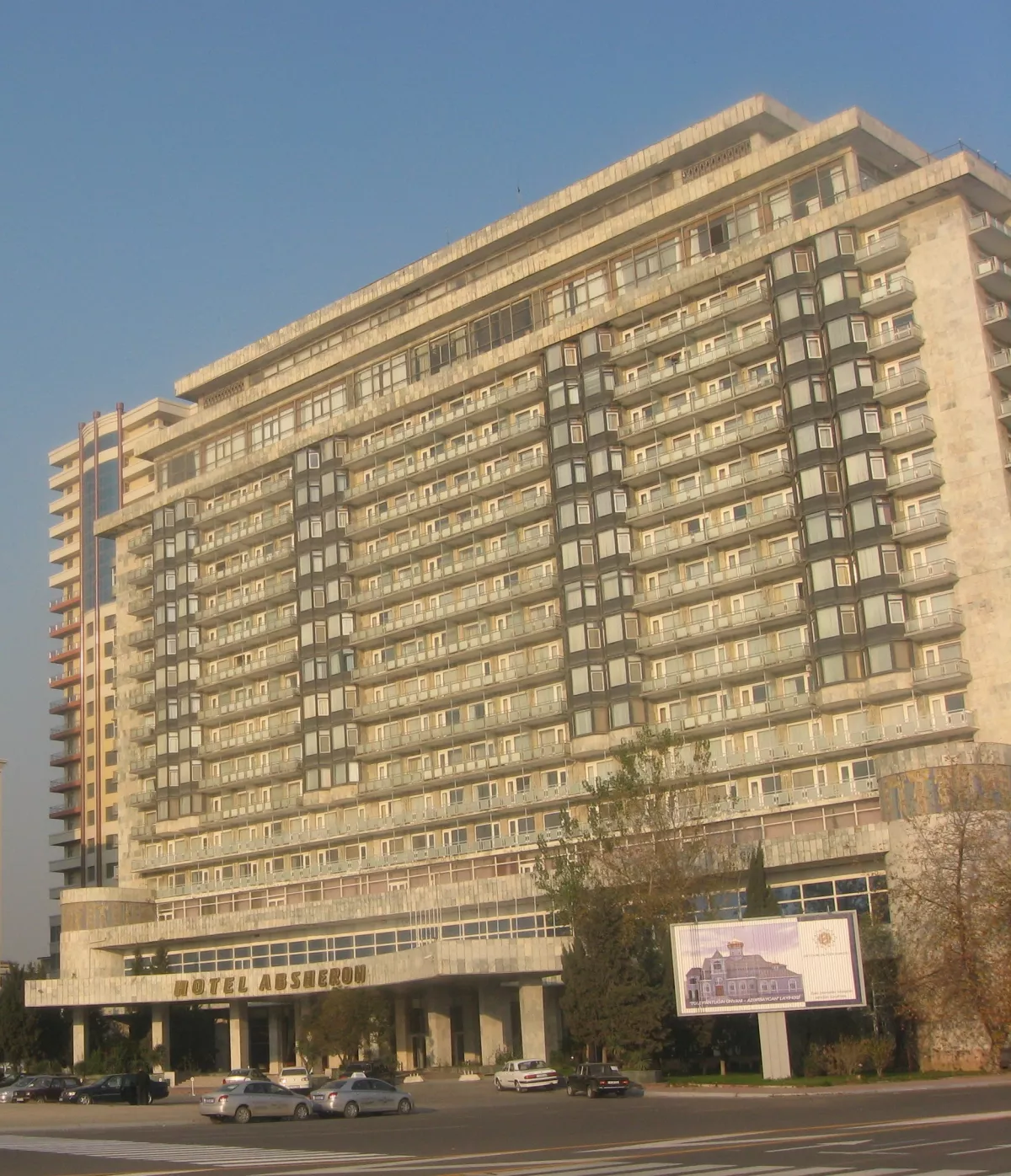
The structure was situated opposite Lenin Square (now Azadlig Square), forming a mirrored composition in relation to the Azerbaijan Hotel. Its main façade, facing the square, was designed as a rhythmic grid of light balconies, punctuated by vertical accents of bay windows. Four pairs of these bay projections, executed in anodised aluminium, established a clear vertical rhythm and lent the façade a dynamic, almost kinetic quality.
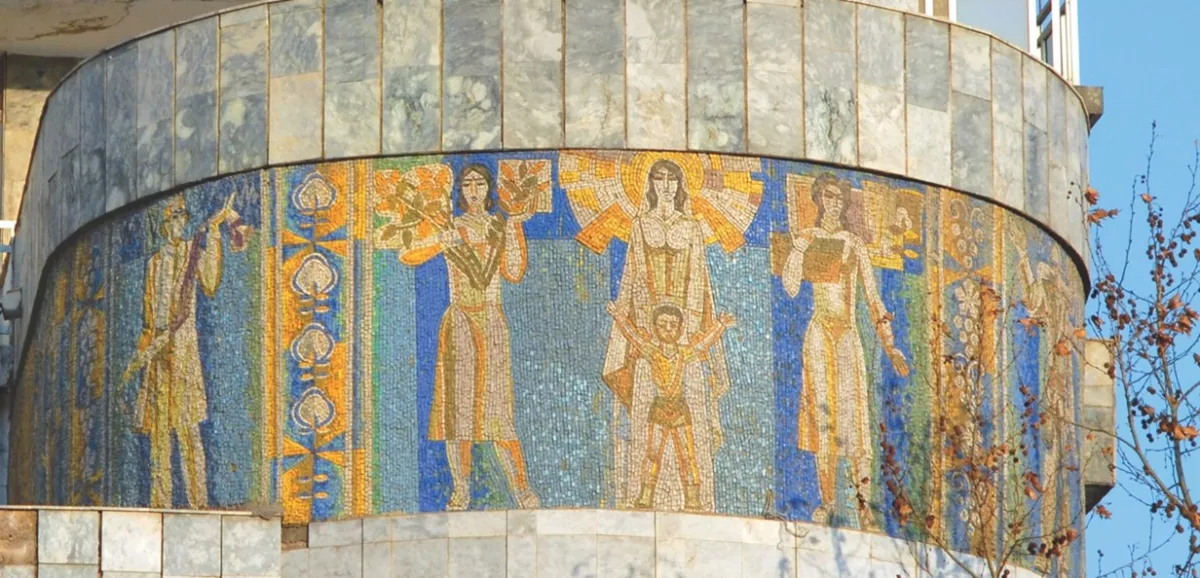
The semi-circular projections at the corners of the building, decorated with mosaic compositions and housing the ceremonial spiral staircases leading to the public spaces of the first three floors, emphasised the plasticity of the structure, enhanced the expressiveness of its silhouette, and served as important compositional accents. The façades were clad in light-grey marble.
The overall composition was based on a rhythmic sequence of elongated human figures executed in a stylised, generalised manner typical of Soviet monumental art. At its centre was a female figure holding a child, symbolising motherhood, the continuity of life, and humanistic ideals. On either side were figures representing labour, knowledge, and creation, emphasised through their attributes and gestures. The colour scheme combined golden, blue, and ochre tones, giving the mosaic decorative richness and ensuring its strong visual presence against the light stone background.
The word “mosaic” itself comes from the Latin musivum, meaning “dedicated to the Muses,” and refers to the art of creating a unified image from numerous small elements brought together into a single composition.
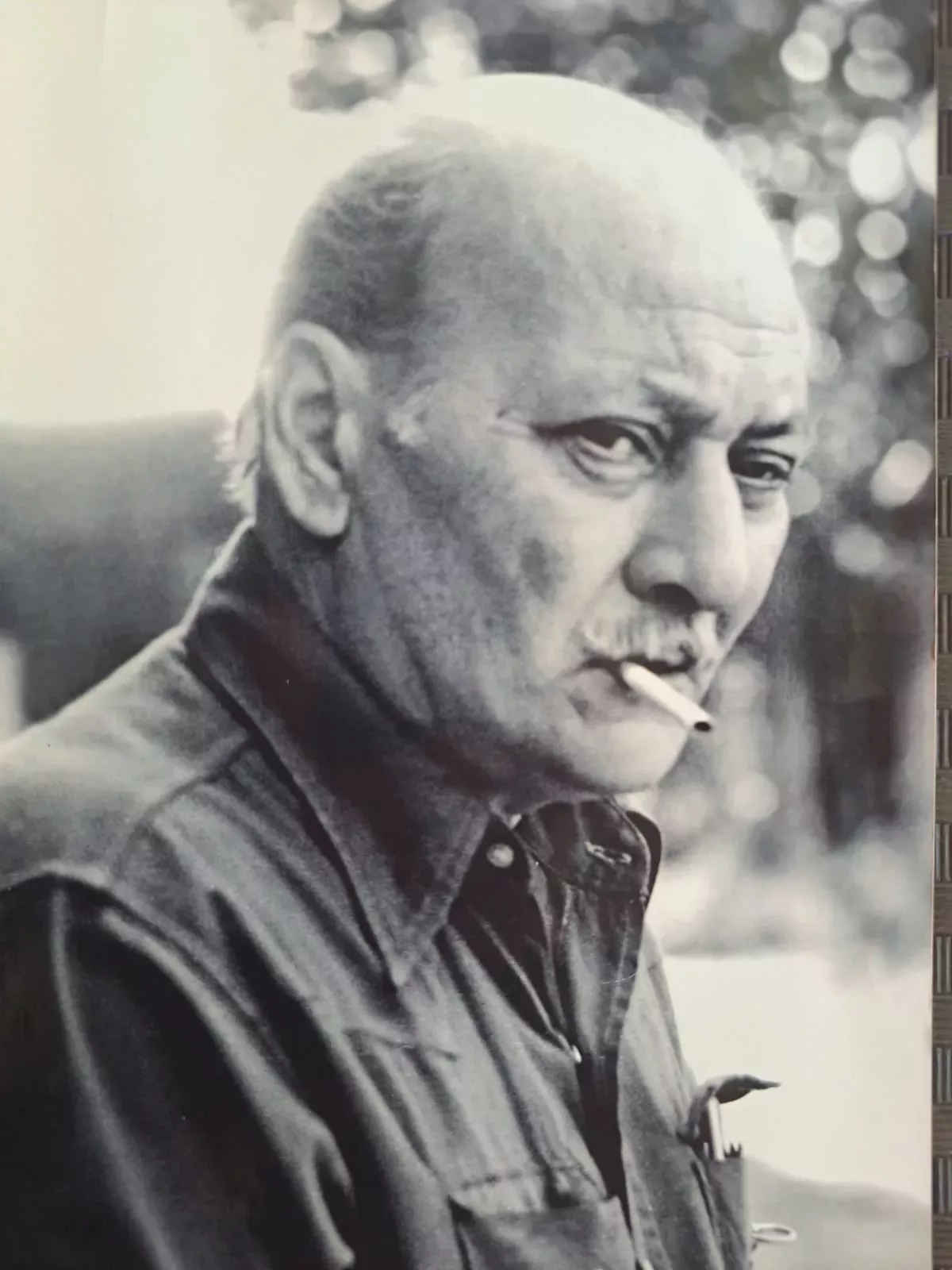
In Azerbaijan, this artistic direction developed in a particularly distinctive way: outstanding masters worked here, creating true masterpieces of monumental art. Among them, a special place belongs to Arif Aghamalov — an Azerbaijani artist who was awarded the title of Honoured Artist of Azerbaijan in 1992. He actively developed mosaic art as one of the most important forms of artistic expression, realising his ideas with originality and a high level of craftsmanship. A special expressiveness in his works was achieved through the use of smalt, which allowed for rich colour intensity and depth of imagery.
In the compositions he created, one can observe a rich diversity of forms and plastic solutions, united by a drive to convey elevated ideas, philosophical and social meanings, as well as to immortalise significant events and the spiritual values of society. One of his most notable works was precisely the mosaic friezes that once adorned the Absheron Hotel.
Notably, Arif Aghamalov designed the interior of both the hotel and its café, where he created sculptural chamotte inserts inspired by jazz themes. Acting within the architectural space as a kind of accompaniment, these panels enhanced the aesthetic expressiveness of the forms, serving as a decorative means of organising the walls.
The Azerbaijan and Absheron hotels played a significant role in shaping the architectural image of the city’s main square. Their volumetric and spatial design was subordinated to the task of structuring and visually unifying the vast open space of the square. Contrasting with the monumental plasticity of the Government House, they introduced a sense of lightness and elegance into the ensemble, forming a more dynamic and ceremonial perception of the urban environment.
The hotel comprised 1,211 rooms. Public functions were concentrated on the first three floors: these included the lobby group with elevator halls, two semi-circular staircases at the building’s ends, large restaurant halls, a restaurant of national cuisine, banquet rooms, and a cinema hall. From the fourth to the fifteenth floor, residential rooms were located, all equipped with necessary amenities, meeting the high standards of hotel architecture of its time.
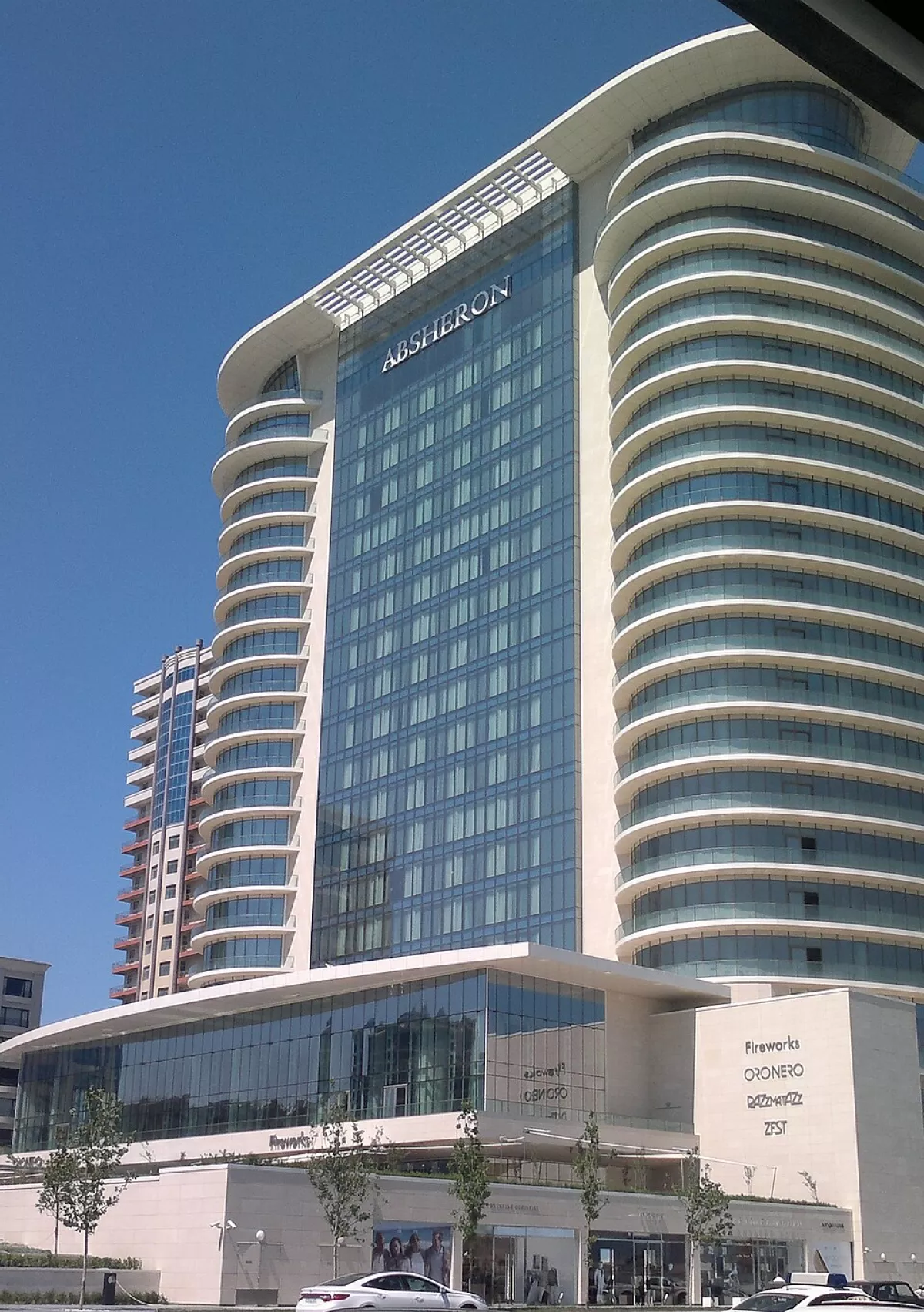
The Absheron Hotel was reconstructed in 1999. In 2009, the building was demolished, and a new twenty-story structure was erected in its place. The opening of the new hotel took place in 2012. The building, now known as the JW Marriott Absheron, features 243 rooms, including single and double rooms as well as suites located on the 9th, 11th, 12th, and 14th floors. It is managed by the JW Marriott company.
Unfortunately, the mosaic that once adorned the original building was not preserved. These lost masterpieces remain only in the memory of Baku’s residents and have become part of the city’s history, serving as a reminder of the high level of craftsmanship of the architects and artists of that era.
By Vahid Shukurov, exclusively for Caliber.Az







 editor@caliber.az
 +994 55 444-88-98
 Азербайджан, Баку, ул. Низами, 203, Af Business House, 5-й этаж