










US foothold in Poland: benefits, risks, and the new geopolitical reality Article by Matanat Nasibova
In the name of strengthening the country’s security, Polish authorities have, over many years, deliberately sought the permanent deployment of US troops on their territory, using a combination of generous funding, direct diplomacy with American presidents, and the projection of their status as a frontline state.
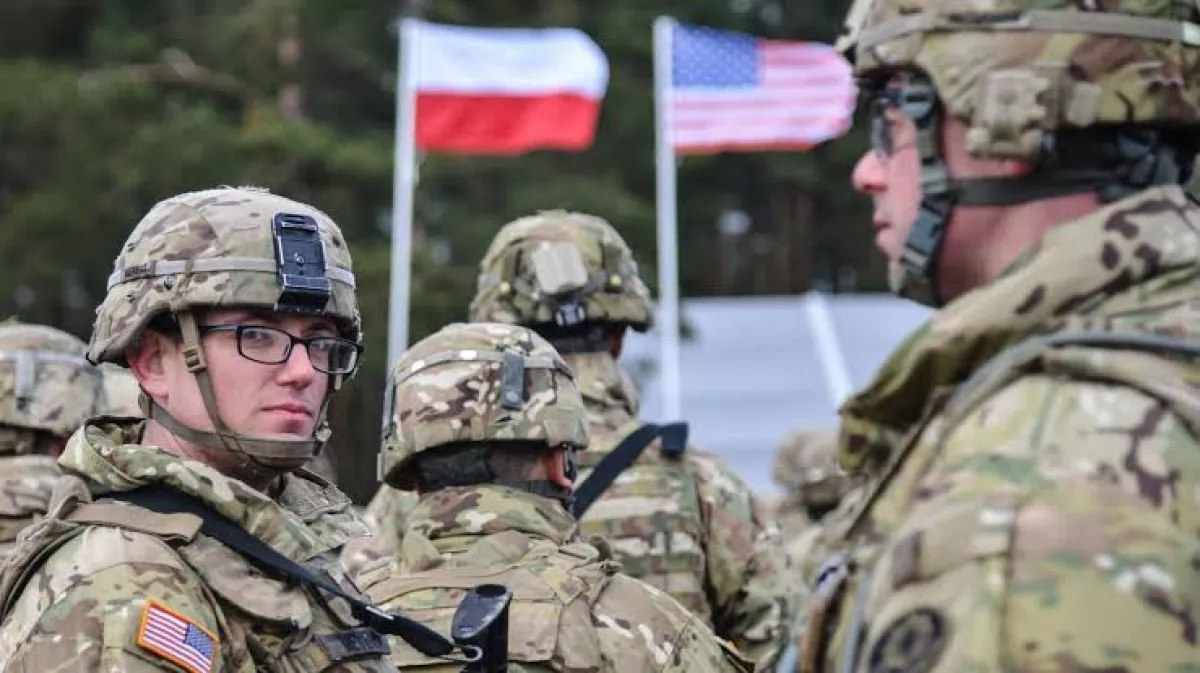
As early as 2018, the Polish government proposed that the US president establish a permanent base in the country, promising to allocate up to $2 billion for its infrastructure and to name it “Fort Trump.” At the same time, Warsaw increased its defence spending to more than 4% of GDP and began actively purchasing American weapons, including Abrams tanks, HIMARS systems, and F-35 fighter jets. In addition, instead of fixed payments for the maintenance of individual troops, Poland finances the presence of the American contingent—numbering around 10,000 service members operating on a rotational basis—through multi-million-dollar investments in infrastructure, including the construction of barracks, warehouses, and dining facilities.
In June of this year, the authorities of this country officially submitted a proposal to the Pentagon for the construction of a new full-scale base for the permanent stationing of US forces, and the US Department of Defense gave the project the “green light.” And just a few days ago, the White House also approved the permanent presence of American troops in Poland, as announced by the Head of the International Policy Bureau Chancellery of the Polish President, Marcin Przydacz, following a meeting with US Secretary of State Marco Rubio.
In particular, he noted that the previous rotational arrangement should now give way to the permanent deployment of US servicemen, and stressed that this decision is the result not only of US military strategy in Europe, but also of the exceptionally strong personal relations between the presidents of the two countries—Karol Nawrocki and Donald Trump.

What has taken place can quite rightly be described as a “grand deal” between Washington and Warsaw, and it is worth examining all its advantages and disadvantages. In essence, the United States has agreed to the establishment of permanent military bases in Poland primarily in order to deter its geopolitical adversaries, such as Russia and its allies, which have received a very clear signal that any hybrid provocations or acts of aggression against Poland would entail a direct conflict with the US military.
The choice of Poland for this role is explained by the fact that the country is one of Washington’s most reliable allies, bearing a significant share of the costs and offering favourable conditions for the stationing of US troops. It also serves as the main hub for the distribution of Western assistance eastward.
The strategic significance of this deal lies in the fact that it aligns with the United States’ plans to strengthen its influence in Eastern Europe and its ties with the countries of the “Three Seas Initiative,” also known as the Trimarium—13 EU member states located between the Baltic, Black, and Adriatic Seas. The initiative is aimed at reducing the infrastructure gap between the northern and southern parts of the region and strengthening energy and digital security. This is what makes it relevant to the United States.
As for Poland, this deal strengthens its geopolitical influence as Washington’s main ally on NATO’s eastern flank and as a conduit for American interests in Eastern Europe. It also provides Poland with a powerful layer of protection, including in terms of the inviolability of its borders, through its integration into the global defence network.

As for the downsides, the main one is that the permanent presence of US troops exacerbates tensions between the North Atlantic Alliance and Russia, as it is viewed by the Kremlin as a provocation capable of triggering a new arms race. Contributing to this escalation are also the relations between Poland and Russia, which have now reached an all-time low—Warsaw considers Moscow its primary existential threat—and reported incursions of drones into Polish airspace, which the Polish authorities interpret as a “stress test” of NATO’s ability to defend its eastern flank.
The second negative factor is that Polish society is far from unanimously supportive of the permanent stationing of US forces on its territory. According to opinion polls, around 40.9% of citizens oppose the deployment of American bases, which could, in the long term, generate social tensions within the country.
Thus, in summary, it can be argued that the establishment of a permanent US base in Poland fundamentally reshapes the security architecture in Europe and serves as yet another confirmation that American interests continue to dominate both NATO and the broader geopolitical landscape.







 editor@caliber.az
 +994 55 444-88-98
 Азербайджан, Баку, ул. Низами, 203, Af Business House, 5-й этаж