










Azerbaijan's new status and EU logic in South Caucasus Article by EU today
The European publication EU Today has published an article by political commentator and editor Gary Cartwright examining the evolving trajectory of cooperation between the European Union and Azerbaijan. Caliber.Az presents the most insightful excerpts from the piece.
In the shifting landscape of the South Caucasus, one development is as profound as it is underrated: Azerbaijan’s emergence from three decades of conflict with Armenia not merely as a victor, but as a strategic partner looking west.
For Brussels, the moment presents a chance to recalibrate European foreign policy in a way that simultaneously consolidates peace, fuels investment, and reinforces Europe’s geopolitical foothold on its southeastern frontier.
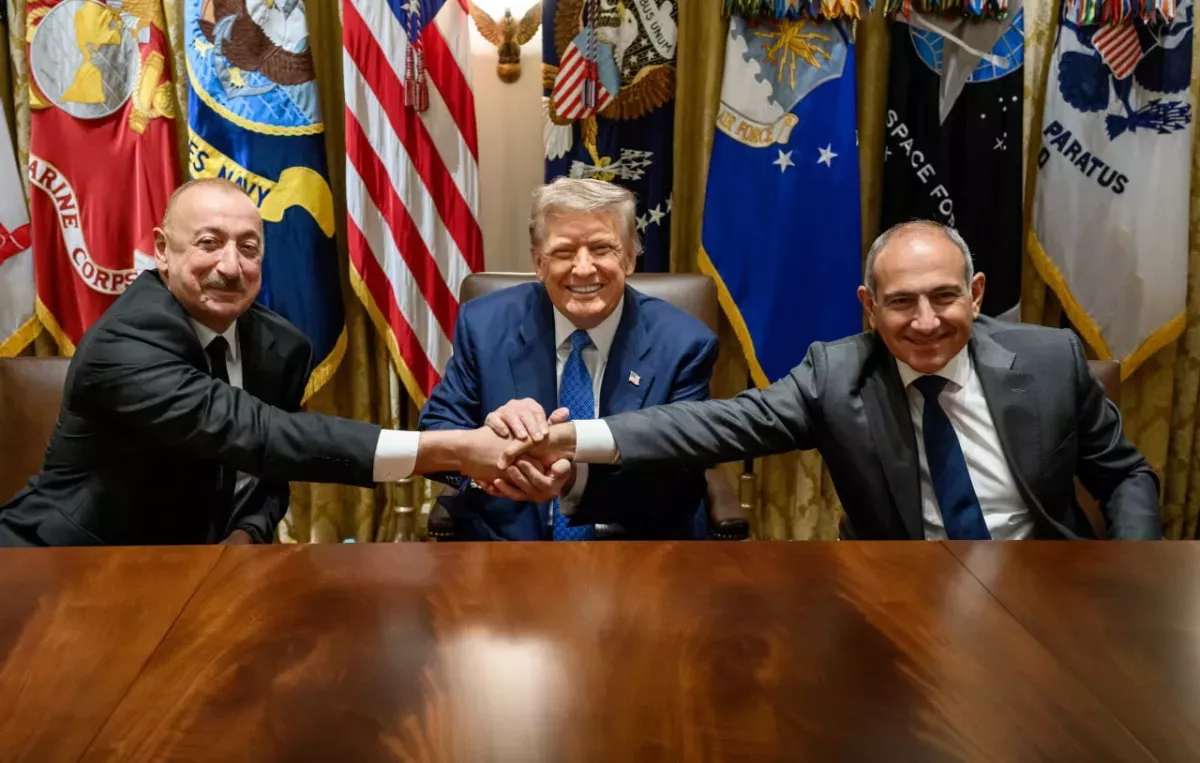
The backdrop is familiar: Azerbaijan regained territorial control over Karabakh in 2023. The resulting shift in the balance of power was confirmed in 2025 with the initialling of a peace agreement between Armenia and Azerbaijan — a milestone backed by international mediation.
Yet the significance of Azerbaijan’s victory extends beyond the cessation of hostilities. For the first time in generations, Baku appears less preoccupied with territorial disputes and more focused on economic renewal and diplomatic outreach — especially toward the West.
This westward reorientation aligns with broader European interests, particularly regarding stability and prosperity in the EU’s neighbourhood. The European Union is already Azerbaijan’s largest trading partner and leading investor, with Brussels accounting for a substantial share of Baku’s trade and investment flows. Energy, too, binds the two closely: Azerbaijan supplies crucial gas through the Southern Gas Corridor, helping Europe diversify away from reliance on traditional suppliers and offering a tangible contribution to European energy security.
Against this backdrop, recent steps to boost investment and economic cooperation are far from incidental. Joint EU–Azerbaijan initiatives — including high-level investment working groups and dedicated infrastructure financing dialogues — not only seek to attract capital into Azerbaijan but also to channel European expertise into areas such as renewable energy, digitalisation and connectivity.
This cooperation dovetails with Brussels’s flagship Global Gateway strategy, which aims to modernise global infrastructure and boost sustainable development through European engagement. Azerbaijan, with its unique position as a crossroads between Europe and Central Asia, offers a strategic gateway in more than just name. Significantly expanding cooperation here could yield dividends for both sides — from job creation to deeper economic integration and reduced geopolitical risk on Europe’s periphery.
Brussels’s increasing engagement with Baku, however, has not been without friction. Baku’s diplomats have publicly criticised certain EU policy documents that appear to prioritise relations with Armenia in ways Baku perceives as skewed or distorting post-conflict realities, warning that such approaches could hamper EU–Azerbaijan relations. This clearly signals that Baku wants to be treated as a partner of equals — not a marginal actor in someone else’s strategic agenda.
For Brussels, the challenge is to balance its normative commitments with hard-nosed realpolitik. The EU rightly champions democracy, human rights and regional stability, but it cannot afford to push away a partner whose cooperation is critical for Europe’s energy resilience and whose geopolitical orientation is increasingly westward. Constructive engagement with Azerbaijan can also help anchor the fragile peace in the South Caucasus by offering economic incentives that make conflict less appealing to revisit.
Critics may argue that deepening ties with Baku risks emboldening an authoritarian government. Yet, engagement — rather than isolation — is often the better route to tempering illiberal tendencies. Bringing Azerbaijan further into European economic, educational and regulatory frameworks drives reform more effectively than standing on the sidelines and issuing ultimatums.
Brussels must also consider the broader regional context. As the EU pushes forward its Black Sea and Eastern Partnership strategies, the inclusion of Azerbaijan as a core partner enhances connectivity from the Caspian to Europe and reinforces a stable arc of cooperation stretching from Ukraine through Georgia to the South Caucasus.
In practical terms, this could mean deepened investment in transport corridors, enhanced energy partnerships, and expanded civil society links — all areas where the EU’s long experience and financial muscle can be decisive. It could also involve a nuanced diplomatic path that supports peace processes while recognising the new strategic realities on the ground.
Azerbaijan’s post-conflict pivot westwards is not a fleeting moment but a structural shift. For Europe, it offers an opportunity to secure peace, prosperity and strategic influence in a region that has long served as a theatre for competing powers. Brussels would do well to embrace this new chapter with clarity, commitment and strategic vision.







 editor@caliber.az
 +994 55 444-88-98
 Азербайджан, Баку, ул. Низами, 203, Af Business House, 5-й этаж