










Azerbaijan accelerates shift to a zero-waste economy From landfills to recycling
One of the key directions of the UN Sustainable Development Goals (SDGs) through 2030 focuses on transitioning to a zero-waste “green” production model and developing infrastructure for the safe disposal of municipal solid waste (MSW).
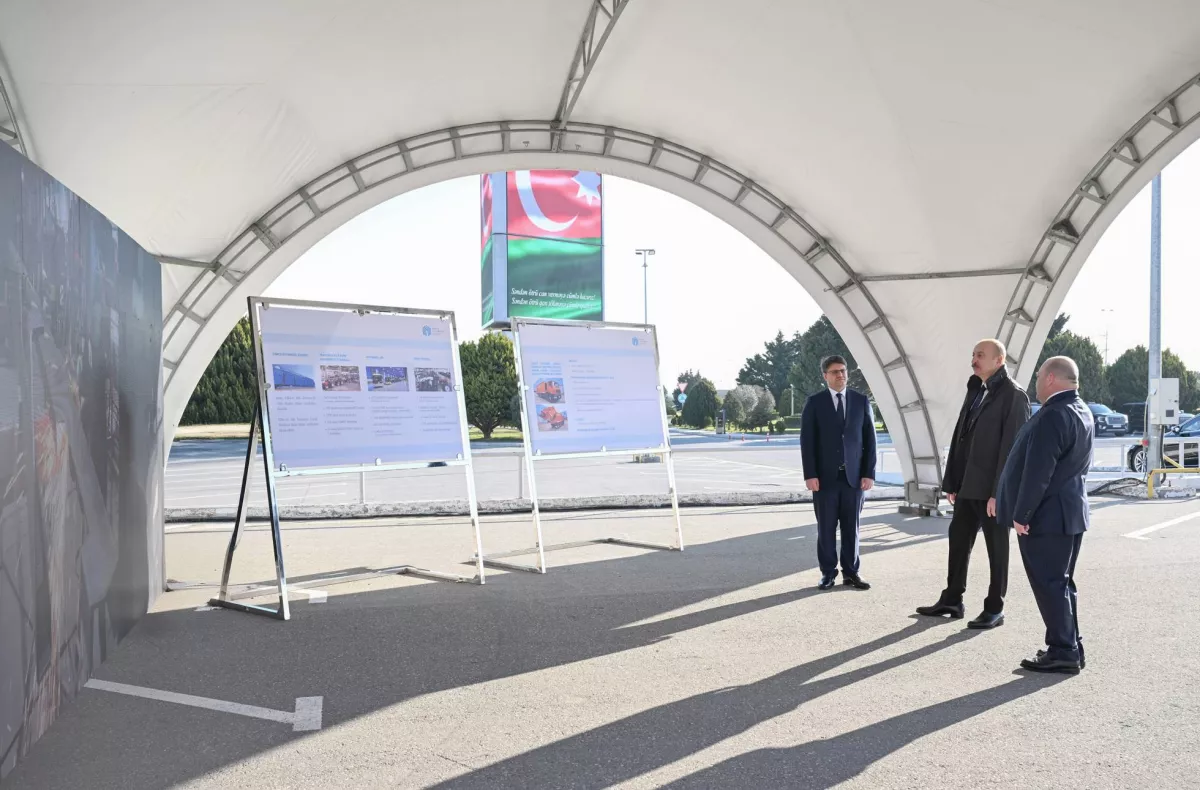
In recent years, Azerbaijan has made notable progress in this area. In particular, the territory of the Balakhani Industrial Park is being expanded, waste management projects have been implemented in Ganja under the EU’s “Green Cities” (GCAP) programme, landfills for household waste are being established in the Karabakh region, and the production of specialised waste collection machinery has been launched at the Ganja Automobile Plant. This work continues, and recently, at the Baku Expo Center exhibition complex, President Ilham Aliyev familiarised himself with domestically produced specialised machinery.
According to UN data, humanity currently generates over 2.3 billion tonnes of municipal solid waste (MSW) annually. Decaying food waste, plastic bottles, and polymer packaging containing hazardous chemicals and heavy metal salts, along with electronics and other industrial waste, contaminate water and soil. When burned, they release greenhouse gases into the atmosphere, contributing to global warming and harming human health. Addressing this problem is a top priority of the UN’s Sustainable Development Goals (SDGs). Accordingly, the UN urges governments worldwide to support the development of a circular “green” economy. This approach would tackle resource depletion, improve resource management, invest in modern waste processing programs, orient industry toward zero-waste production, and promote the reuse and recycling of both industrial and household waste.
In recent years, Azerbaijan has made notable progress on the UN environmental agenda, developing a modern municipal solid waste (MSW) management sector not only in Baku but also across the country’s regions. A key element of waste-management infrastructure is specialised collection and transport equipment, and Azerbaijan has largely achieved self-sufficiency in its production.
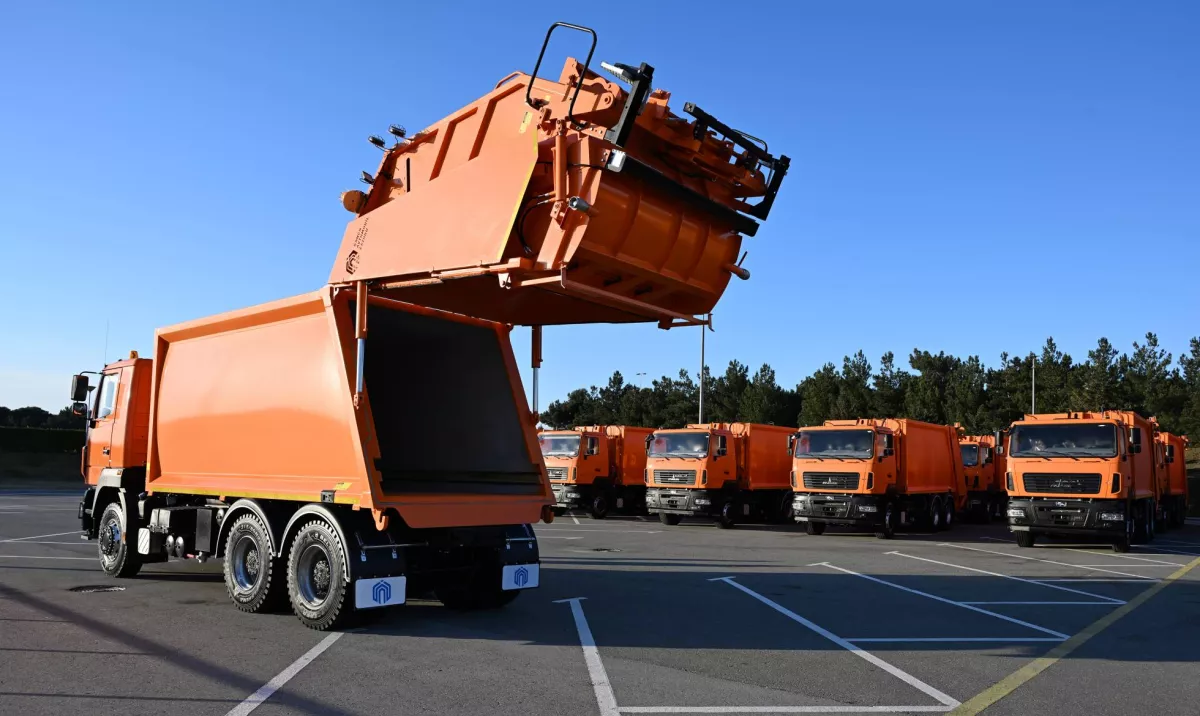
Recently, President Ilham Aliyev inspected domestically produced specialised machinery at an open site at the Baku Expo Center, manufactured at the Ganja Automobile Plant (“GanjAZ”). During the briefing, Minister of Ecology and Natural Resources Rashad Ismayilov and Chairman of GanjAZ’s Supervisory Board Khanlar Fatiyev reported that a total of 70 units of municipal vehicles, each with a 22-cubic-metre capacity, have been produced under the project. These vehicles, manufactured by GanjAZ on the Ministry of Ecology’s order, will be distributed to 58 cities and districts across Azerbaijan.
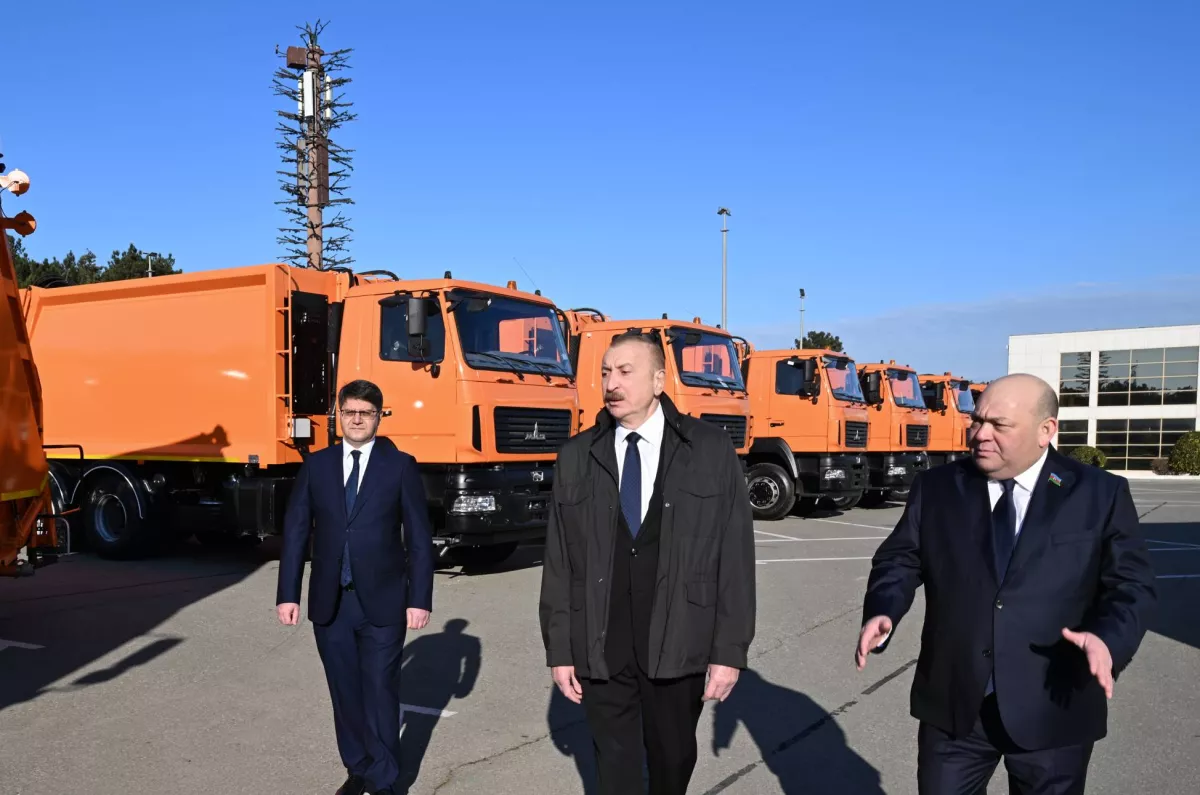
Notably, for many years, under Azerbaijan-Belarusian cooperation, six models of trucks, dump trucks, and specialised municipal-construction vehicles have been assembled in Azerbaijan using components from the Minsk Automobile Plant (MAZ). By May of last year, approximately 3,500 units of MAZ trucks and specialised machinery had been assembled in Ganja. Last year, GanjAZ also signed a trilateral agreement with MAZ and the Belarusian company Pozhsnab to assemble various types of emergency rescue and fire-fighting vehicles in Azerbaijan. Additionally, the Ganja Automobile Plant assembles several models of flatbed trucks and dump trucks from Russia’s KAMAZ plant, as well as all-wheel-drive URAL trucks. These import-substitution efforts provide Azerbaijan with a relatively affordable fleet of waste collection vehicles, enabling the expansion of MSW management projects not only in Baku and other major cities but also into the country’s peripheral regions.
At the initiative of the Ministry of Ecology, OJSC Təmiz Şəhər (Clean City), and other relevant agencies, Azerbaijan has been steadily implementing projects across the regions alongside Baku, aimed at developing modern social infrastructure and improving the country’s overall environmental situation. Deploying modern municipal waste collection machinery to cities and districts enhances the quality of communal services, ensures more efficient waste removal, and improves sanitary and hygiene conditions regionally.
A particularly significant regional project is underway in Ganja: under the EU’s Green Cities (GCAP) programme, over three years ago, the European Bank for Reconstruction and Development (EBRD) financed a municipal solid waste (MSW) management initiative in Azerbaijan’s second-largest city. Similar projects are being implemented in other cities, especially in the Karabakh region. In early January, a presidential decree “On Improving Waste Management in the Liberated Territories and Amending Certain Presidential Decrees and Orders” established the authorities responsible for waste collection and transport in Karabakh and East Zangezur.
Since last year, MSW management work has been progressing in the liberated territories, with design and cost documentation prepared for landfills in the districts of Gubadli, Jabrayil, Aghdam, Fuzuli, and Zangilan. Construction has already begun on a 10-hectare landfill in the Aghdara district, designed to handle 60–65 thousand cubic metres of waste.
Overall, Azerbaijan is placing strong emphasis on industrial management and recycling of household and industrial waste. In this regard, the country became the first in the South Caucasus to implement a large-scale municipal solid waste (MSW) management project within the Balakhani Industrial Park. At its core is the Baku MSW Processing Plant, commissioned in 2012, which processes over 500,000 tonnes of solid waste annually, generating more than 200 million kWh of electricity—enough to supply around 100,000 households for a year.
Currently, the industrial park hosts 25 resident companies engaged in diverse recycling activities: converting used motor and vegetable oils into diesel fuel, processing paper and polymer waste, producing rubber crumbs and granules from tyres, manufacturing furniture and building materials from wood and industrial waste, and turning food waste into animal feed and compost. To support this expansion, in April of last year, the President signed a decree “On Expanding the Territory of Balakhani Industrial Park”, granting an additional 18.415 hectares to the park.
A recycling cluster has also been established in the Sumgayit Industrial Park (SIP), where a facility for processing lead-acid batteries operates. In October 2024, construction began on a plant to produce pyrolysis oil from plastic waste as part of an Azerbaijani-Italian joint project, with planned investments of €97 million.
Meanwhile, in the Hajigabul Industrial Quarter, a factory was recently commissioned to produce organic fertilisers by processing agricultural waste.
The largest environmental protection project has been implemented by AzerGold CJSC, which mines gold and copper ore and processes it into concentrates. The company has developed a high-tech and safe method for extracting and disposing of toxic mercury, which is then exported to countries including Singapore and Papua New Guinea.







 editor@caliber.az
 +994 55 444-88-98
 Азербайджан, Баку, ул. Низами, 203, Af Business House, 5-й этаж